
The Tennison Gambit trap: play …h6?? and lose your queen
In the Tennison Gambit (1.Nf3 d5 2.e4) Black’s natural-looking 5…h6?? loses the queen: 6.Nxf7! Kxf7 7.Bg6+!! gives check, opens the d-file and 8.Qxd8 follows. The trap, why it works and the right defence.
5 min readBy Hasan Süzen
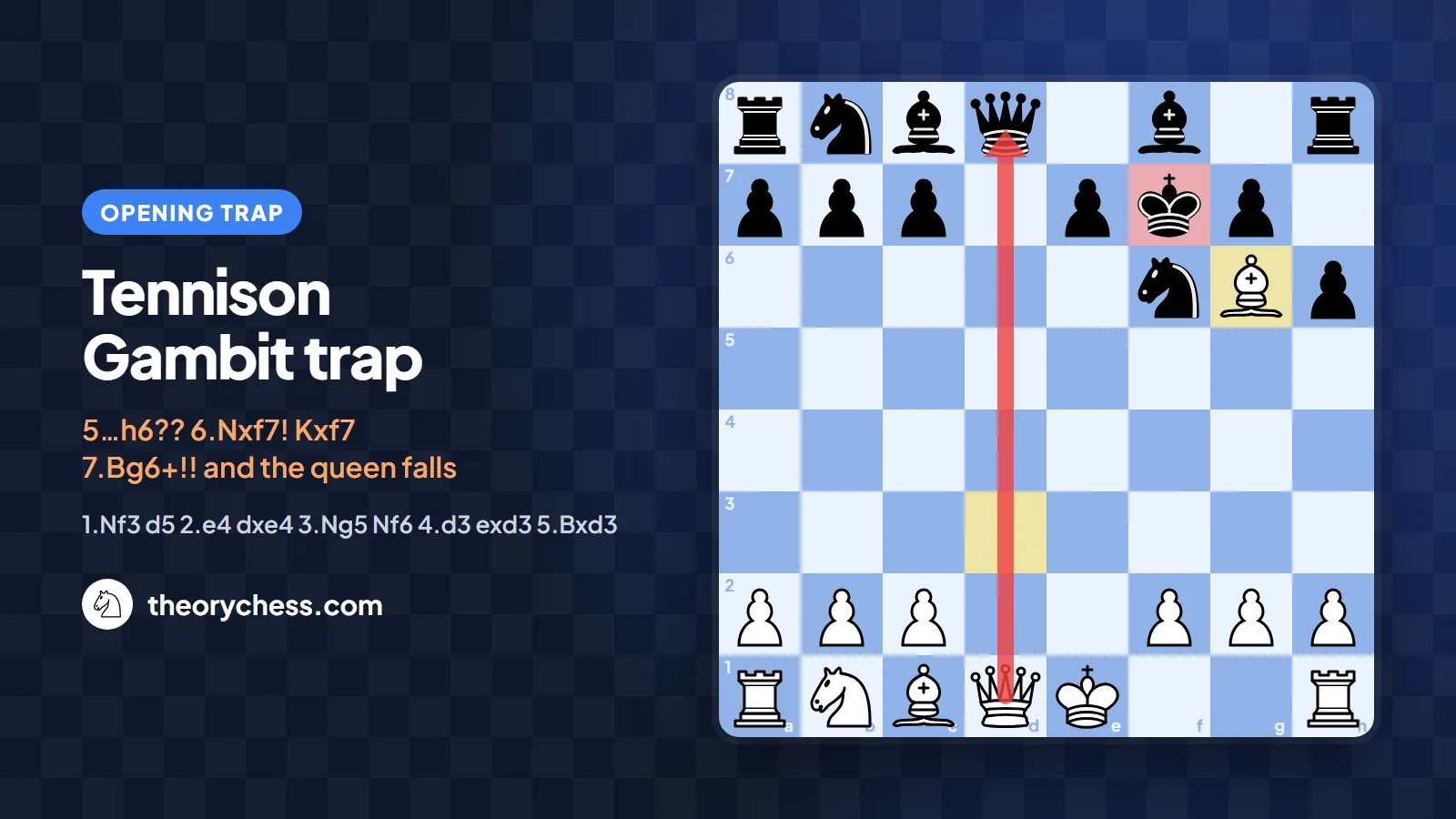
The Tennison Gambit is a sharp opening where White gives up a pawn early and goes straight for f7. Its best-known trap punishes a completely natural-looking move by Black: White sacrifices a knight on f7, then a single bishop check opens the d-file and Black’s queen falls. In this post we go through the trap move by move, explain the discovered attack behind it, and show the right defence for Black.
What is the Tennison Gambit?
The Tennison Gambit arises in two ways: 1.Nf3 d5 2.e4 (a Réti Opening move order) or 1.e4 d5 2.Nf3 (a Scandinavian Defence move order). Either way Black takes with …dxe4, and White plays 3.Ng5 to hit both the e4-pawn and the f7 square.
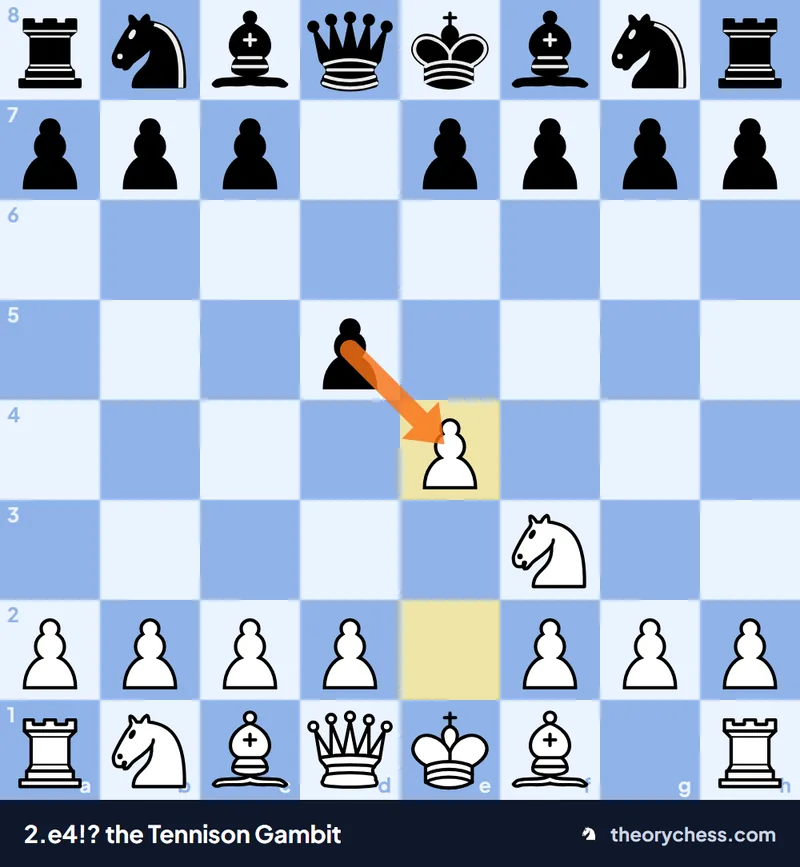
2.e4!?: White gives a pawn for quick development and pressure on f7.
The gambit is a risky choice for White: Stockfish shows that Black gets a comfortable game with accurate play. But one small slip by Black can end the game in the opening.
The trap move by move
3.Ng5 Nf6 4.d3 exd3 5.Bxd3: f7 is the target
Black develops with 3…Nf6. White plays 4.d3 to win the pawn back, Black takes with 4…exd3, and White recaptures with 5.Bxd3. Two important things have happened: the knight on g5 eyes f7, and both d-pawns have left the board. The only piece between White’s queen on d1 and Black’s queen on d8 is the bishop on d3.
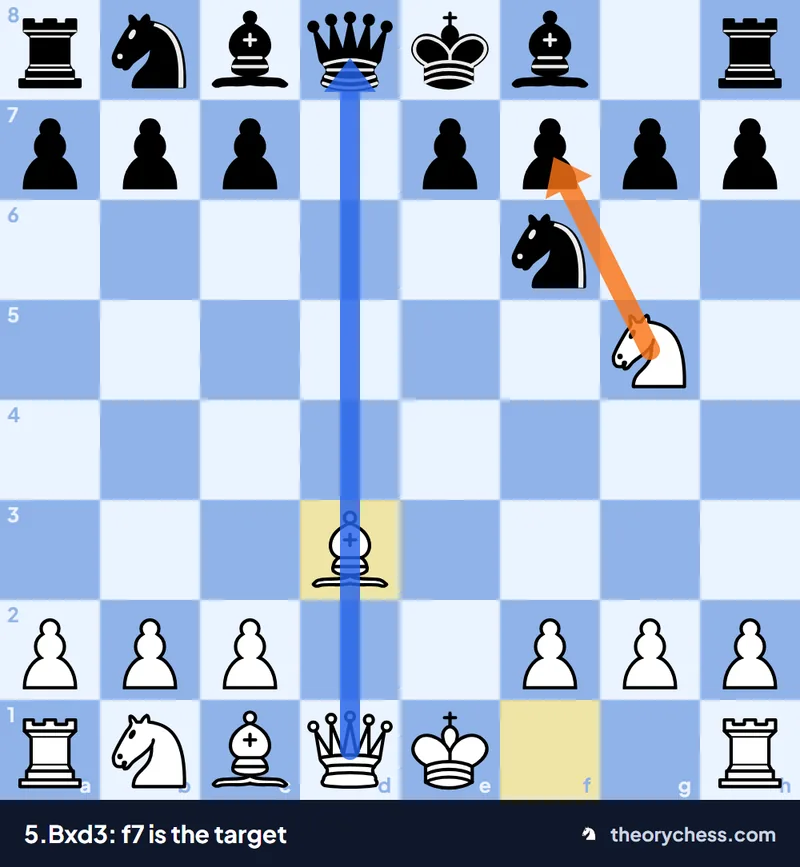
5.Bxd3: f7 is the target and the d-file is almost open.
5…h6??: kicking the knight
Black finds the knight on g5 annoying and kicks it with 5…h6??. It looks perfectly natural: surely the knight has to retreat. But White has no intention of retreating.
6.Nxf7!: no retreat, attack
6.Nxf7! The knight takes on f7 and forks the queen on d8 and the rook on h8. Black takes it with 6…Kxf7. Now the king sits on f7, and g6 is on the d3-bishop’s diagonal.
7.Bg6+!!: the discovered attack
Here is the heart of the trap: 7.Bg6+!! The bishop gives check from g6. But what really matters is that it has left d3: the d-file opens, and White’s queen on d1 now sees Black’s queen on d8. That is a discovered attack: one piece moves and uncovers the attack of the piece behind it.
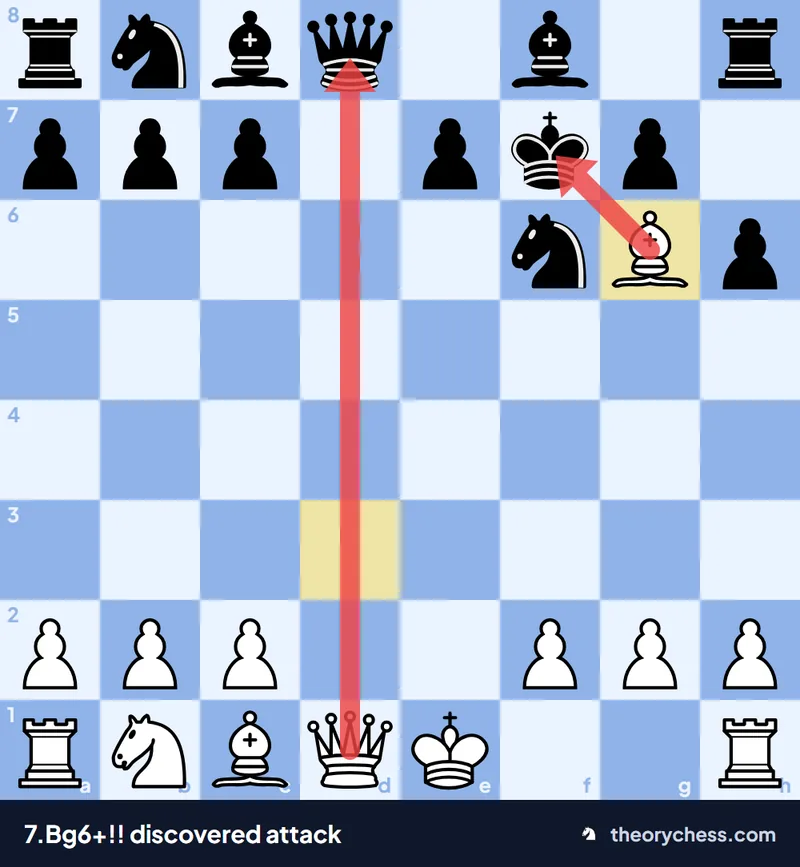
7.Bg6+!!: while the king is in check, the queen on d1 sees the queen on d8.
Black must get out of check first. Whether the king takes with 7…Kxg6 or goes elsewhere, the result is the same: 8.Qxd8 wins the queen.
The full sequence: 1.Nf3 d5 2.e4 dxe4 3.Ng5 Nf6 4.d3 exd3 5.Bxd3 h6 6.Nxf7 Kxf7 7.Bg6+ Kxg6 8.Qxd8.
Doing the maths
White gave up a knight and a bishop and got the queen and the f7-pawn in return. In rough numbers, White gave two minor pieces (3 + 3) for a queen and a pawn (9 + 1). Stockfish agrees that White is clearly winning, and on top of that Black’s king is stranded on g6 in the middle of the board.
What should Black play?
After 5.Bxd3 the best move is 5…Nc6. Black develops first and controls e5. Kicking the knight with …h6 should wait until White’s discovered attack on the d-file is no longer possible. According to Stockfish, Black has a comfortable game here even though the gambit pawn has been returned.
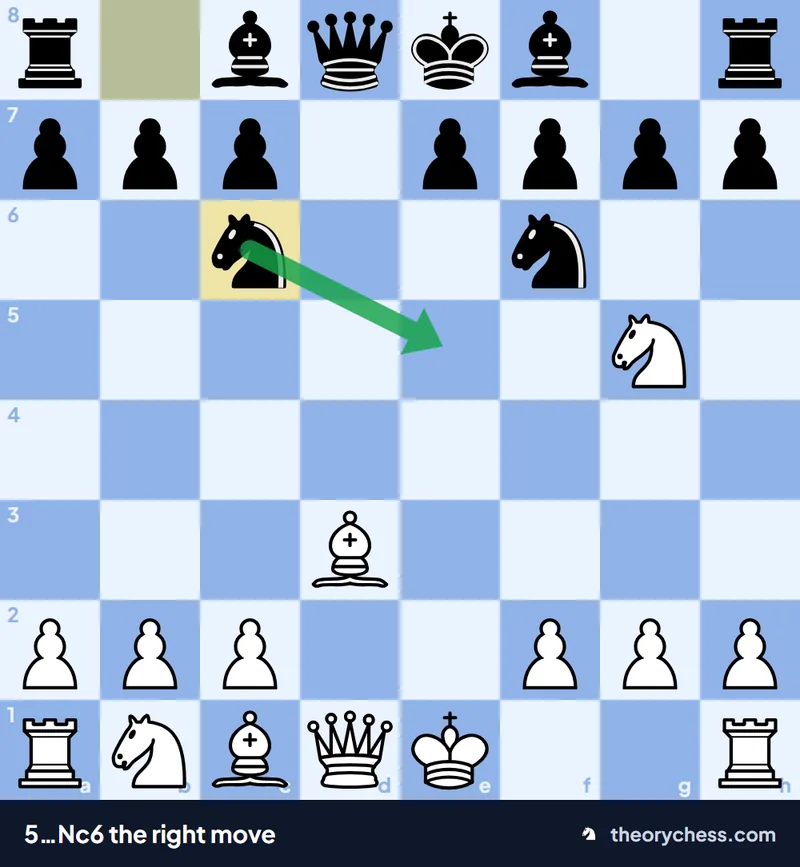
5…Nc6: develop first, …h6 later.
There is an earlier option too: after 3.Ng5, grabbing the centre with 3…e5 is Stockfish’s first choice in that position.
Key moments at a glance
| Move | What happens | Lesson |
|---|---|---|
| 2.e4!? | White gives a pawn. | A gambit trades a pawn for development and attack. |
| 5.Bxd3 | The d-pawns are gone; the queens share a file. | Two queens on one file is a tactical red flag. |
| 5…h6?? | Black kicks the knight. | Check the threats before you chase a piece. |
| 6.Nxf7! | The knight takes f7 instead of retreating. | An attacked piece can sometimes go forward. |
| 7.Bg6+!! | Check, and the d-file opens. | A discovered attack with check is deadly. |
| 5…Nc6 | Black develops; normal game. | Development first, pawn moves later. |
What this trap teaches
The lesson of the Tennison Gambit trap is that two queens on the same file are always a tactical warning sign. If there is only one piece between them, every move that lets that piece give check is a discovered attack. It also shows once more how weak f7 is in the opening: when pieces are aimed at f7, be careful with “tempo” moves like …h6. For more f7 classics, see Légal’s mate and the Blackburne Shilling trap, and this week’s other trap is the King’s Gambit Declined trap.
Frequently asked questions
Is the Tennison Gambit a good opening?
It is a risky gambit for White. With the right defence Black gets a comfortable game, so it works best as a surprise weapon and in fast time controls.
Can Black save the queen after 7.Bg6+?
No. Black has to deal with the check first, and with the d-file open, 8.Qxd8 follows wherever the king goes.
Can the Tennison Gambit come from 1.e4?
Yes. 1.e4 d5 2.Nf3 dxe4 3.Ng5 reaches the same positions, so Scandinavian players should know this trap too.
How do I set this trap in my own games?
Play 1.Nf3 d5 2.e4 or 1.e4 d5 2.Nf3 as White. After Black takes the pawn, build pressure on f7 with Ng5 and d3. If Black kicks the knight with …h6, calculate the Nxf7 and Bg6+ idea.
Practise it on TheoryChess
Reading a trap and spotting it over the board are two different things. On TheoryChess you can play every line of the Réti Opening trainer against Stockfish, with an explanation for every theory move, then test yourself with the Réti quiz. For Black’s side, read our Scandinavian Defence guide. Every opening is waiting in the opening catalogue.
Keep reading
· 5 min read
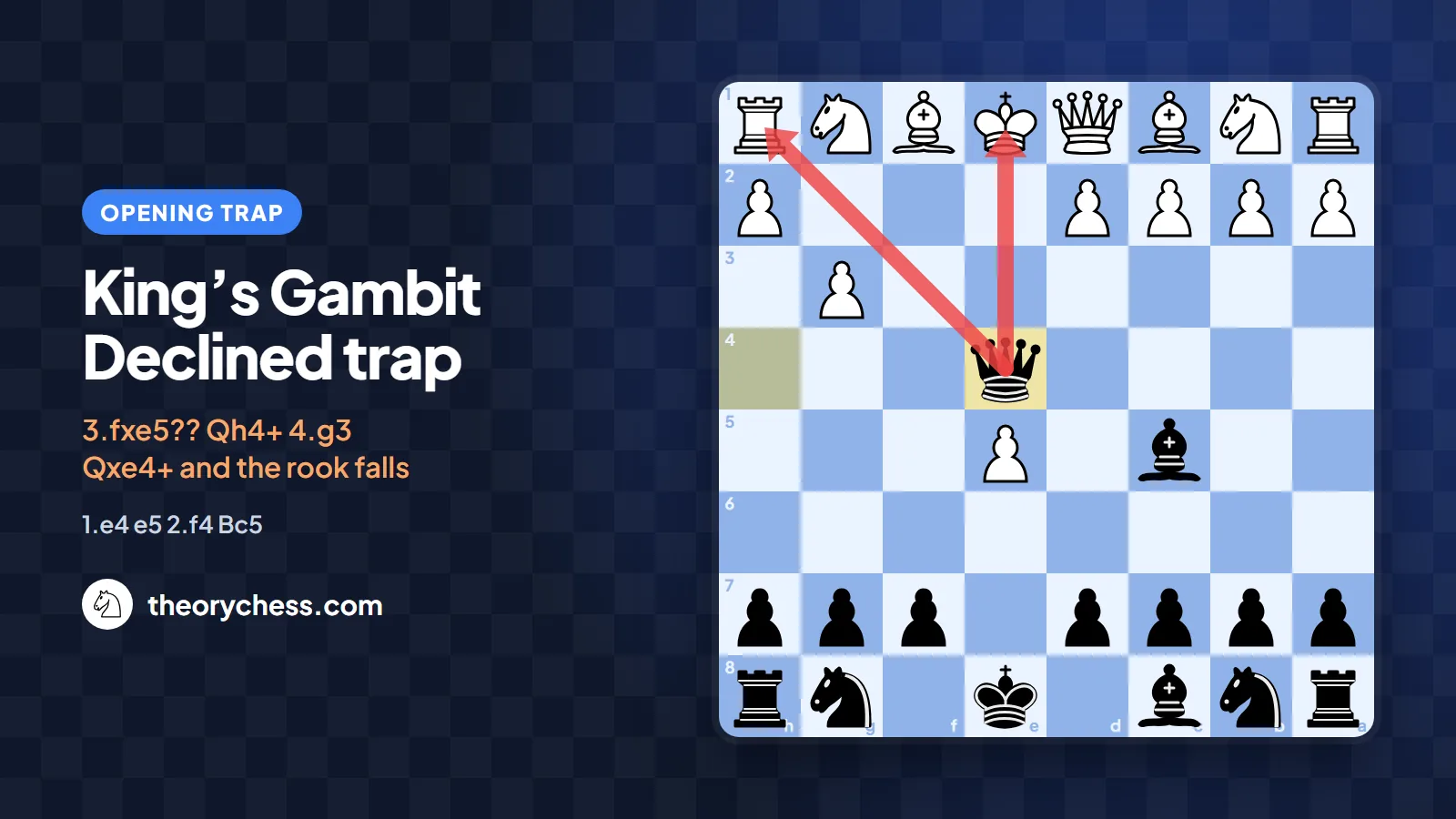
The King’s Gambit Declined trap: take this pawn and lose your rookDeclining the King’s Gambit with 2…Bc5 sets a nasty trap: if White plays 3.fxe5??, then 3…Qh4+ 4.g3 Qxe4+ wins the rook on h1, and 4.Ke2 runs into 4…Qxe4# mate. The trap, why it works and the right move.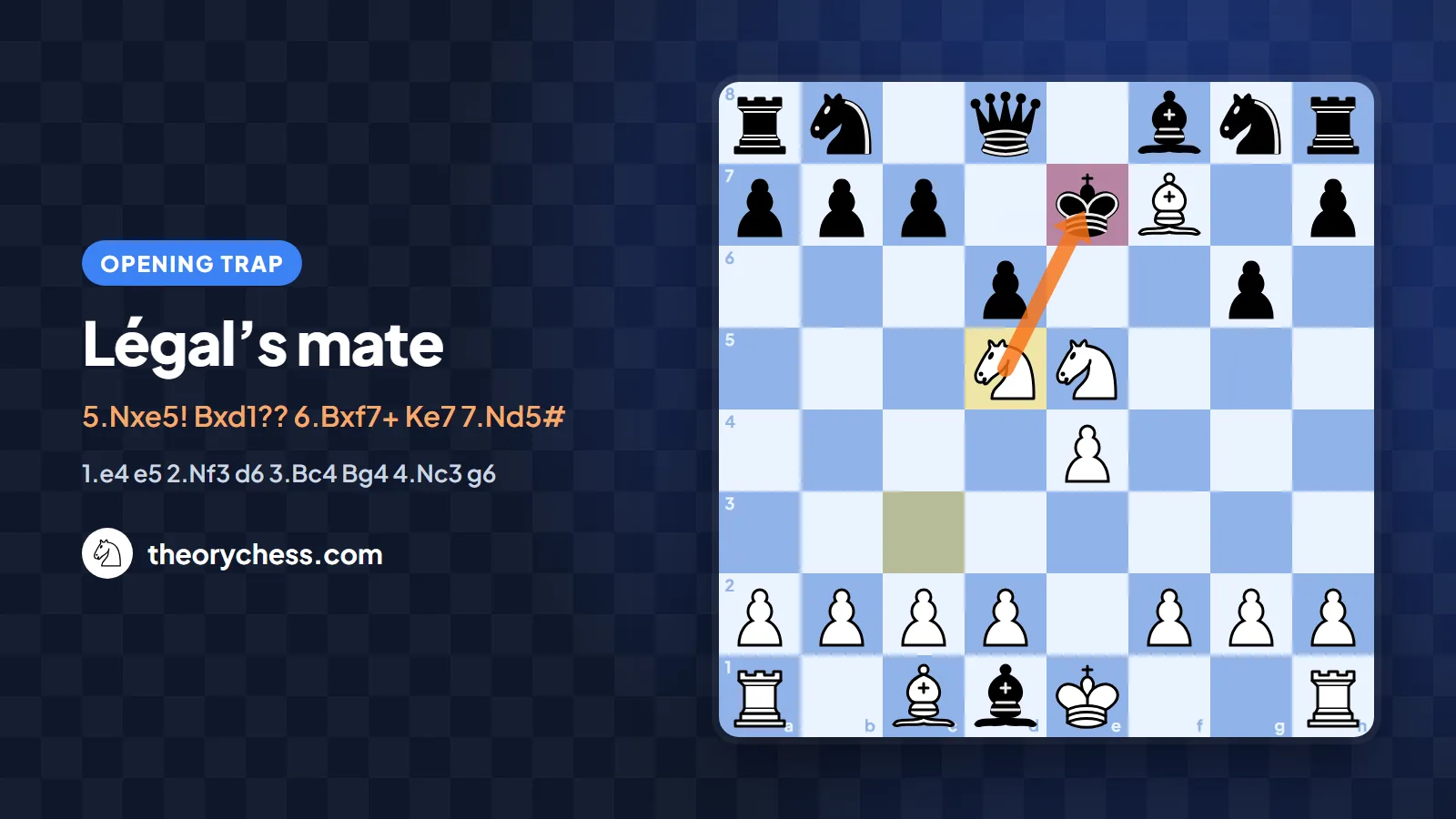
· 5 min read
Légal’s mate: give up the queen and mate in 7 with three minor piecesLégal’s mate is one of the oldest opening traps in chess: White ignores the pin and leaves the queen hanging, and if Black takes it, 6.Bxf7+ Ke7 7.Nd5# is mate. The trap, why it works and the right defence.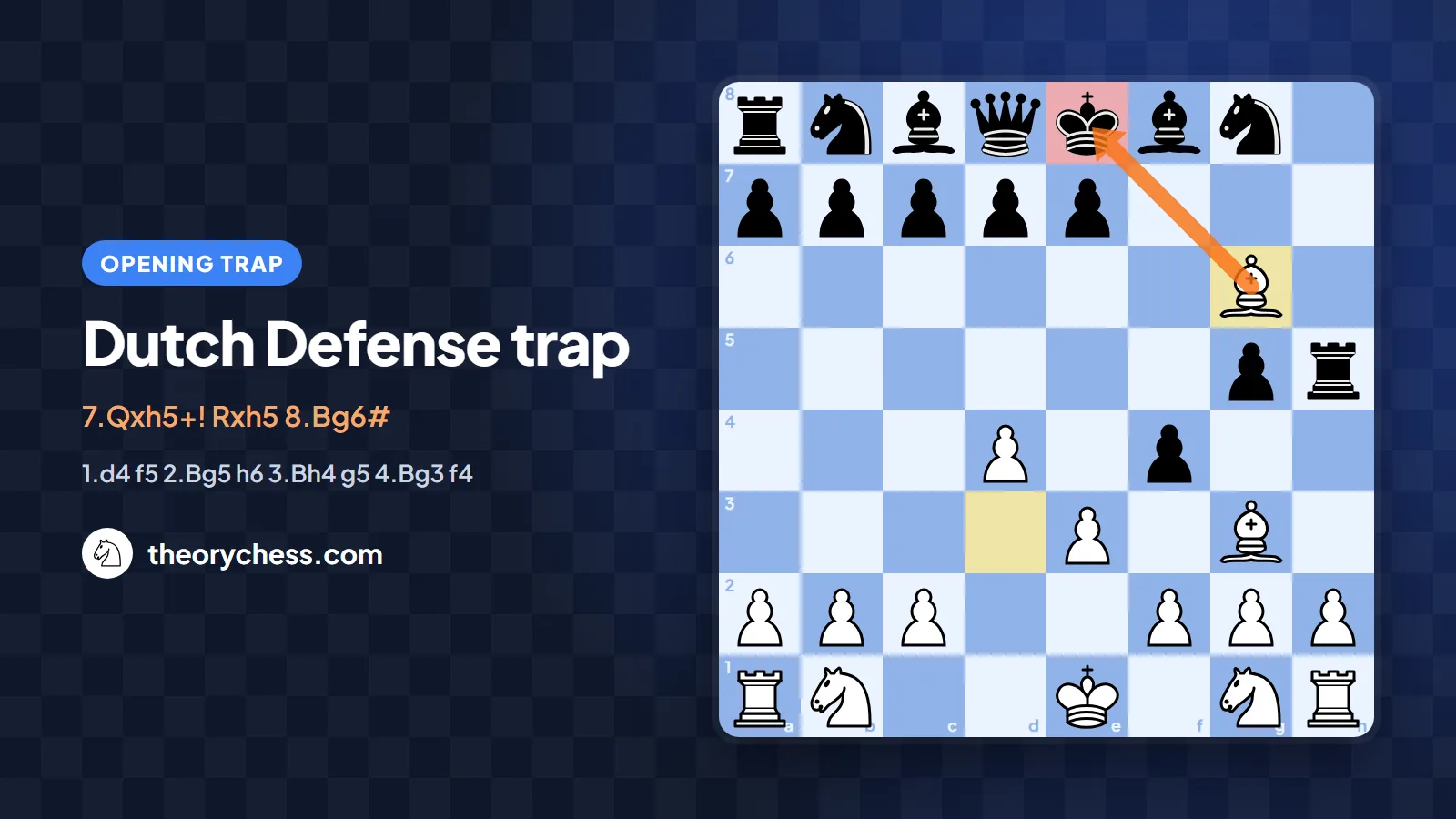
· 5 min read
The Dutch Defense trap: a queen sacrifice and Bg6# in 8 movesIn the Dutch Defense, chasing White’s bishop after 2.Bg5 ends in a queen sacrifice and mate in eight: 6…Rh6?? 7.Qxh5+! Rxh5 8.Bg6#. The trap, why it works and the right defence.