
The Blackburne Shilling Trap: checkmate in 7 moves in the Italian Game
How 4.Nxe5? gets mated after 1.e4 e5 2.Nf3 Nc6 3.Bc4 Nd4?!: the Blackburne Shilling trap move by move, and the right replies for White.
6 min readBy Hasan Süzen
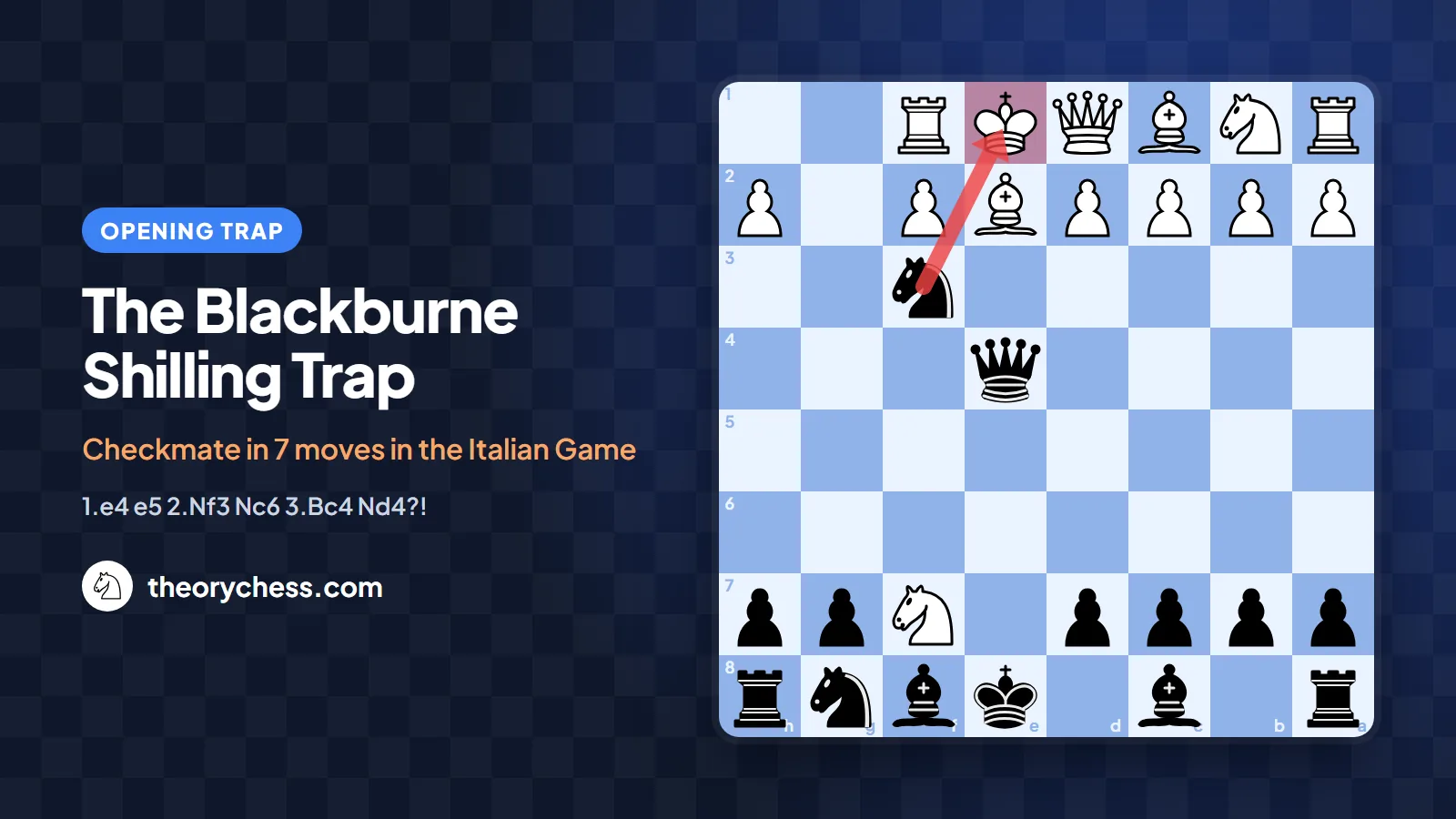
The Blackburne Shilling trap is an opening trap in the Italian Game that starts with 1.e4 e5 2.Nf3 Nc6 3.Bc4 Nd4?! and punishes the greedy 4.Nxe5? with checkmate in seven moves. The main line is 4.Nxe5? Qg5! 5.Nxf7?? Qxg2 6.Rf1 Qxe4+ 7.Be2 Nf3#. One important warning first: 3…Nd4 is objectively a weak move, and if White answers correctly Black is the one in trouble. But the “free pawn” 4.Nxe5 is so natural that the trap still scores points at club level and in blitz.
In this guide we go through the trap move by move, explain why it works, and, most importantly, show you how to avoid falling for it as White.
Where does the name come from?
According to legend, the strong 19th-century English master Joseph Henry Blackburne used this trap to beat coffee-house opponents in games played for a shilling a time. Whether the story is true or not, the name stuck. The line is also known as the Kostić Gambit.
The Blackburne Shilling trap move by move
3…Nd4?!: setting the bait
In the Italian Game Black normally plays 3…Bc5 (the Giuoco Piano) or 3…Nf6 (the Two Knights Defence). 3…Nd4?! breaks the development rules: it moves the same knight twice and leaves the e5 pawn undefended. White immediately sees a free pawn.
4.Nxe5? Qg5!: a double threat
4.Nxe5? takes the pawn and attacks f7 a second time. White feels great, but Black has a strong reply: 4…Qg5!. The queen creates two threats at once:
- it attacks the undefended knight on e5;
- it attacks the g2 pawn, and after …Qxg2 the rook on h1 is in danger too.
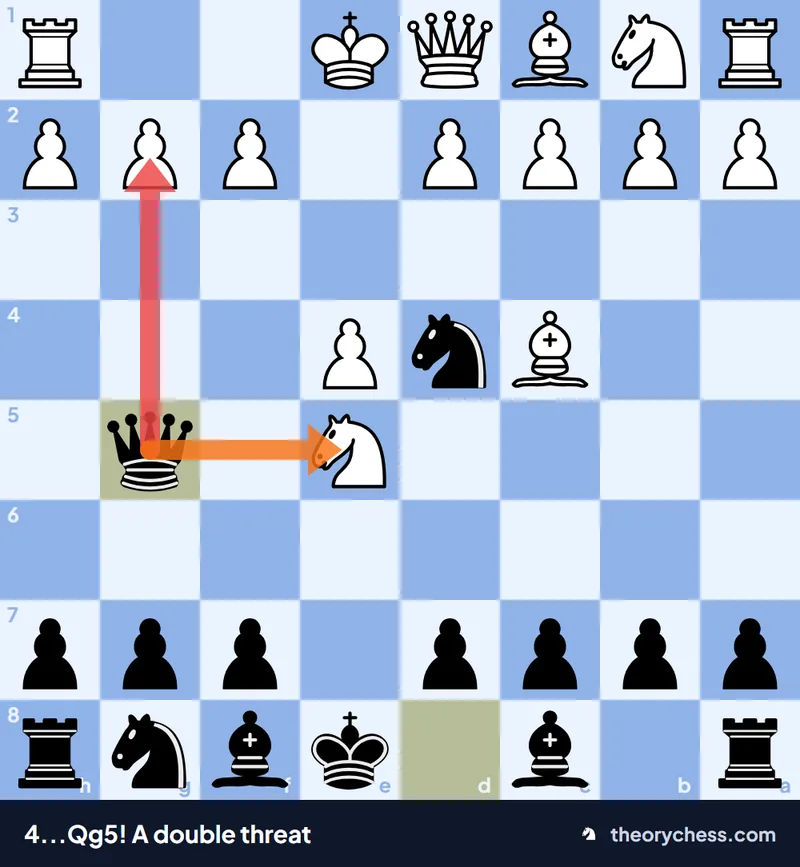
4…Qg5!: the queen hits both g2 and the knight on e5. White cannot easily deal with both in one move.
5.Nxf7?? Qxg2
White’s biggest mistake is to keep attacking with 5.Nxf7??. The knight forks the queen and the rook on h8, which looks wonderful on paper. But Black simply plays 5…Qxg2!, taking the pawn and attacking the rook on h1. The threat is not just the rook: the knight on d4 is ready to join the attack.
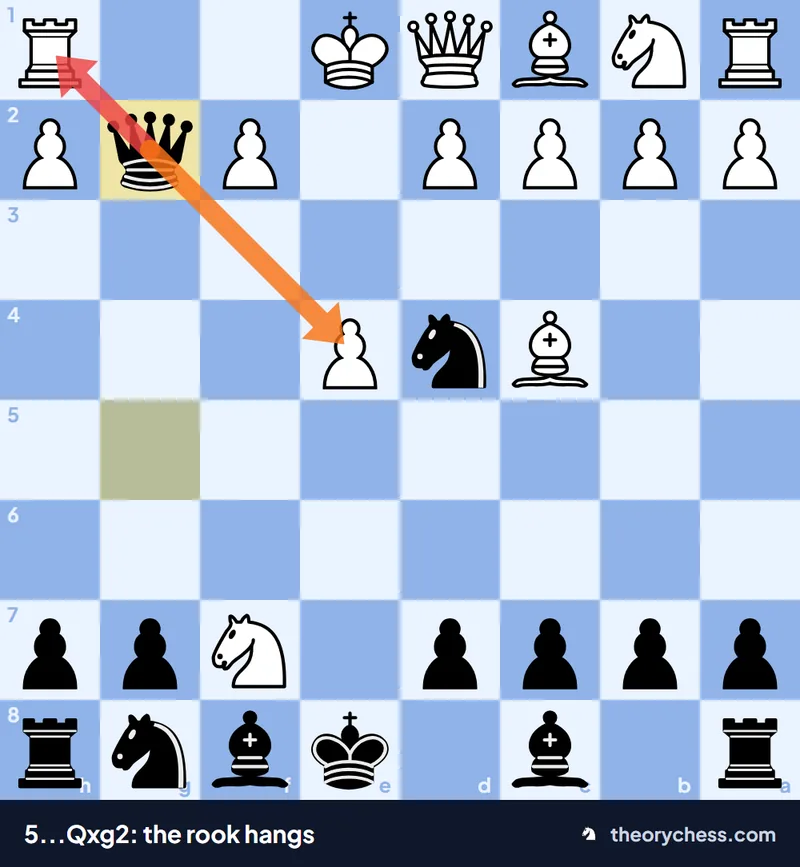
5…Qxg2: the rook on h1 is hanging and the queen also eyes e4. Mate is coming.
6.Rf1 Qxe4+ 7.Be2 Nf3#
White saves the rook with 6.Rf1, and Black checks with 6…Qxe4+. White has two ways to block on e2: the bishop or the queen. After the natural 7.Be2?? comes 7…Nf3#. The knight on f3 gives check, the king has no squares (the queen is on d1, the rook on f1 and the bishop on e2) and nothing can take the knight, because the bishop on e2 is pinned by the queen on e4. Checkmate!
7.Qe2 is more stubborn, but then 7…Qxe2+ 8.Bxe2 Nxc2+ forks the king and the rook on a1, and Black wins a large amount of material.
Move-by-move summary
| Move | Side | What happens |
|---|---|---|
| 3…Nd4?! | Black | The bait: the e5 pawn is left undefended. |
| 4.Nxe5? | White | Takes the pawn and hits f7 a second time. |
| 4…Qg5! | Black | Attacks the e5 knight and the g2 pawn at once. |
| 5.Nxf7?? | White | Forks queen and rook but forgets the kingside. |
| 5…Qxg2 | Black | Attacks the h1 rook and eyes e4. |
| 6.Rf1 Qxe4+ | — | The rook is saved; Black checks. |
| 7.Be2 Nf3# | Black | The e2 bishop is pinned, so the knight cannot be taken: mate. |
Spotting the trap in fast games
In blitz and bullet this trap is especially effective, because White plays the first moves almost on autopilot. Watch for these warning signs:
- Your opponent moved the same knight twice and left a pawn hanging. That can be a mistake, but it can just as easily be bait.
- The enemy queen lands on g5 or h4. Check g2 and f2 straight away, especially if you have not castled yet.
- A fork looks too easy. 5.Nxf7 forks queen and rook, but Black’s checks are much faster than your knight.
Why the trap works
- Greed. 4.Nxe5 wins a pawn and attacks f7; 5.Nxf7 forks queen and rook. White thinks every move is winning something.
- A weak kingside. The knight on e5 and the bishop on c4 do nothing to defend the kingside, and g2 is a pawn with no defender.
- The hidden power of the d4 knight. 3…Nd4 is not just about hitting the f3 knight; the knight is waiting to jump to f3 and complete the mating net.
How White avoids the trap
The simplest and most solid reply is 4.Nxd4!. White trades off the centralised knight, and after 4…exd4 develops quickly with 5.c3 or 5.O-O. Black has moved the same knight twice only to trade it, so Black is behind in development.
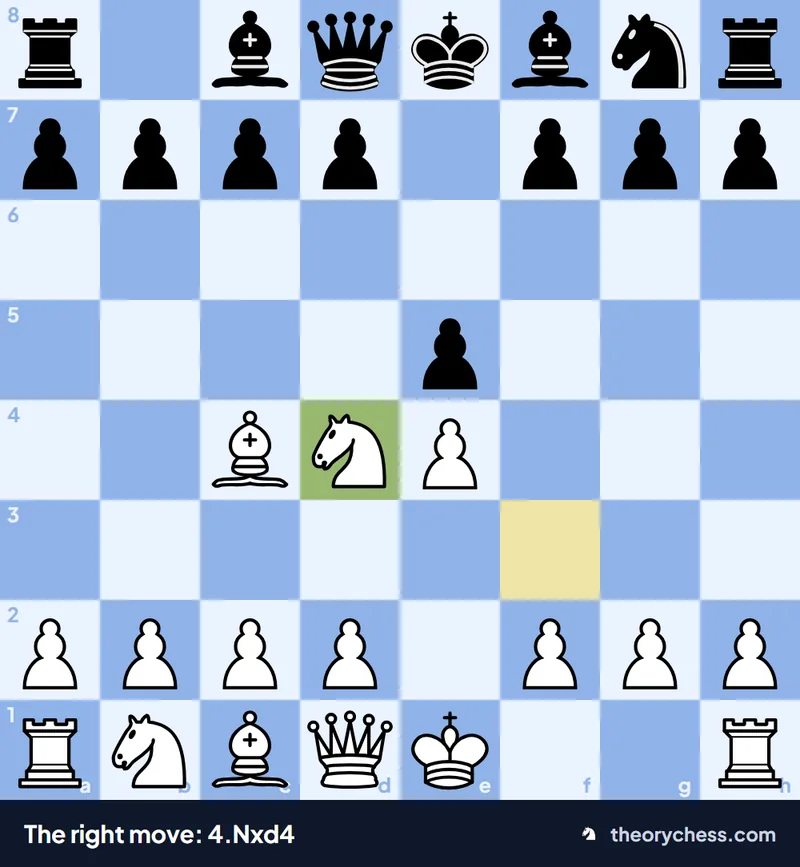
The right reply is 4.Nxd4: White trades the knight and keeps the lead in development.
Other sound options are 4.O-O and 4.c3; both simply continue developing without taking on e5. If White has already reached 4.Nxe5 Qg5, the best practical try is 5.Bxf7+!: after 5…Ke7 6.O-O Qxe5 7.Bxg8 Rxg8 8.c3 White has two pawns for the piece and Black’s king is exposed. 5.Ng4 is met by 5…d5!, giving Black a strong initiative. The golden rule: when your opponent offers a pawn for free, look for the reason before you take it.
A note for Black
3…Nd4 is a surprise weapon, not a sound repertoire move. If your opponent plays 4.Nxd4 or 4.O-O, you come out of the opening worse. In the long run it pays far more to learn the main lines against the Italian, such as the Giuoco Piano or the Two Knights Defence; our practical guide to the Italian Game covers both.
Similar traps
The Blackburne Shilling belongs to the same family as Scholar’s Mate and other short traps built around f7 and f2. You will see the same “punish the greedy move” theme in the Lasker Trap in the Albin Countergambit and in the Fishing Pole trap in the Berlin Defence of the Ruy Lopez. For more, read opening traps every club player should know.
Frequently asked questions
In which opening does the Blackburne Shilling trap occur?
In the Italian Game: after 1.e4 e5 2.Nf3 Nc6 3.Bc4 Nd4?!, when White takes the pawn with 4.Nxe5?.
Is 3…Nd4 a good move?
No. It is objectively weak, and against the correct reply (4.Nxd4 or 4.O-O) Black falls behind in development. Its value is purely practical: 4.Nxe5 looks so natural that many players take the bait.
Can White survive after 4.Nxe5?
Yes. After 4…Qg5, 5.Bxf7+ is the best practical try. The losing move is 5.Nxf7??.
How many moves until checkmate?
In the main line, on Black’s seventh move: 7…Nf3#.
Practise it on TheoryChess
The best protection against traps like this is to learn the real main lines by playing them. On TheoryChess you can open the Italian Game trainer and play the theory against Stockfish, then test yourself with the Italian Game quiz. Browse the opening catalogue for your next opening.
Keep reading
· 5 min read
The Siberian Trap: checkmate on h2 in the Smith-Morra GambitThe Siberian Trap in the Smith-Morra: 8…Ng4! 9.h3?? Nd4! and 10…Qh2#. Move by move, why it works and how White avoids it.
· 5 min read
The Scandinavian Defence: a practical guide to 1.e4 d5The Scandinavian Defence strikes at the centre with 1…d5. Main line 3…Qa5, the alternatives, typical plans and common mistakes.
· 6 min read
The Noah’s Ark Trap: how Black traps the bishop in the Ruy LopezThe Noah’s Ark Trap in the Ruy Lopez, move by move: after 8.Qxd4?? c5! and …c4, White’s b3-bishop is trapped by Black’s pawns. How to set it and avoid it.