
The Siberian Trap: checkmate on h2 in the Smith-Morra Gambit
The Siberian Trap in the Smith-Morra: 8…Ng4! 9.h3?? Nd4! and 10…Qh2#. Move by move, why it works and how White avoids it.
5 min readBy Hasan Süzen
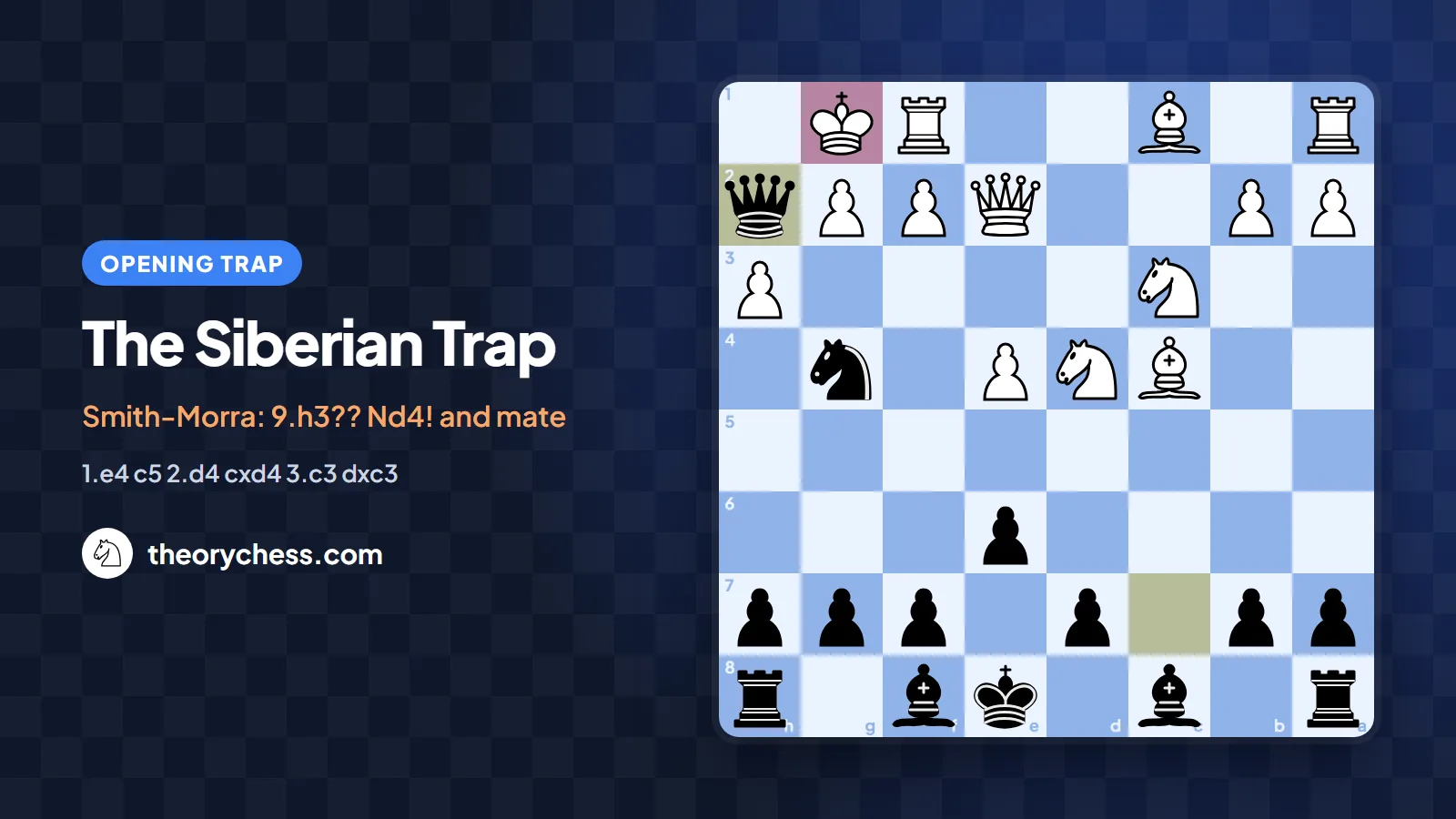
The Siberian Trap is the best-known mating trap Black can set against the Smith-Morra Gambit. White thinks the development lead is working, then Black's queen and knight meet on h2: 8…Ng4! 9.h3?? Nd4! and White either loses the queen or gets mated with 10…Qh2#. This guide walks through the trap move by move, explains why it works and shows how to avoid it as White.
The Smith-Morra Gambit in brief
The Smith-Morra is a pawn sacrifice against the Sicilian Defence: 1.e4 c5 2.d4 cxd4 3.c3 dxc3 4.Nxc3. White gives a pawn for quick development, open c- and d-files and pressure against Black's king. It is very popular at club level because it sidesteps the heavy theory of the Open Sicilian. But the gambiteer has to be careful too: a lead in development can turn into a counter-attack after a single careless move.
One of Black's most solid set-ups is 4…Nc6 5.Nf3 e6 6.Bc4 Qc7. The queen on c7 sits on the c-file and also looks down the b8–h2 diagonal. That diagonal, and the h2 square at the end of it, is the key to the Siberian Trap.
The trap move by move
7.O-O Nf6 8.Qe2 Ng4!
White castles and plays 8.Qe2, preparing Rd1 and e5. Black's reply looks quiet but is poisonous: 8…Ng4! The knight eyes h2, and the queen on c7 hits the same square along the diagonal. Right now h2 is defended only by the knight on f3 and the king.
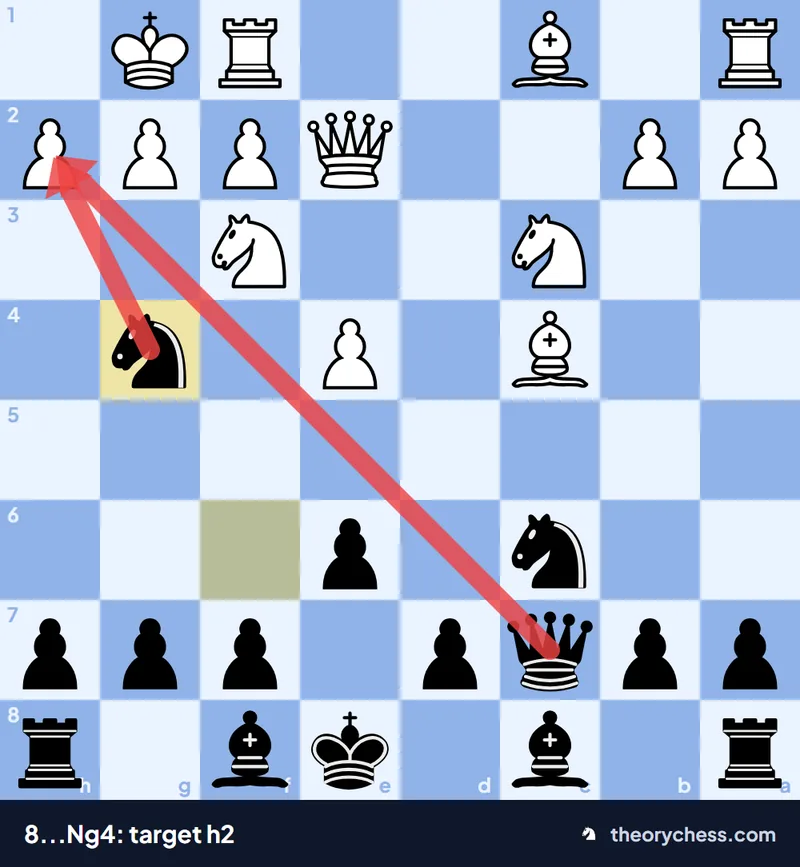
After 8…Ng4 the queen on c7 and the knight on g4 both aim at h2.
The threat is …Nd4, attacking the queen on e2. If White takes on d4 with the knight, the f3-knight leaves the defence of h2 and …Qxh2# follows. So 8…Ng4 quietly prepares a mating idea for the next move.
9.h3?? Nd4!
White's most natural reaction is to kick the annoying knight: 9.h3?? But this empties h2 and springs the trap. Black does not retreat: 9…Nd4!
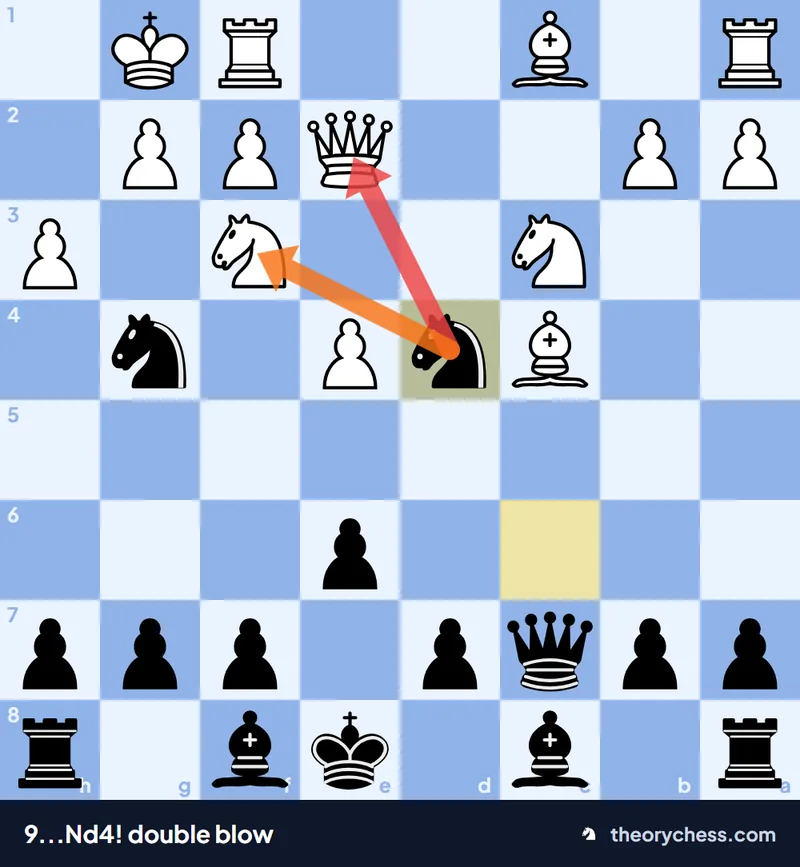
9…Nd4! hits the queen on e2, and no White reply saves everything.
Every White option now fails:
- 10.Nxd4?? The f3-knight abandons h2: 10…Qh2#. The queen is protected by the g4-knight and the king's escape square f1 is blocked by its own rook.
- Queen retreats such as 10.Qd1 or 10.Qd3: 10…Nxf3+ and whichever piece recaptures, 11…Qh2# follows.
- 10.hxg4 or any move that leaves the queen on e2: 10…Nxe2+ and Black wins the queen.
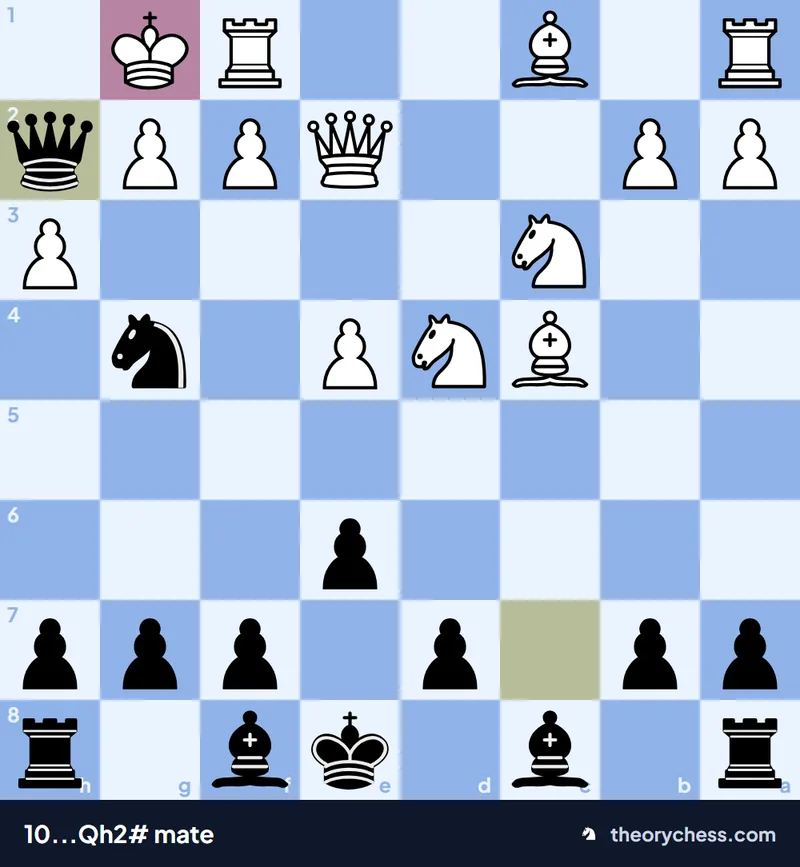
10.Nxd4?? Qh2#: the queen is protected by the g4-knight and the king has no square.
Why the trap works
The Siberian Trap combines three ingredients:
- The diagonal: the queen on c7 looks along b8–h2. Unless White closes it with e5 or a piece on f4, h2 is always a target.
- A single defender: apart from the king, only the f3-knight guards h2. Any move that deflects or exchanges that knight creates a mating threat.
- No escape square: after castling the rook sits on f1, so the king on g1 is boxed in and a queen on h2 mates on her own.
9.h3 makes things worse because the h2-pawn is gone and the queen can walk straight in. White's "kick the knight" reflex is exactly what Black is hoping for. You see the same reflex punished in the Fishing Pole trap, where h3 against a knight on g4 opens the h-file for Black.
How White avoids it
After 8…Ng4 White has to see the threat against h2 first. Practical, safe options:
- 9.g3: blocks the b8–h2 diagonal. The queen can no longer reach h2, so …Nd4 Nxd4 is not mate.
- 9.Rd1: the rook leaves f1 and gives the king a flight square, while also pressing down the d-file against the d7-pawn.
- 9.Nb5: hitting the queen first to gain time. After 9…Qb8 the queen is still on the same diagonal, so White still needs to secure h2, for example with g3.
The broader lesson: in the Smith-Morra, White's lead in development only counts together with king safety. While playing Qe2, Rd1 and e5, check every move where Black's c7-queen is pointing. Drilling the main set-ups in the Smith-Morra trainer before you play the gambit removes most of these surprises.
Setting the trap as Black
For Black the Siberian Trap is a free try: 8…Ng4 is not a bad move, and if White defends correctly the game simply goes on. But the move order matters:
- The queen has to be on c7; without …Qc7 there is no pressure on h2.
- The …Nf6–g4 manoeuvre makes sense once White has castled short.
- If White has already played e5 or put a piece on f4, the diagonal is closed and the trap does not work; go back to normal development.
For an overview of the other Sicilian branches and White's sidelines, read our Sicilian Defence for beginners guide. If you prefer a solid centre over a gambit as White, the Alapin Sicilian with 2.c3 is a good alternative.
Frequently asked questions
Which opening does the Siberian Trap come from?
It arises in the Smith-Morra Gambit against the Sicilian, in the line where Black sets up with …Nc6, …e6, …Qc7 and …Nf6. The heart of the trap is 8.Qe2 Ng4 9.h3?? Nd4!
Is White lost after 8…Ng4?
No. 8…Ng4 only creates a threat. If White secures h2 with moves like 9.g3 or 9.Rd1, the game continues normally. The losing move is 9.h3??
Why is it called the Siberian Trap?
There is no reliable source for the origin of the name; chess literature simply knows this combination as the Siberian Trap. What matters is the queen-and-knight teamwork against h2, not the name.
Is the Smith-Morra Gambit worth playing?
At club level, yes: fast development and the initiative score a lot of points in practice. But if you play it without knowing Black's solid set-ups and tactical counter-blows like this one, the missing pawn quickly becomes a lasting problem.
Practise it on TheoryChess
Reading a trap is one thing, spotting it over the board is another. On TheoryChess you can play the Smith-Morra Gambit against Stockfish with an explanation for every theoretical move, then take the 10-question quiz to check what has stuck. For more classic traps, see opening traps every club player should know and browse the opening catalogue.
Keep reading
· 5 min read
The Scandinavian Defence: a practical guide to 1.e4 d5The Scandinavian Defence strikes at the centre with 1…d5. Main line 3…Qa5, the alternatives, typical plans and common mistakes.
· 6 min read
The Noah’s Ark Trap: how Black traps the bishop in the Ruy LopezThe Noah’s Ark Trap in the Ruy Lopez, move by move: after 8.Qxd4?? c5! and …c4, White’s b3-bishop is trapped by Black’s pawns. How to set it and avoid it.
· 7 min read
The French Defence: a complete guide to plans and variationsThe idea behind 1.e4 e6, the Advance, Tarrasch, Winawer and Exchange lines, how to fix the bad bishop, and the 9.Bb5+ trap in the Advance.