
The Fishing Pole trap: mate down the h-file in the Berlin
In the Berlin Defence, 4…Ng4!? sets the bait: if White grabs the knight, the h-file opens and 8…Qh1# follows. The trap and how White avoids it.
6 min readBy Hasan Süzen
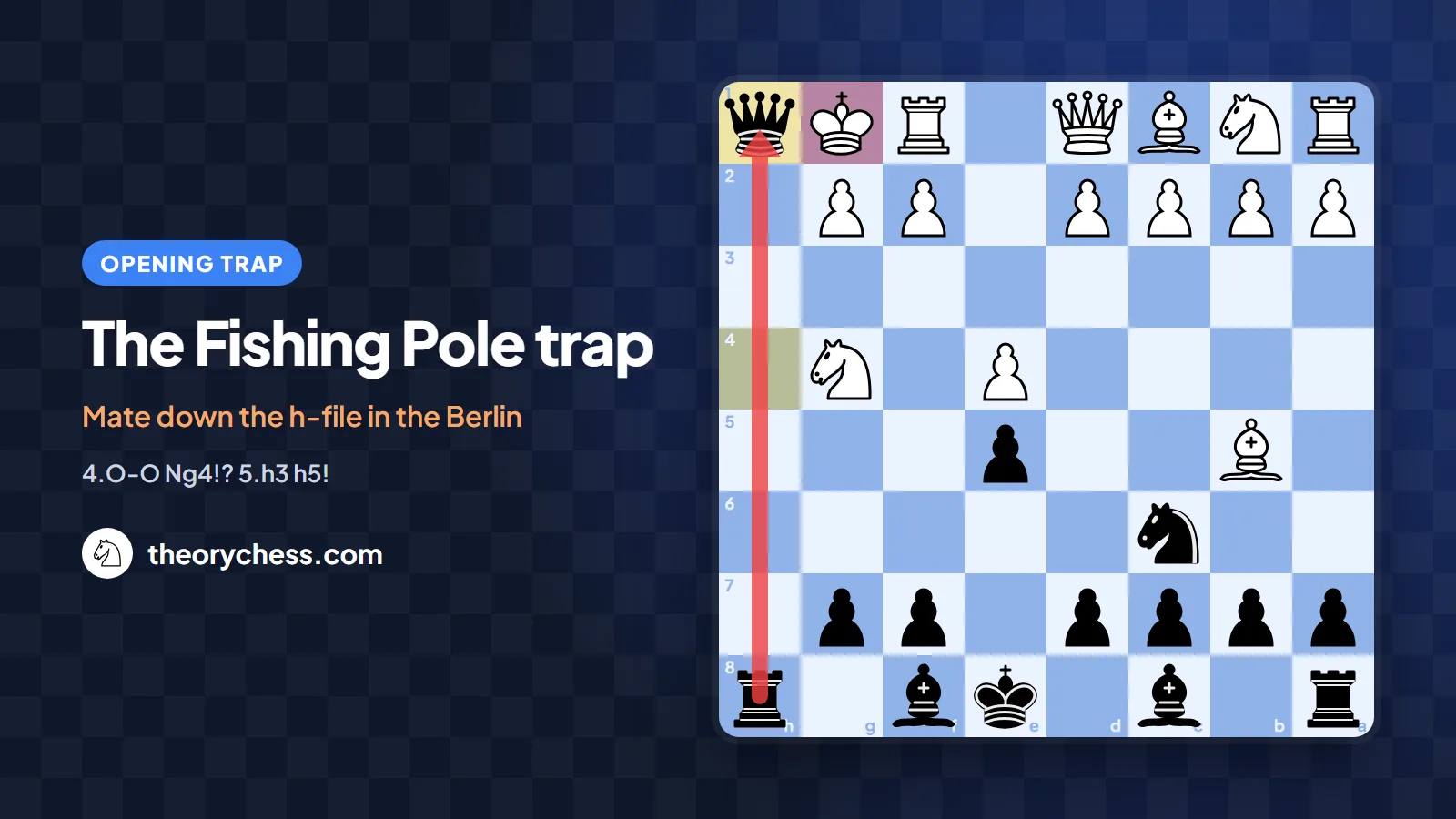
The Fishing Pole trap is a baited trap for Black in the Berlin Defence of the Ruy Lopez. Black sends a knight to g4 and invites White to attack it with h3 and then take it. If White bites, the h-file opens and Black’s queen and rook mate together on h1. Below you will find the trap move by move, why it works, and how to play safely as White.
The starting position
The trap comes from the most common Berlin move order: 1.e4 e5 2.Nf3 Nc6 3.Bb5 Nf6 4.O-O. White has castled and the e4-pawn is technically hanging; in the Berlin main line Black usually takes it with 4…Nxe4. The player setting the Fishing Pole chooses something else: 4…Ng4!?
Objectively this is not a good move. The knight attacks nothing on g4, the f2-pawn is defended by the rook and king, and Black loses time. The move’s only purpose is to be bait. What makes it dangerous is that it targets White’s most natural reaction.
The trap move by move
5.h3 h5!
White’s instinctive reply is 5.h3: “The knight came to g4, so let’s kick it.” Instead of retreating, Black defends it with 5…h5! Now 6.hxg4 seems to win a piece, but in reality it opens the h-file for Black’s rook.
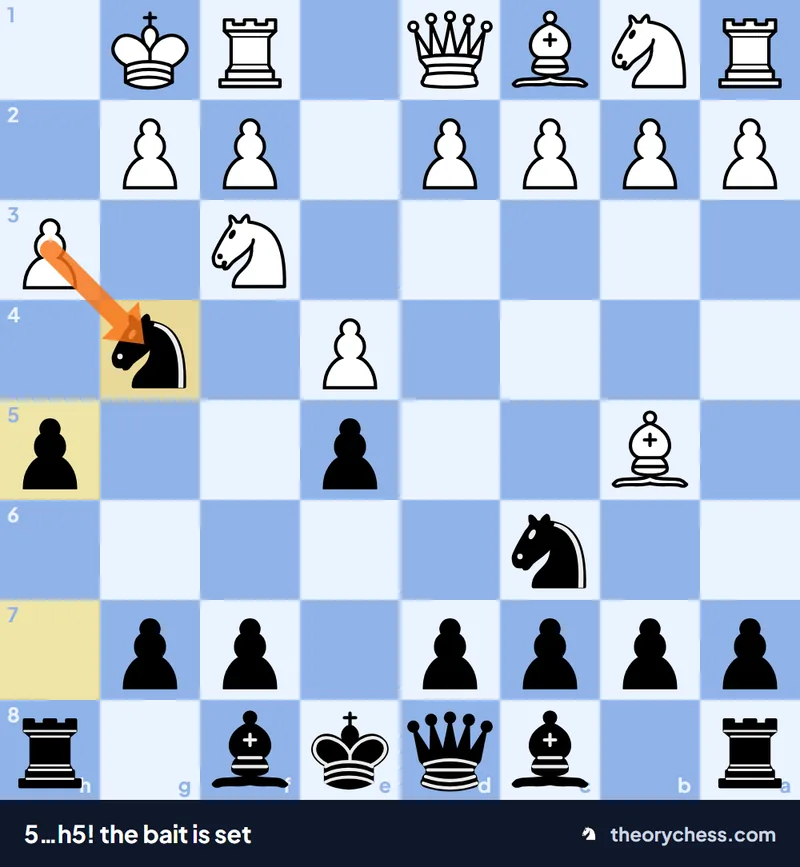
After 5…h5! the knight on g4 looks loose; the real target is the h-file.
6.hxg4? hxg4
White takes the bait: 6.hxg4? and Black recaptures 6…hxg4. Two things have happened at once. The h-file is fully open, so the rook on h8 points straight at White’s castled king, and the new pawn on g4 attacks the knight on f3. Black is a piece down, but everything is aimed at the white king.
7.Nh2 Qh4
The knight has to move, and 7.Nh2 is the natural square: it blocks the h-file and attacks the g4-pawn. Black replies 7…Qh4, bringing the queen onto the h-file. The threat is obvious: Qxh2#. The knight on h2 is defended only by the king, while Black attacks it twice, with queen and rook.
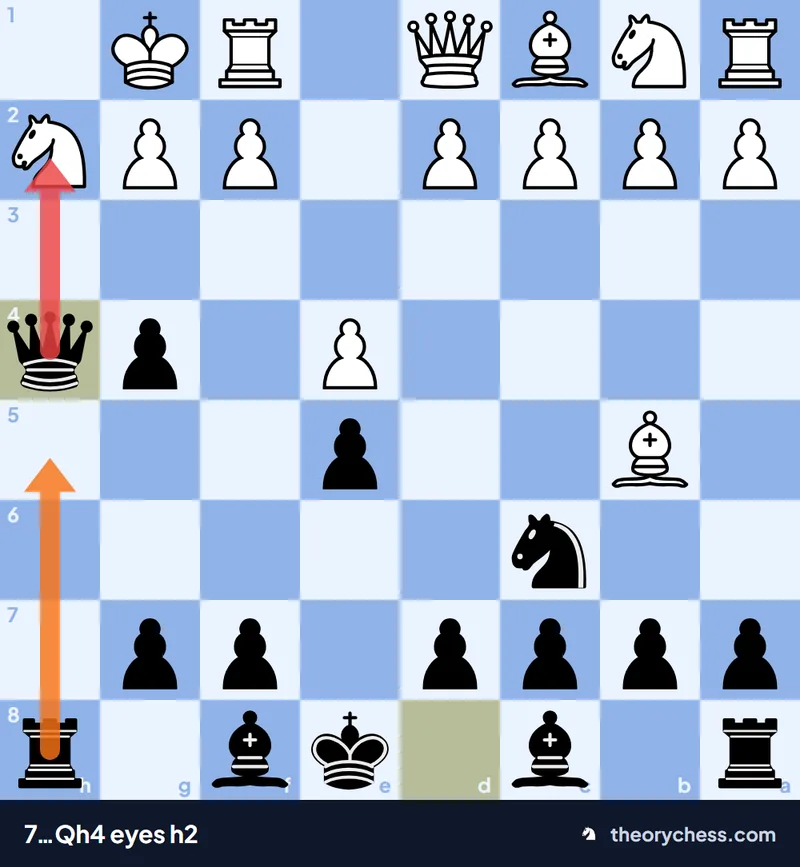
After 7…Qh4 the queen and the h8-rook bear down on h2, threatening Qxh2#.
8.Nxg4?? Qh1#
The most natural-looking move for White is to remove the annoying pawn and bring the knight back towards the centre: 8.Nxg4?? But once the knight leaves h2, the h-file is wide open: 8…Qh1#. The queen is protected by the rook on h8, so the king cannot take it, and with a rook on f1 and pawns on f2 and g2 there is no escape square.
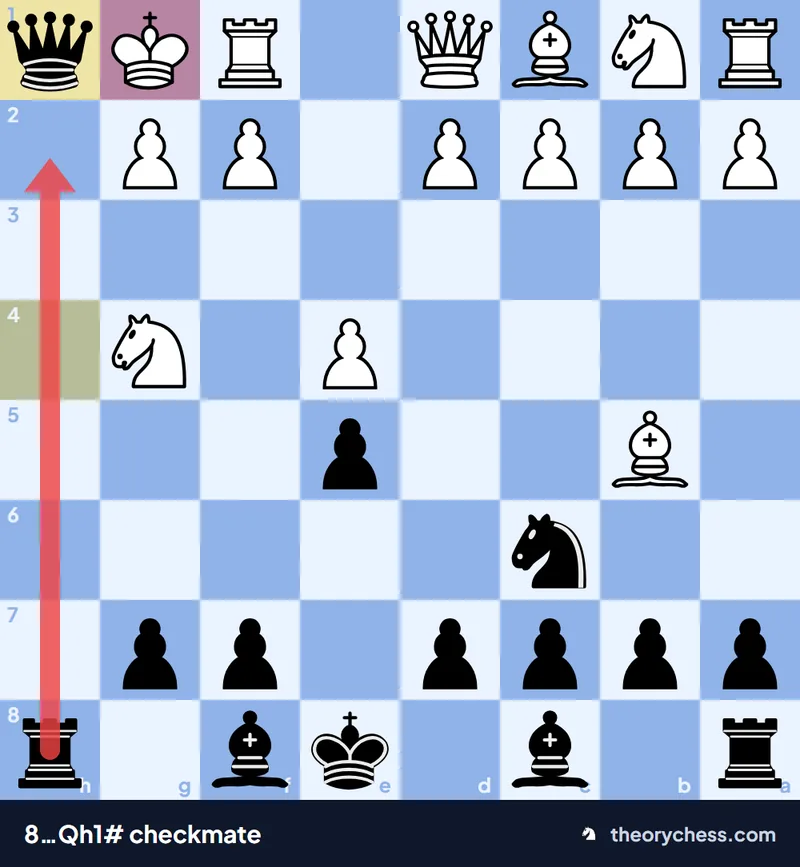
8…Qh1#: White’s own rook and pawns take away every escape square.
The whole sequence: 1.e4 e5 2.Nf3 Nc6 3.Bb5 Nf6 4.O-O Ng4!? 5.h3 h5! 6.hxg4? hxg4 7.Nh2 Qh4 8.Nxg4?? Qh1#.
The trap at a glance
| Move | What happens | Lesson |
|---|---|---|
| 4…Ng4!? | The knight attacks nothing; it is bait. | When a move looks pointless, ask what your opponent wants. |
| 5…h5! | The h-pawn defends the knight. | Taking on g4 can open the h-file for the opponent. |
| 6.hxg4? | White wins a knight; the h-file opens. | Weigh a free piece against your king’s safety. |
| 7…Qh4 | Queen and rook pile up on h2. | Queen plus rook on an open file is a deadly battery. |
| 8.Nxg4?? | h2 is vacated and 8…Qh1# follows. | Don’t pull a defender away from your king. |
Why the trap works
- A free piece is hard to refuse: 6.hxg4 wins a knight and looks logical on paper. But once the pawn recaptures, the h-file opens and the castled king loses its most important shield.
- Open file plus rook: Black has not castled yet, so the rook is still on h8 and uses the newly opened file at once.
- A boxed-in king: the f1-rook and the f2- and g2-pawns normally protect the king; in this trap they take away its escape squares.
Opening lines in front of your own castled king is a theme behind many traps. You will find more examples in opening traps every club player should know.
How should White play?
The simplest rule: don’t take the knight in a way that opens the h-file. After 5…h5 the knight on g4 does nothing to White, who can increase the advantage by playing in the centre. Building the centre with 6.d4, or 6.c3 followed by d4, pressing e5 with Re1 and freeing the f1-square for the king is a healthy approach. Black has lost time and pushed the h-pawn; calm play gives White a comfortable position.
In fact White does not need 5.h3 at all. After 4…Ng4, playing 5.d4 or 5.c3 straight away leaves the knight offside, and sooner or later it has to go back.
If White has already taken the knight, 8.Nxg4?? loses on the spot after 7.Nh2 Qh4. 8.Re1, for example, frees f1 for the king and stops the immediate mate, but after 8…Qxh2+ 9.Kf1 Black wins the piece back and the attack goes on. So survival is possible after grabbing the knight, but it demands very precise defence in practice.
Beyond the trap: the Ruy Lopez and the Berlin
The Fishing Pole is a surprise weapon; the main lines of the Berlin rest on much sounder ideas, from the endgame after 4…Nxe4 to the Open Ruy Lopez and the sharp Marshall Attack. If you play 3.Bc4 instead of 3.Bb5 you reach the Italian Game, covered in our practical guide to the Italian Game; it has its own famous bait in the Blackburne Shilling trap.
Frequently asked questions
Why is it called the Fishing Pole trap?
The knight on g4 is thrown out like bait on a fishing line: White “catches” it with h3 and hxg4, but pulling it in opens the h-file and drags the king into a mating net.
Is 4…Ng4 a good move?
No. Objectively Black loses time, and accurate play gives White the advantage. The move’s value is purely practical: it punishes natural reactions.
Does White lose immediately after taking the knight?
Not immediately, but the defence becomes very difficult. After 6.hxg4 hxg4 the most natural moves strengthen Black’s attack, and 8.Nxg4?? loses at once to 8…Qh1#.
Does the trap appear in other Ruy Lopez lines?
The idea works whenever White has castled short, Black has not castled, and the h-file can be opened. This exact move order, though, is most common in the Berlin after 4.O-O.
Practise it on TheoryChess
On TheoryChess you can play the main lines in the Berlin Defence trainer against Stockfish, with an explanation for every move, then test yourself with the Berlin Defence quiz and the Ruy Lopez quiz. For another quick mate, this time against 1.d4, read about the Englund Gambit trap; every opening is in the opening catalogue.
Keep reading
· 5 min read
The Siberian Trap: checkmate on h2 in the Smith-Morra GambitThe Siberian Trap in the Smith-Morra: 8…Ng4! 9.h3?? Nd4! and 10…Qh2#. Move by move, why it works and how White avoids it.
· 5 min read
The Scandinavian Defence: a practical guide to 1.e4 d5The Scandinavian Defence strikes at the centre with 1…d5. Main line 3…Qa5, the alternatives, typical plans and common mistakes.
· 6 min read
The Noah’s Ark Trap: how Black traps the bishop in the Ruy LopezThe Noah’s Ark Trap in the Ruy Lopez, move by move: after 8.Qxd4?? c5! and …c4, White’s b3-bishop is trapped by Black’s pawns. How to set it and avoid it.