
The Noah’s Ark Trap: how Black traps the bishop in the Ruy Lopez
The Noah’s Ark Trap in the Ruy Lopez, move by move: after 8.Qxd4?? c5! and …c4, White’s b3-bishop is trapped by Black’s pawns. How to set it and avoid it.
6 min readBy Hasan Süzen
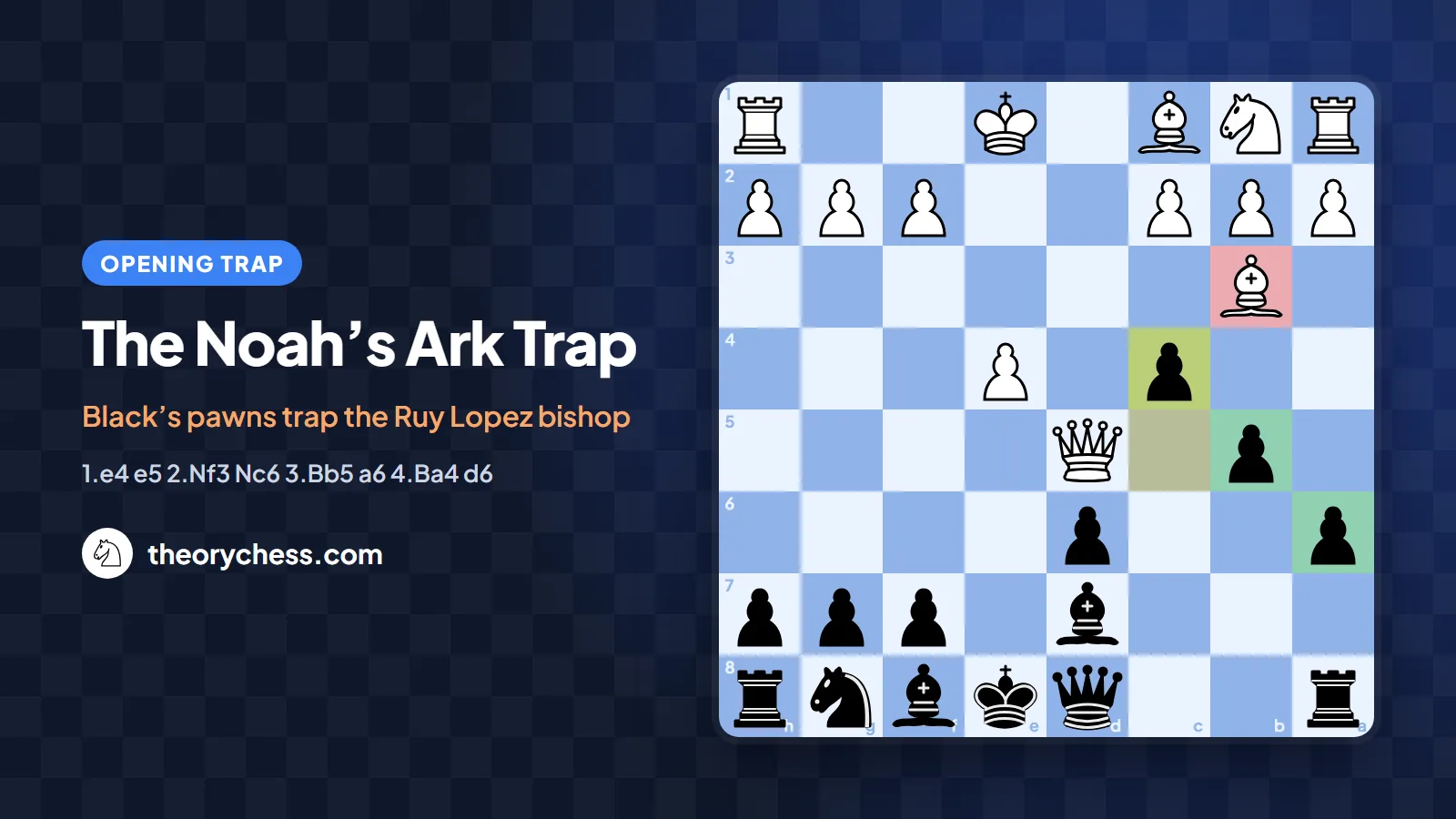
The Noah’s Ark Trap is a centuries-old trap in the Ruy Lopez in which Black’s pawns lock White’s bishop on b3. White recaptures a pawn with the queen, 8.Qxd4??, Black answers 8…c5! with tempo, and a few moves later …c4 closes the a6-b5-c4 pawn chain around the bishop like the hull of a ship. This guide shows the trap move by move, explains why it works and how White can stay out of it.
The starting position
The trap arises from the Steinitz Defence Deferred: 1.e4 e5 2.Nf3 Nc6 3.Bb5 a6 4.Ba4 d6. Black has pushed the bishop back with …a6 and then supported e5 with …d6. White opens the centre with 5.d4, and after 5…b5 6.Bb3 the bishop retreats to b3.
Now Black exchanges in the centre: 6…Nxd4 7.Nxd4 exd4. The knights are gone and a black pawn sits on d4. To White it looks like an obvious target that the queen can simply take back. Two details are worth noticing, though: the b3-bishop is short of squares, and Black’s a6 and b5 pawns are already closing in on it.
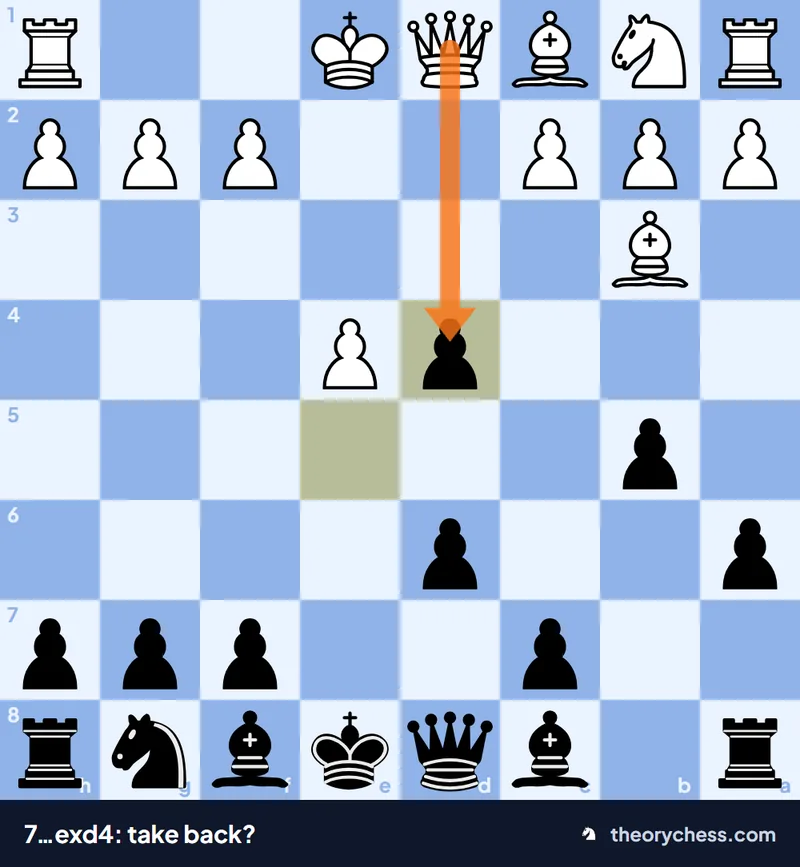
After 7…exd4 White wants to take back with the queen, but the b3-bishop is already short of squares.
The trap move by move
8.Qxd4?? c5!
White takes the pawn: 8.Qxd4??. It looks natural, but it is a serious mistake. Black attacks the queen with tempo: 8…c5!. The pawn is also ready to advance to c4, where it will cut off the bishop’s last way out.
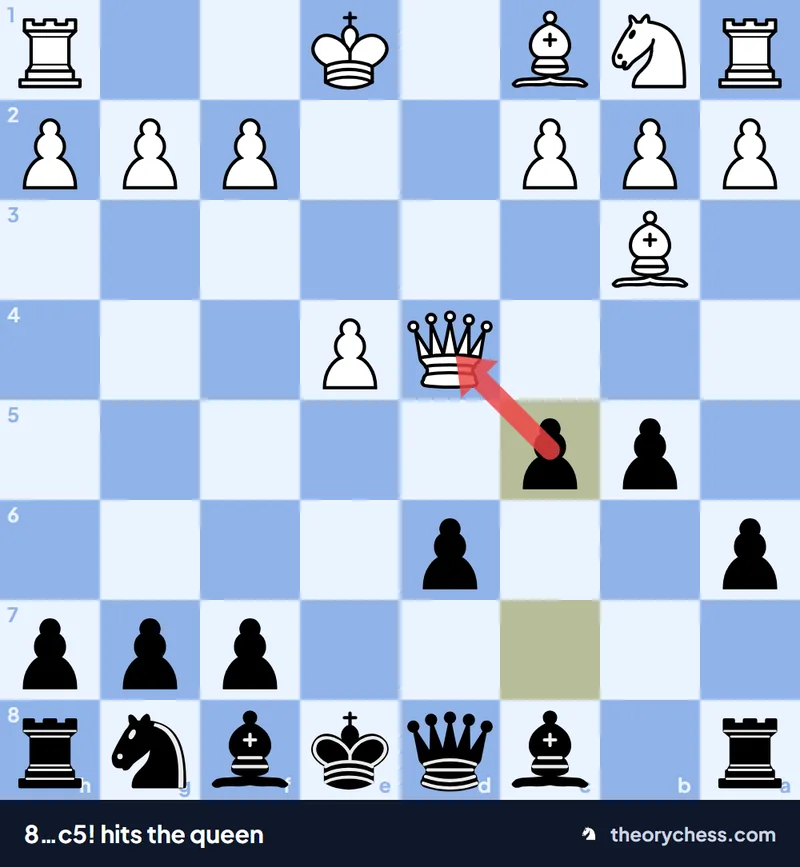
8…c5! attacks the queen and prepares …c4 to shut the bishop in.
9.Qd5 Be6 10.Qc6+ Bd7 11.Qd5 c4
The queen wants to stay active and goes to 9.Qd5, eyeing the rook on a8. Black hits it again with 9…Be6. White checks with 10.Qc6+, Black blocks with 10…Bd7, and the queen returns with 11.Qd5. Now the blow lands: 11…c4.
Look at the bishop’s squares: a4 is covered by the b5 pawn, a2 and c2 are blocked by White’s own pawns, and the c4 diagonal is closed. The bishop is trapped and will be captured with …cxb3 next move.
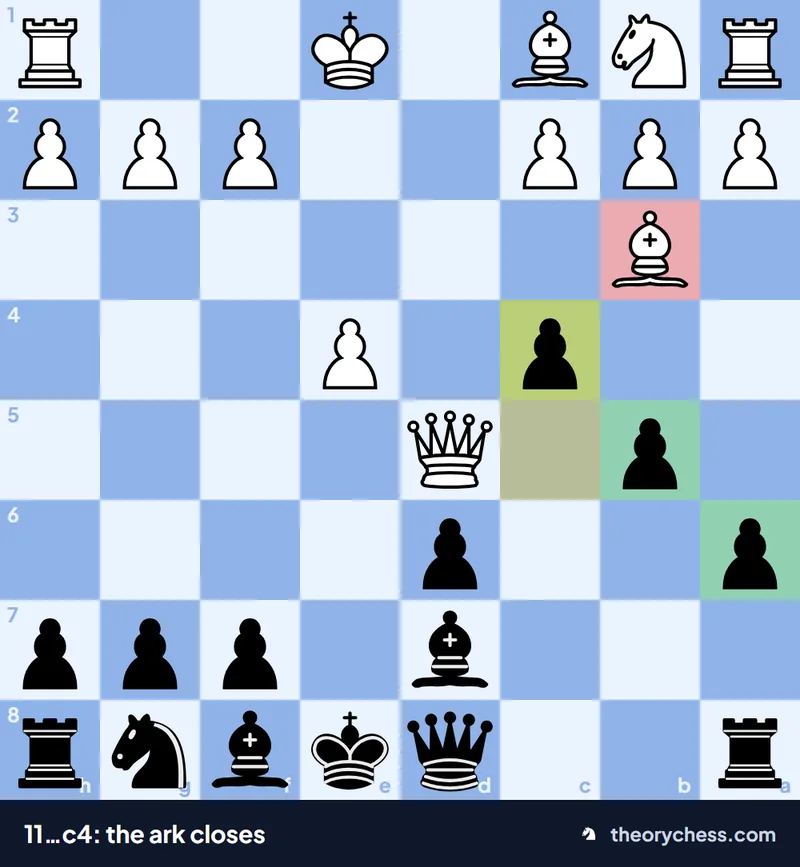
After 11…c4 the a6-b5-c4 pawns form the “ark”; the b3-bishop has nowhere to go.
What can White save?
White’s best practical try is to give the bishop for two pawns: 12.Bxc4 bxc4 13.Qxc4. That still leaves White a piece for two pawns, and Black is clearly better.
Why the trap works
The logic of the Noah’s Ark comes down to one observation: a bishop without retreat squares is a target. The b3-bishop is a great piece in the Ruy Lopez because it aims at f7 and Black’s kingside. But the square has a weakness: White’s own pawns on a2 and c2 block its way back. Since Black’s a6 and b5 pawns already control a4 and the route through c4, the advance …c5-c4 closes the last exit.
8.Qxd4 hurts White twice: the queen loses time to …c5, and the c-pawn gets a free run towards c4. That is why anyone who plays the Ruy Lopez should keep an eye on the pawn structure around the b3-bishop.
How White avoids it
The simplest solution is not to recapture with the queen. There are two reasonable alternatives in the position:
- 8.Bd5, attacking the rook from an active square. After 8…Rb8 9.Bc6+ Bd7 10.Bxd7+ Qxd7 11.Qxd4 White wins the pawn back safely and the game is level.
- 8.c3, playing in gambit style for development and open lines instead of grabbing the pawn at once.
White can also avoid the whole line earlier. After 4…d6, calm moves such as 5.c3 (the main line of the Modern Steinitz) or 5.O-O don’t give Black the chance to exchange in the centre with …b5 and …Nxd4. With 5.c3 Bd7 6.d4, for example, White supports the centre first.
The same motif elsewhere in the Ruy Lopez
The Noah’s Ark motif is not tied to one move order. In many branches of the Ruy Lopez, the advance …a6, …b5 and …c5-c4 carries the same threat against a bishop on b3. White’s usual safety measure is to prepare a retreat square on c2, which is why c3 followed by Bc2 appears so often in the main lines.
Another famous trap in the Ruy Lopez comes from the Berlin Defence: the Fishing Pole trap mates down the open h-file. And for a different kind of trick against 1.d4, see the Elephant Trap in the Queen’s Gambit Declined.
How Black sets it up
The beauty of the Noah’s Ark is that Black risks nothing to set it. 4…d6 builds a solid structure, 5…b5 pushes the bishop back, and 6…Nxd4 7.Nxd4 exd4 resolves the central tension on Black’s terms. From here Black has one idea in mind: if White takes on d4 with the queen, trap the bishop with …c5 and …c4.
Black should watch two things. First, after …b5 the a6 and b5 pawns are the foundation of the trap, so don’t push them without a reason. Second, if White plays correctly, for example 8.c3 or 8.Bd5, Black has a normal, balanced position; no need to panic when the trap doesn’t work.
The trap at a glance
| Move | What happens |
|---|---|
| 4…d6 | Steinitz Deferred: Black supports e5. |
| 5.d4 b5 6.Bb3 | The bishop drops back to b3, hemmed in by its own pawns. |
| 6…Nxd4 7.Nxd4 exd4 | Exchanges in the centre leave a black pawn on d4. |
| 8.Qxd4?? | White recaptures with the queen and walks into the trap. |
| 8…c5! | The queen is hit with tempo. |
| 9.Qd5 Be6 10.Qc6+ Bd7 11.Qd5 c4 | The a6-b5-c4 chain closes and the bishop is trapped. |
Frequently asked questions
Why is it called the Noah’s Ark Trap?
The name is usually explained by the a6-b5-c4 pawn chain, which wraps around the bishop like the hull of a ship, and by the trap being very old, “as old as Noah’s Ark”. Its exact origin is unclear.
Does the trap only work after 8.Qxd4?
The main line is 8.Qxd4?? c5. Wherever the queen goes after …c5, the advance …c4 traps the b3-bishop, so the real mistake is 8.Qxd4 itself.
Is 4…d6 a reliable defence for Black?
Yes. The Steinitz Defence Deferred, also called the Modern Steinitz, is a solid and respected defence. The trap grows out of normal, healthy moves, so Black takes no risk setting it.
Is the game over once White loses the bishop?
White can collect two pawns but stays a piece down. At club level that usually decides the game, though Black still has to play carefully.
Practise it on TheoryChess
The best way to recognise motifs like this over the board is to play the lines yourself. On TheoryChess you can play the Ruy Lopez trainer against Stockfish, with an explanation for every theory move, then test yourself with the Ruy Lopez quiz. For more tricks, read opening traps every club player should know, and browse every opening in the opening catalogue.
Keep reading
· 5 min read
The Siberian Trap: checkmate on h2 in the Smith-Morra GambitThe Siberian Trap in the Smith-Morra: 8…Ng4! 9.h3?? Nd4! and 10…Qh2#. Move by move, why it works and how White avoids it.
· 5 min read
The Scandinavian Defence: a practical guide to 1.e4 d5The Scandinavian Defence strikes at the centre with 1…d5. Main line 3…Qa5, the alternatives, typical plans and common mistakes.
· 7 min read
The French Defence: a complete guide to plans and variationsThe idea behind 1.e4 e6, the Advance, Tarrasch, Winawer and Exchange lines, how to fix the bad bishop, and the 9.Bb5+ trap in the Advance.