
The Elephant Trap: how 6.Nxd5?? loses a piece in the QGD
The Elephant Trap in the Queen’s Gambit Declined, move by move: after 6.Nxd5?? Nxd5! 7.Bxd8 Bb4+ Black wins a piece. Here is why it works and how to avoid it.
6 min readBy Hasan Süzen
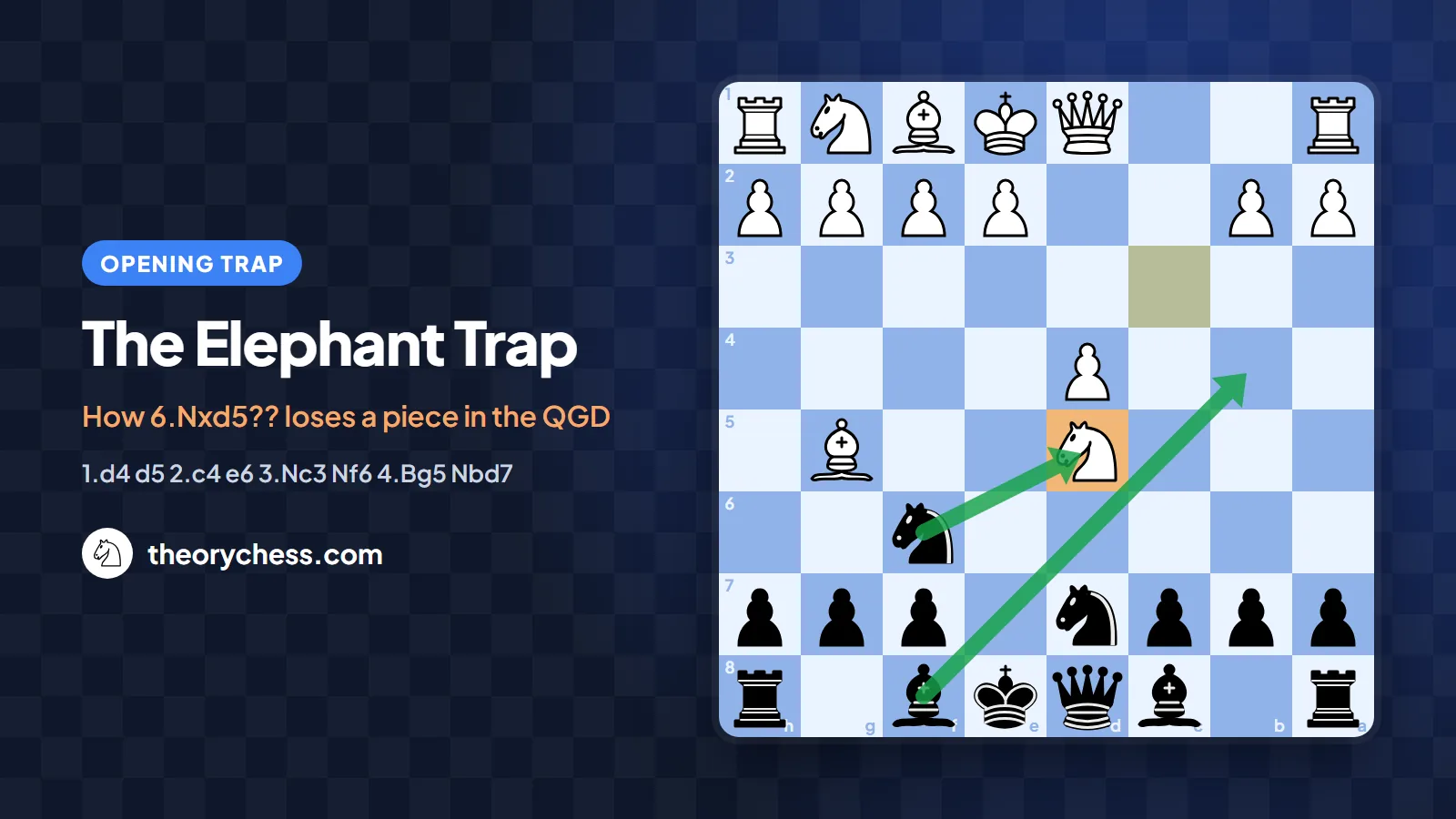
The Elephant Trap is a classic trap for Black in the Queen’s Gambit Declined. White thinks the knight on f6 is pinned and grabs the d5 pawn with 6.Nxd5??. But the pin is an illusion: Black takes with 6…Nxd5!, White wins the queen, and after 7…Bb4+ Black wins it straight back and ends up a full piece ahead. This guide walks through the trap move by move, explains why it works and shows what both sides should learn from it.
The starting position
The trap comes from one of the most classical move orders in the Queen’s Gambit: 1.d4 d5 2.c4 e6 3.Nc3 Nf6 4.Bg5. White develops the bishop to g5 and pins the f6-knight against the queen. One of Black’s most natural replies is 4…Nbd7: the knight develops, covers c5 and e5, and prepares to break in the centre later with …c5 or …e5.
White often releases the central tension with 5.cxd5 exd5. That exchange creates the typical structure of the Exchange Variation and gives White long-term pressure against d5. And at exactly this moment the d5 pawn looks free: the c3-knight attacks it, its only defender is the knight on f6, and that knight is pinned by the bishop on g5. Or so it seems.
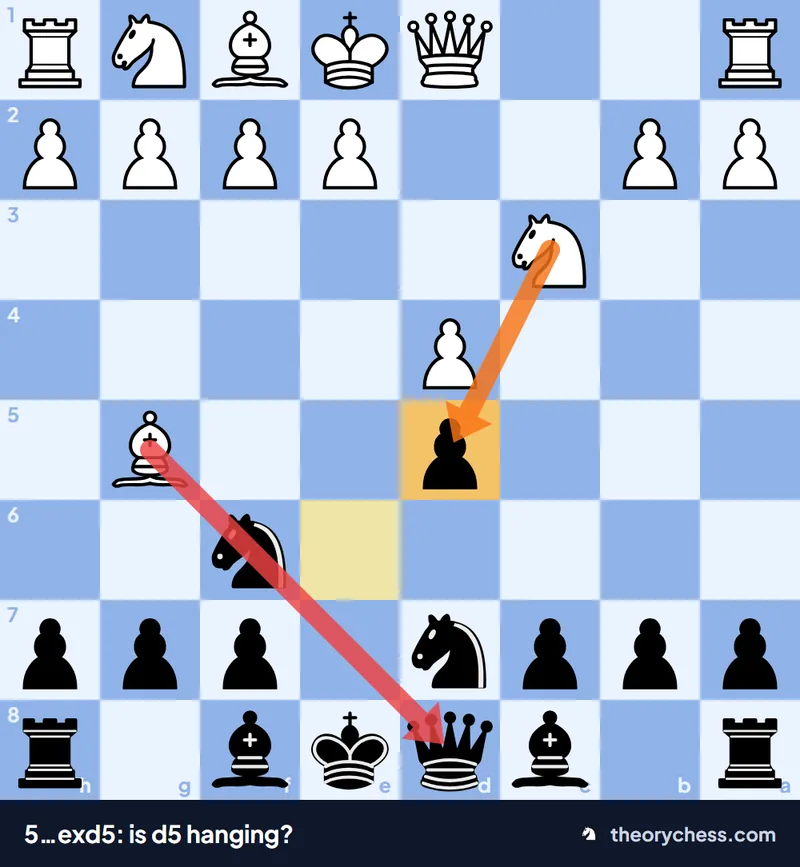
After 5…exd5 White believes the f6-knight is pinned and the d5 pawn is there for the taking.
The trap move by move
6.Nxd5?? Nxd5!
White takes the bait: 6.Nxd5??. The idea is simple: if the f6-knight recaptures, the g5-bishop takes the queen on d8. And that is exactly what Black allows: 6…Nxd5!. It looks like a queen sacrifice, because the pin on f6 is only a relative pin: behind the knight stands the queen, not the king, so the knight is free to move. With the right calculation, giving up the queen costs Black nothing.
7.Bxd8 Bb4+!
White carries on and takes the queen: 7.Bxd8. Now the hidden resource appears: 7…Bb4+!. The f8-bishop gives check, and the white king has no square: the queen stands on d1, White’s own pawns on e2 and f2, and d2 is covered by the bishop. The only legal move is to block with the queen: 8.Qd2.
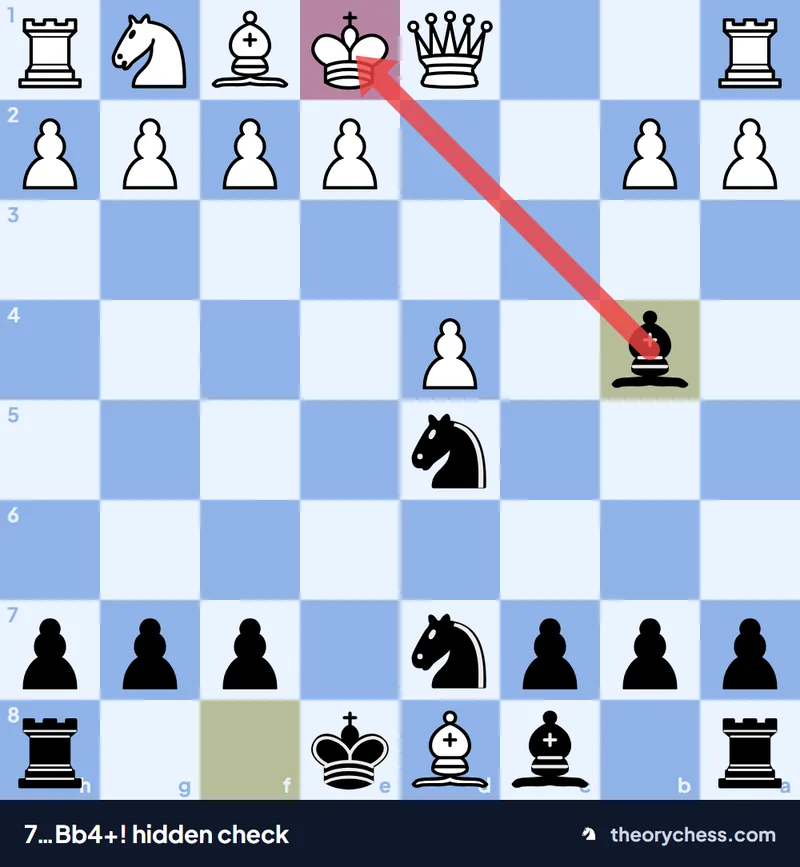
7…Bb4+! White has to block with the queen, and Black gets the queen back.
8.Qd2 Bxd2+ 9.Kxd2 Kxd8
Black takes the queen with 8…Bxd2+, White recaptures with 9.Kxd2, and Black collects the bishop on d8 with 9…Kxd8. The accounting is clear: both queens are gone, but Black has an extra knight and White has only a pawn to show for it. In practical terms Black has a winning material advantage.
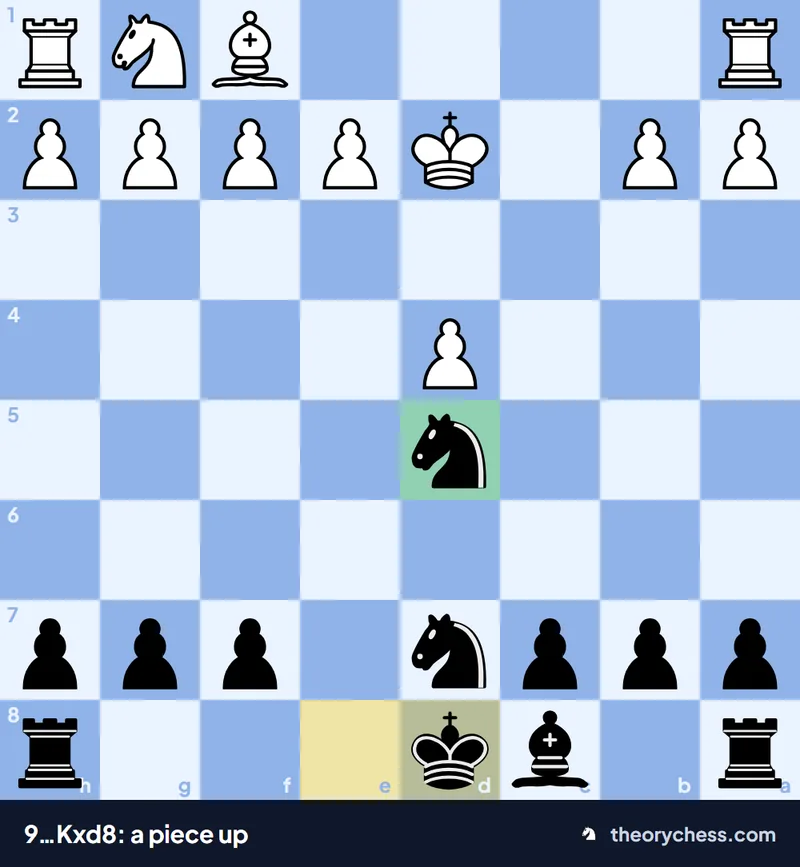
After 9…Kxd8 the queens are off and Black is a knight up for a pawn.
Why the trap works
The heart of the Elephant Trap is a misread pin. There are two kinds of pin in chess:
- Absolute pin: the king stands behind the pinned piece, so by the rules the piece cannot move.
- Relative pin: a more valuable piece, such as the queen, stands behind it. The piece can move, but usually at a cost.
In the Elephant Trap the f6-knight is only relatively pinned. White treats it as an absolute pin and decides the d5 pawn is undefended. But Black has a forcing move that makes up for the lost queen: the check from the f8-bishop along the diagonal to e1. It is a lesson that applies to every opening: before you call a piece “undefended”, check your opponent’s checks, captures and threats.
One detail matters a lot: the trap only works because the knight went to d7. If Black had played 4…Be7, the f8-bishop could no longer check from b4, and 6.Nxd5 would really win a pawn. That is why the trap depends on the 4…Nbd7 move order.
How White avoids it
The cure is simple: don’t rush to take on d5. After 5.cxd5 exd5, White’s healthy continuations are developing moves:
- 6.e3, opening the f1-bishop and supporting the centre. A typical set-up: 6…c6 7.Bd3 Be7 8.Qc2 O-O 9.Nge2.
- 6.Nf3, developing the knight and following up with e3, Bd3 and O-O.
White’s real plan in the Exchange Variation is not to win d5 at once but to build long-term pressure, often with the minority attack b4-b5 to create a weakness on Black’s queenside. If White plays 5.e3 instead of 5.cxd5, the game becomes a normal Queen’s Gambit Declined; 5…c6 6.Nf3 Qa5, for example, is the Cambridge Springs Variation.
For the bigger picture of this opening, read our guide to the Queen’s Gambit, accepted or declined.
Lessons for Black
The Elephant Trap is one of the rare traps that costs Black nothing to set: 4…Nbd7 is a perfectly sound, theoretical move. If White errs, Black wins a piece; if not, Black simply has a normal position. That makes it less of a trick and more of a good move order.
Black still has to know what comes next. If White avoids the trap, the game turns into a long positional struggle where the c8-bishop is often Black’s problem piece. Players who want a more active structure can look at the Slav Defence or the Tarrasch Defence.
Against the Queen’s Gambit there is an even sharper trap for Black: the Lasker Trap in the Albin Countergambit, which ends with a pawn promoting to a knight.
The trap at a glance
| Move | What happens |
|---|---|
| 4…Nbd7 | Black sets the trap with a sound developing move; the f8-bishop is ready for the check on b4. |
| 5.cxd5 exd5 | The Exchange structure appears and d5 looks free. |
| 6.Nxd5?? | White grabs the pawn, trusting a pin that isn’t real. |
| 6…Nxd5! | Black seems to give up the queen, but the calculation works. |
| 7.Bxd8 Bb4+! | The check forces White’s queen to block. |
| 8.Qd2 Bxd2+ 9.Kxd2 Kxd8 | The queens are gone and Black is a knight up for a pawn. |
Frequently asked questions
Why is it called the Elephant Trap?
The name is usually traced to the bishop’s historical name: in older forms of chess, and still in several languages, the bishop is the “elephant” (Arabic al-fil). Fittingly, it is the bishop’s check on b4 that springs the trap.
Which move order does the trap need?
The standard order is 1.d4 d5 2.c4 e6 3.Nc3 Nf6 4.Bg5 Nbd7 5.cxd5 exd5 6.Nxd5??. Black’s knight must be on d7 and the bishop still on f8; otherwise 7…Bb4+ isn’t possible.
What if White doesn’t take the queen on move 7?
After 6…Nxd5, if White leaves the queen alone, Black is simply a knight up for a pawn. In other words, once White plays 6.Nxd5?? the piece is lost; 7.Bxd8 only exchanges the queens as well.
Does the Elephant Trap happen at a high level?
Rarely among masters, because the idea is well known. In blitz and club games it still wins points regularly.
Practise it on TheoryChess
Reading a trap and spotting it over the board are two different skills. On TheoryChess you can play the lines in the Queen’s Gambit Declined trainer against Stockfish, with an explanation for every theory move, then test yourself with the Queen’s Gambit Declined quiz. For more classic tricks, read opening traps every club player should know, and browse every opening in the opening catalogue.
Keep reading
· 5 min read
The Siberian Trap: checkmate on h2 in the Smith-Morra GambitThe Siberian Trap in the Smith-Morra: 8…Ng4! 9.h3?? Nd4! and 10…Qh2#. Move by move, why it works and how White avoids it.
· 5 min read
The Scandinavian Defence: a practical guide to 1.e4 d5The Scandinavian Defence strikes at the centre with 1…d5. Main line 3…Qa5, the alternatives, typical plans and common mistakes.
· 6 min read
The Noah’s Ark Trap: how Black traps the bishop in the Ruy LopezThe Noah’s Ark Trap in the Ruy Lopez, move by move: after 8.Qxd4?? c5! and …c4, White’s b3-bishop is trapped by Black’s pawns. How to set it and avoid it.