
The Scandinavian Defence: a practical guide to 1.e4 d5
The Scandinavian Defence strikes at the centre with 1…d5. Main line 3…Qa5, the alternatives, typical plans and common mistakes.
5 min readBy Hasan Süzen
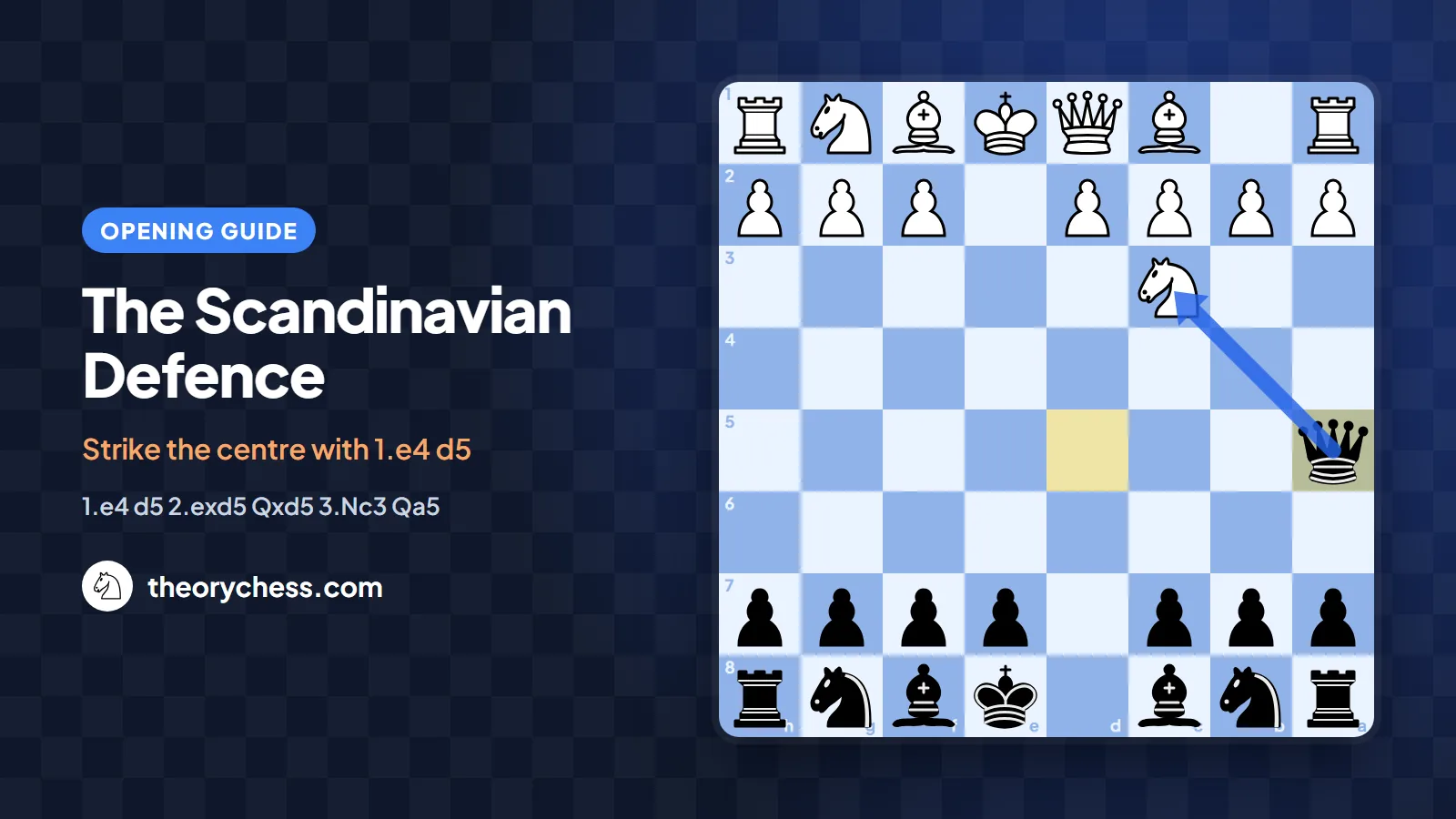
The Scandinavian Defence meets 1.e4 with 1…d5, striking at the centre on move one. It is easy to learn, solid and gets White out of their preparation immediately. After 2.exd5 Black recaptures either with the queen (2…Qxd5) or later with the knight (2…Nf6). This guide covers the main line 3…Qa5, the alternatives 3…Qd6 and 3…Qd8, the Modern Scandinavian, typical plans and the mistakes that cost games.
The idea behind the Scandinavian
In most defences to 1.e4 Black prepares first and challenges the centre later: …e6 and …d5 in the French Defence, …c6 and …d5 in the Caro-Kann. The Scandinavian does not wait. After 1.e4 d5 2.exd5 Black resolves the central tension at once and leaves White with a simple structure instead of a mountain of theory.
The price is clear: after 2…Qxd5 the queen comes out early and White gains a tempo with 3.Nc3. The art of the Scandinavian is finding the queen a safe square and making up for the lost time with a sound pawn structure.
Main line: 2…Qxd5 3.Nc3 Qa5
The most popular continuation is 3…Qa5. On a5 the queen is safe and presses the c3-knight along the a5–e1 diagonal; once the d-pawn has moved, that knight is pinned. A typical sequence: 4.d4 Nf6 5.Nf3 c6 6.Bc4 Bf5 7.Bd2 e6.
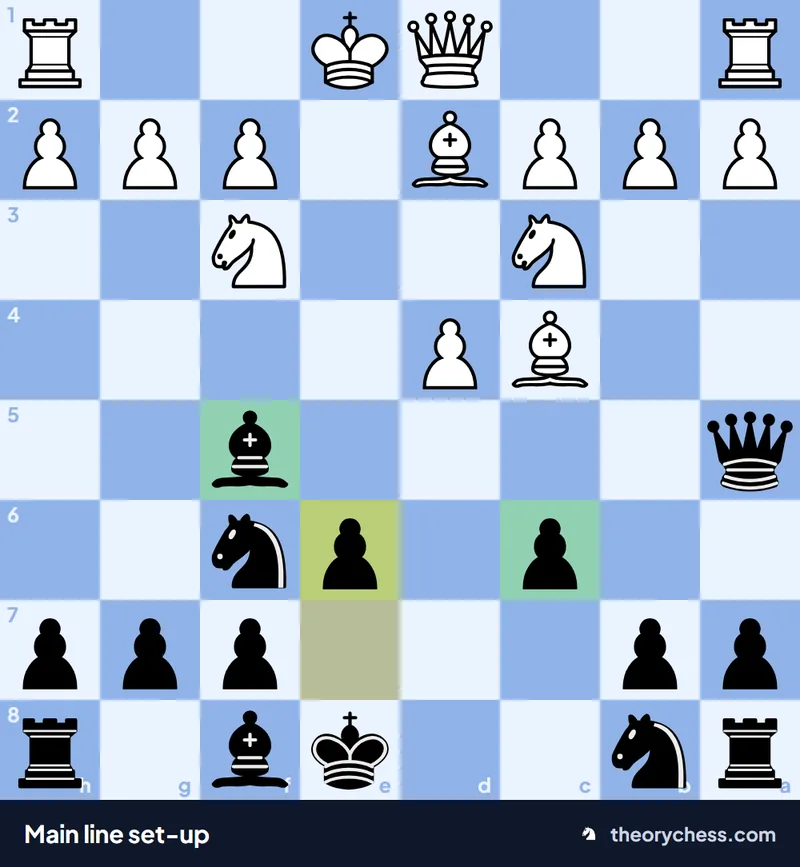
The typical main-line set-up: queen on a5, pawns on c6 and e6, bishop outside the chain on f5.
The logic is very close to the Caro-Kann:
- …c6 controls d5 and gives the queen a retreat to c7.
- …Bf5 (or …Bg4) gets the c8-bishop outside the pawn chain before …e6.
- …e6 completes the structure, followed by …Nbd7, …Be7 or …Bb4, and castling short.
White's typical plans are to keep the space advantage of the d4-pawn, use Bd2 and knight jumps such as Nd5 to harass the queen, and in the long run plant knights on e5 or d5. For Black, the key is never to let the queen get caught by a knight fork or by tempo-gaining jumps like Nd5 and Nb5.
The alternative: 3…Qd6
Very popular in recent years, 3…Qd6 keeps the queen close to the centre with options of …Qd8 or …Qb6 later. A typical sequence: 4.d4 Nf6 5.Nf3 a6.
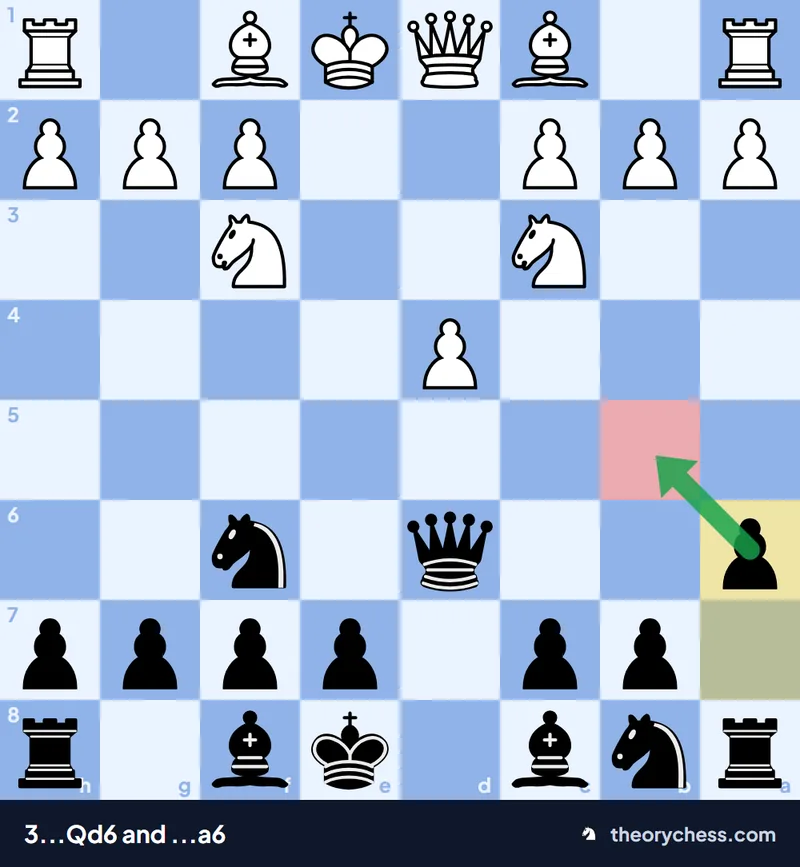
In the 3…Qd6 line, …a6 stops the knight jumping to b5 with tempo on the queen.
The little move …a6 is the key to this line. With the queen on d6, White's Nb5 and Bf4 come with tempo. For example, if Black plays an early 5…Bf5?! instead of …a6, then 6.Nb5! Qd8 sends the queen home again. After …a6 Black can choose …Bg4, …Nc6 and even castling long for an active game.
3…Qd8: the safest retreat
3…Qd8 looks the most passive but is the safest: the queen goes home, Black accepts the lost time, and the queen cannot be attacked again. A typical line is 4.d4 Nf6 5.Nf3 c6 6.Bc4 Bf5, leading to a solid if slightly cramped position reminiscent of the classical Caro-Kann.
The Modern Scandinavian: 2…Nf6
If you do not want to recapture with the queen, there is 2…Nf6. Black plans to regain the pawn with the knight: in lines such as 3.d4 Nxd5 4.Nf3 g6 5.c4 Nb6 Black fianchettoes and gets a Grünfeld-style position. White has a broad centre, but Black attacks it with …c5 and …Bg7.
If White tries to keep the pawn with 3.c4, Black has two interesting answers: 3…c6, asking for the pawn back, or the sharper 3…e6!? (the Icelandic Gambit), 4.dxe6 Bxe6, with fast development for the pawn.
Common mistakes and a small trap
Most Scandinavian mistakes involve the queen and the c8-bishop:
- Putting the queen where it loses more time: moves like 3…Qe5+ only invite 4.Be2 and another queen move.
- Locking in the c8-bishop: playing …e6 before …Bf5 or …Bg4 buries the bishop behind its pawns.
- Forgetting the bishop's escape squares: once the bishop is on f5, White can chase it with g4, Ne5 and h4.
A concrete example of the last point: 4.d4 Nf6 5.Nf3 Bf5 6.Ne5 c6 7.g4 Be4 8.f3 Bg6 9.h4! The threat is 10.h5: with e4, f5 and h5 all covered, a bishop left on g6 is simply lost.
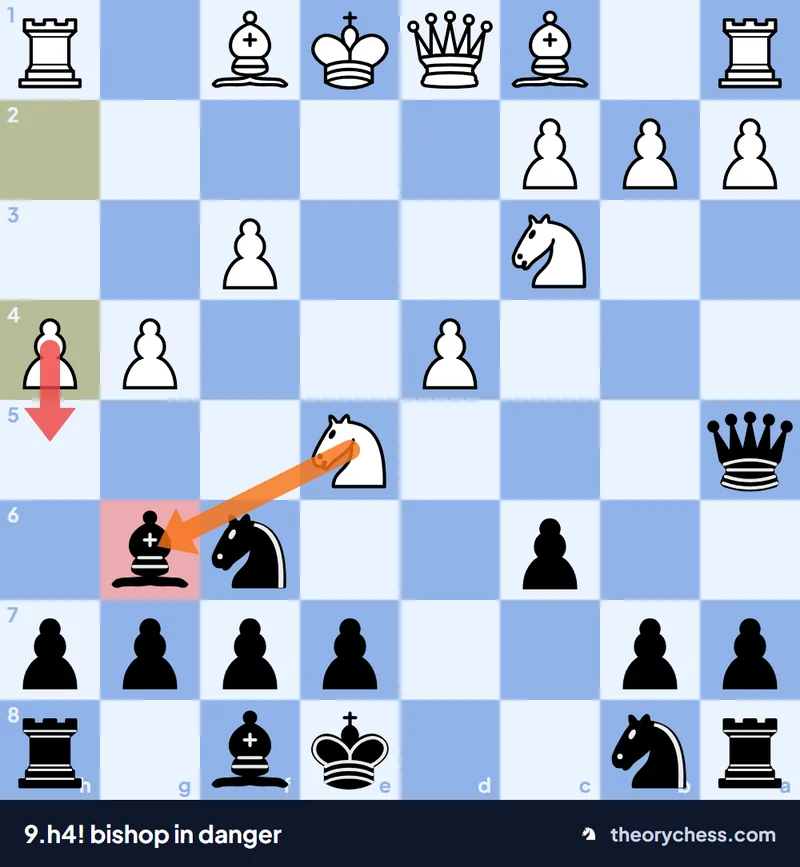
After 9.h4! the threat of h5 traps the g6-bishop; Black must react at once with …Nbd7.
The right answer is 9…Nbd7!, preparing to exchange the e5-knight: after 10.h5 Nxe5 11.hxg6 Nxg6 material stays level. If Black ignores the threat with 9…e6? 10.h5, the bishop cannot be saved. Cutting off a piece's escape squares is one of the recurring themes in our guide to opening traps every club player should know.
Does it fit your repertoire?
The Scandinavian suits players who want a solid answer to 1.e4 with little theory: you decide the type of position on move one, and most of White's main-line preparation becomes irrelevant. In return you get positions that are more structural than dynamic. For general principles on building a repertoire, read how to build an opening repertoire, and to learn efficiently, see how to learn opening theory without memorising it.
Frequently asked questions
Is the Scandinavian Defence good for beginners?
Yes. The theory is light, the ideas are clear, and it drags 1.e4 players onto your territory from move one. You only need to understand the risks of bringing the queen out early.
Should I play 3…Qa5 or 3…Qd6?
3…Qa5 is the classical, most studied line and gives a Caro-Kann-style solid set-up. 3…Qd6 is more flexible and allows active plans such as castling long, but you need to know details like …a6. For a start, 3…Qa5 is the recommendation.
What if White does not play 3.Nc3?
After moves like 3.Nf3 or 3.d4 the queen can stay on d5 for longer. The general rule stays the same: develop the c8-bishop first, then complete the structure with …e6 and …c6.
Is the Modern Scandinavian (2…Nf6) better?
Not better, just different. The queen stays at home, but White gets more space in the centre. If you like sharp, dynamic positions it is worth a try.
Practise it on TheoryChess
You can play the Scandinavian main lines against Stockfish in TheoryChess's trainer, with an explanation for every theoretical move, then test yourself with the 10-question quiz. The full list of variations is on the Scandinavian Defence page; for other defences, browse the opening catalogue.
Keep reading
· 5 min read
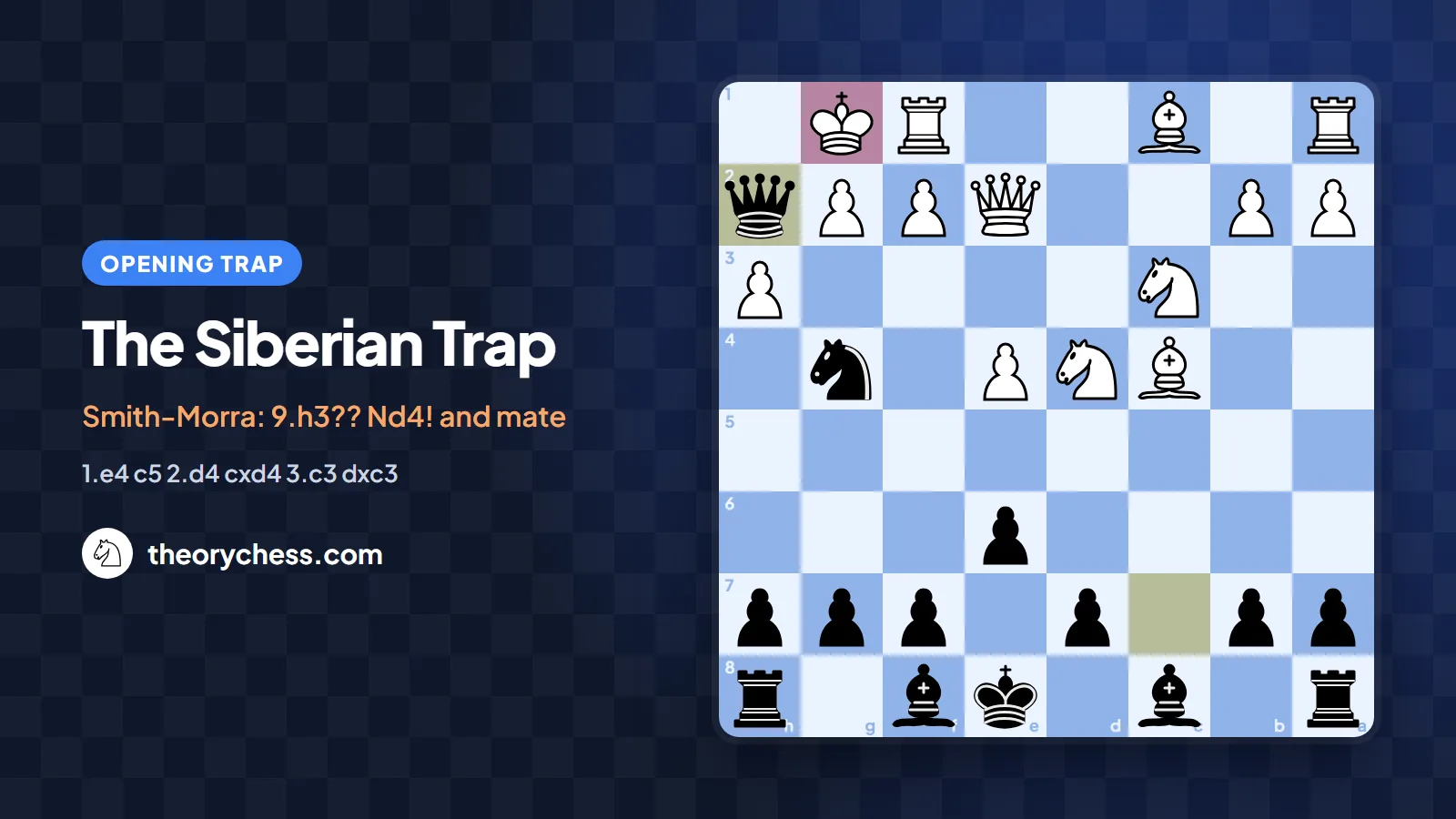
The Siberian Trap: checkmate on h2 in the Smith-Morra GambitThe Siberian Trap in the Smith-Morra: 8…Ng4! 9.h3?? Nd4! and 10…Qh2#. Move by move, why it works and how White avoids it.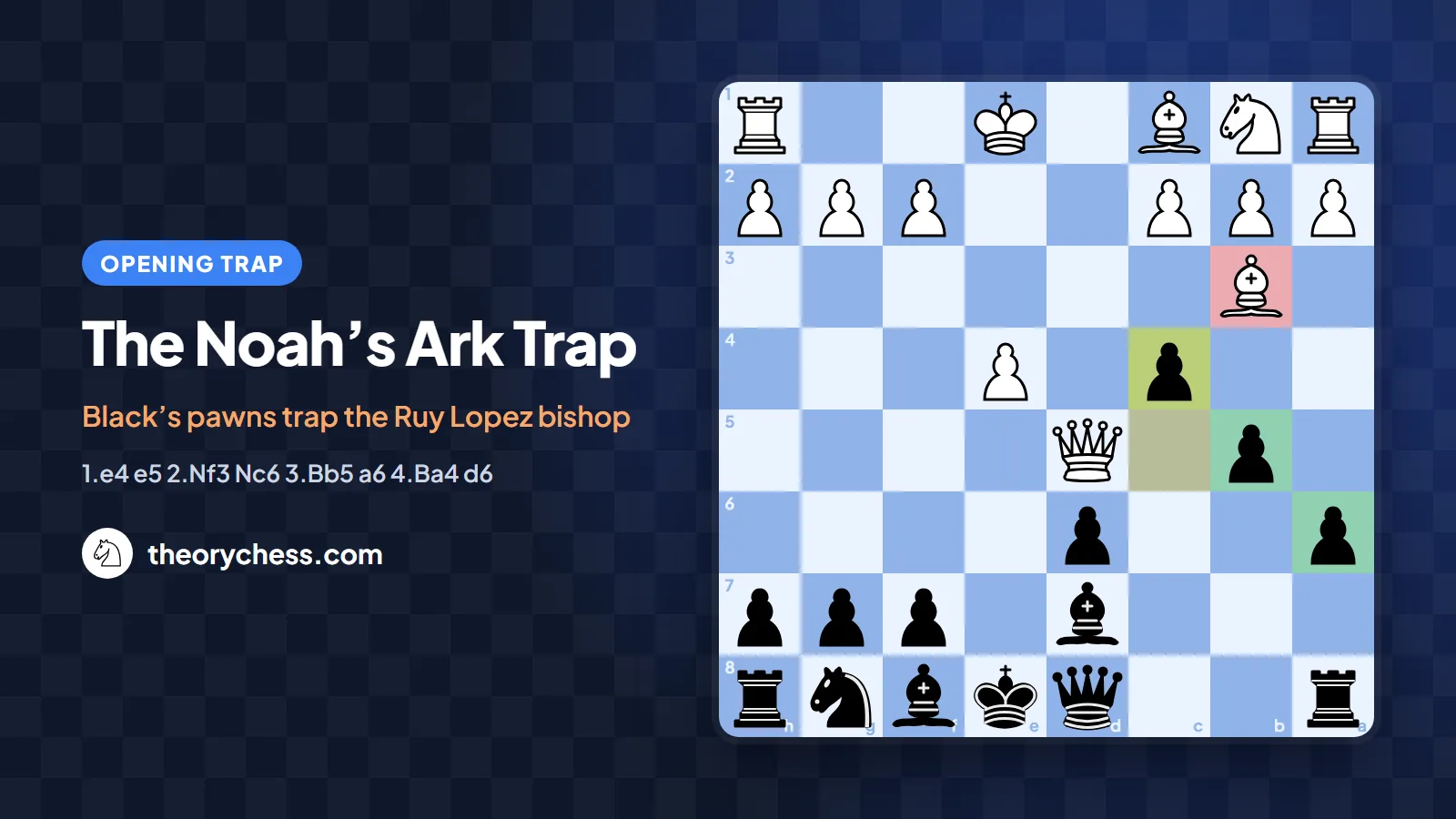
· 6 min read
The Noah’s Ark Trap: how Black traps the bishop in the Ruy LopezThe Noah’s Ark Trap in the Ruy Lopez, move by move: after 8.Qxd4?? c5! and …c4, White’s b3-bishop is trapped by Black’s pawns. How to set it and avoid it.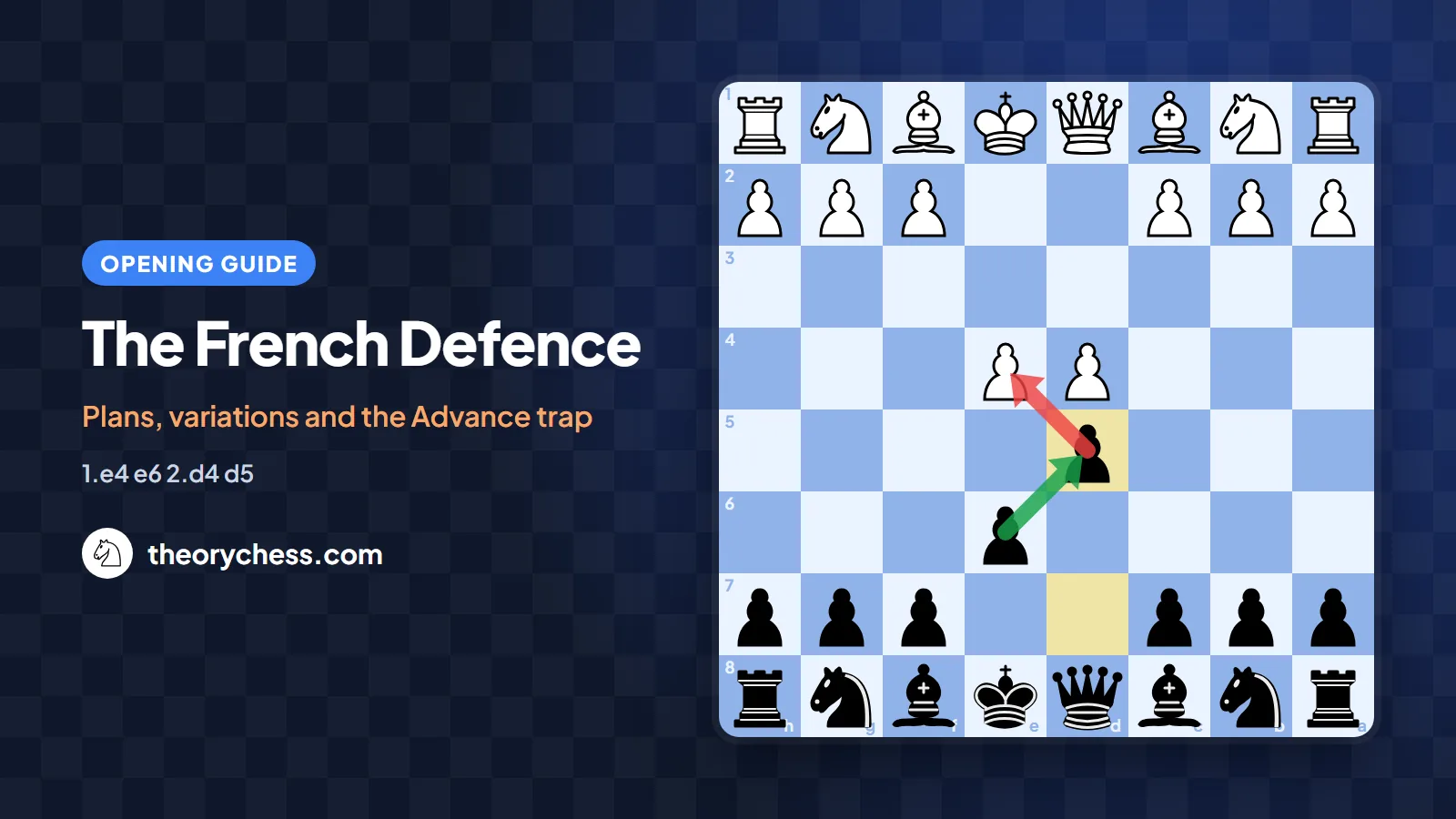
· 7 min read
The French Defence: a complete guide to plans and variationsThe idea behind 1.e4 e6, the Advance, Tarrasch, Winawer and Exchange lines, how to fix the bad bishop, and the 9.Bb5+ trap in the Advance.