
The French Defence: a complete guide to plans and variations
The idea behind 1.e4 e6, the Advance, Tarrasch, Winawer and Exchange lines, how to fix the bad bishop, and the 9.Bb5+ trap in the Advance.
7 min readBy Hasan Süzen
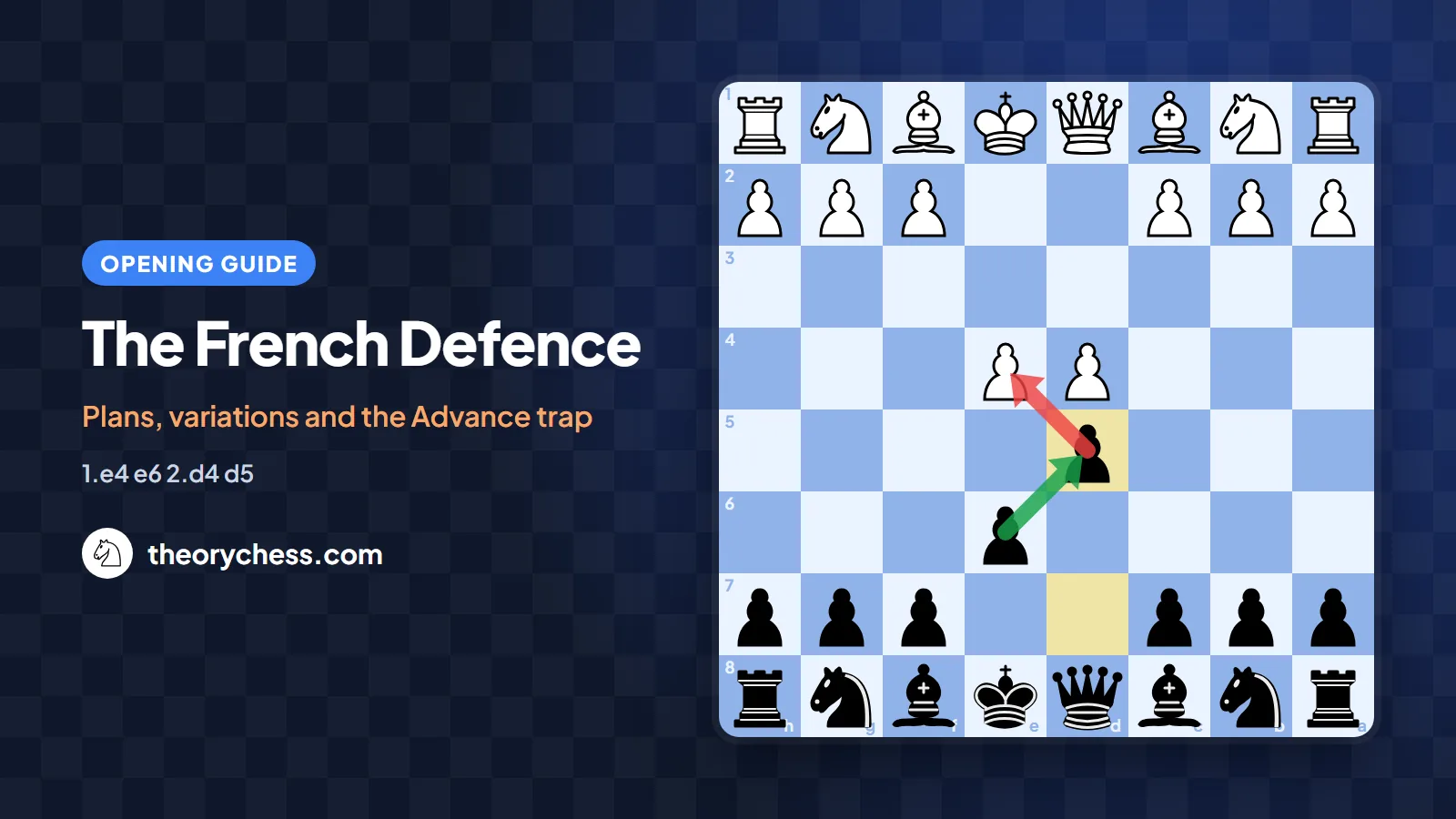
The French Defence starts with 1.e4 e6 and follows up with 2.d4 d5, challenging White’s centre straight away from a solid base. Black gives White some space in return for a clear pawn structure and long-term plans. This guide covers the core idea of the French Defence, the Advance, Tarrasch, Winawer, Classical and Exchange variations, the famous “bad bishop” problem, and a trap in the Advance Variation that catches club players all the time.
The idea behind the French Defence
After 1.e4 e6 2.d4 d5 the e4 pawn is under attack. Black questions White’s two central pawns at once, but does it with d5 supported by e6, so there are no early tactics against f7 of the kind you meet in the open games. The price is just as clear: the bishop on c8 is stuck behind the e6 and d5 pawns. Playing the French means learning to bring that bishop into the game over time and to undermine White’s centre with pawn breaks.
It helps to compare it with the Caro-Kann Defence, which uses the same “support first, then …d5” idea with 1…c6. In the Caro-Kann the light-squared bishop can get out before …e6; in the French, Black accepts more cramped but more dynamic positions. If you are choosing between them, the criteria in our guide to building an opening repertoire will help.
The Advance Variation: 3.e5
In the Advance Variation White plays 3.e5, locks the centre and gains space. Two pawn chains appear: d4-e5 for White and e6-d5 for Black. The rule for pawn chains is to attack them at the base, and the base of White’s chain is d4. That is why Black’s two main breaks are …c5, hitting d4, and later …f6, hitting e5.
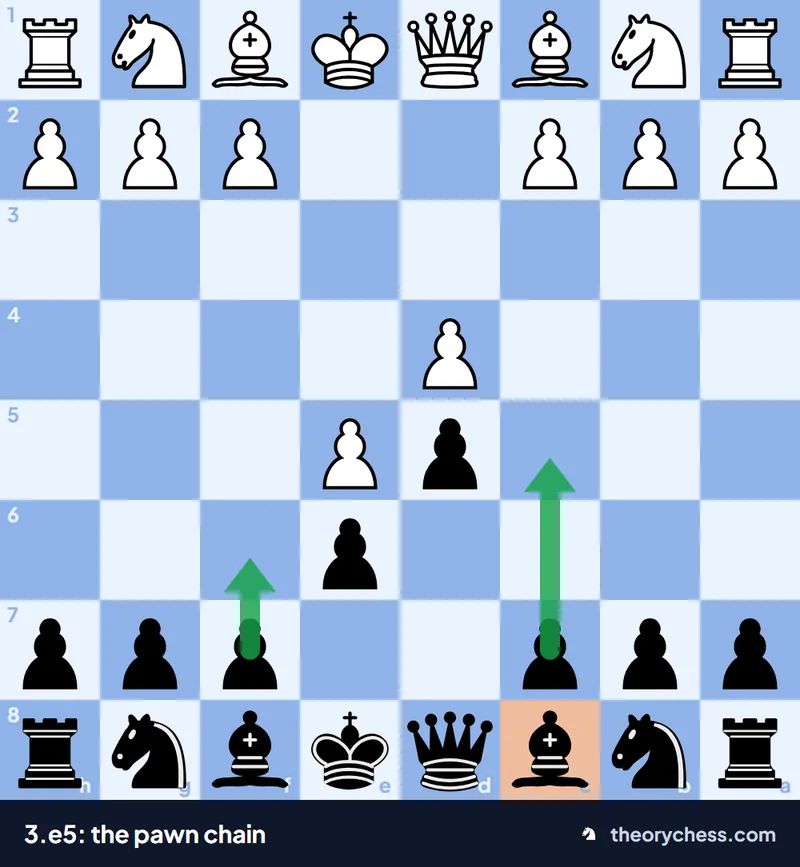
The pawn chains after 3.e5: Black aims to break them with …c5 and …f6, while the c8 bishop sits behind its own pawns.
The main line runs 3…c5 4.c3 Nc6 5.Nf3 Qb6. The c5 pawn, the knight on c6 and the queen on b6 all bear down on d4. The queen also eyes b2, so White’s dark-squared bishop cannot develop freely. White’s most popular reply is 6.a3, preparing b4 to gain space on the queenside. Black can then close that wing with 6…c4 or bring the king’s knight to f5 via h6 to add more pressure on d4.
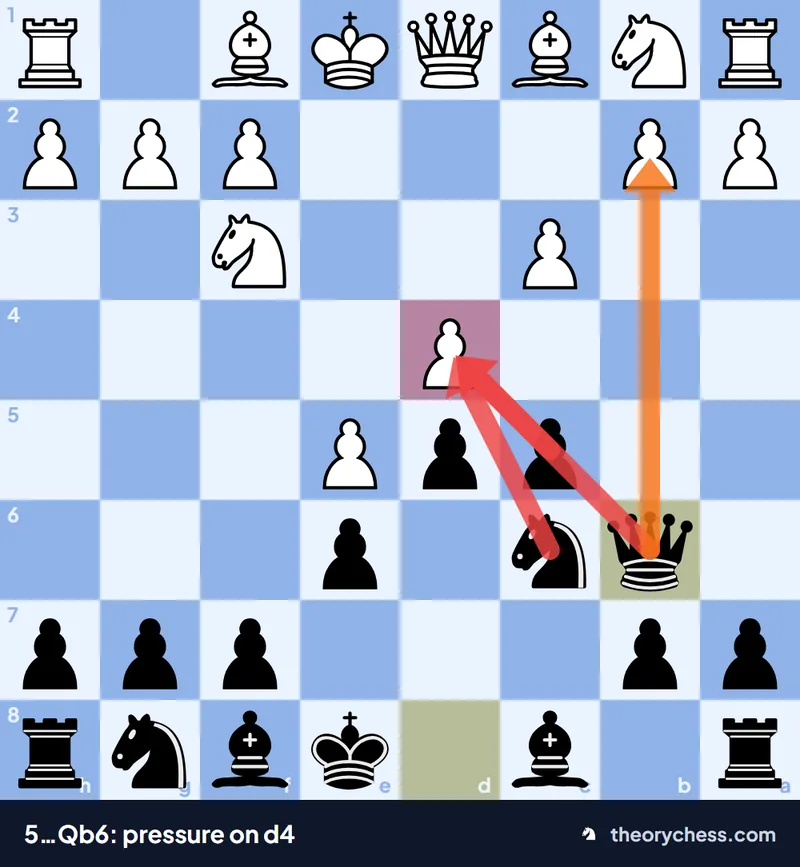
After 5…Qb6 the c5 pawn, the c6 knight and the queen all attack d4, and the queen also eyes b2.
The Advance trap every French player must know
Another common choice for White is 6.Bd3. After 6…cxd4 7.cxd4 the d4 pawn seems to be defended only by the knight on f3, and with two attackers it feels natural to grab it: 7…Nxd4?? 8.Nxd4 Qxd4?? But the bishop on d3 moves away with check: 9.Bb5+! It checks the king on e8 and at the same time opens the d-file for the queen on d1. Whatever Black does about the check, Qxd4 follows and the queen is gone.
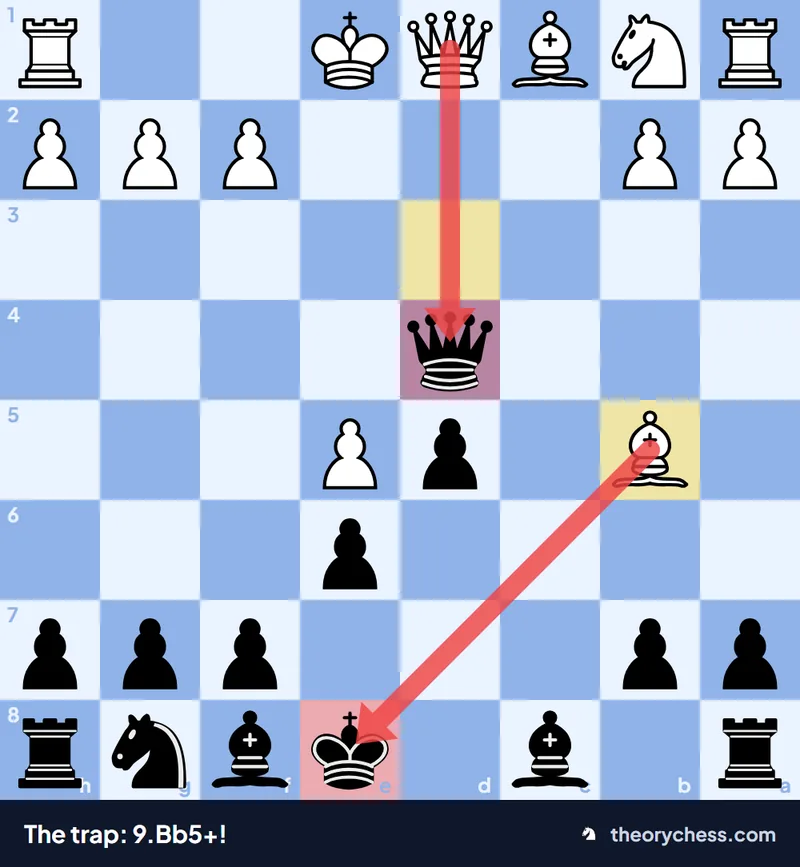
9.Bb5+! gives check and uncovers the queen on d1; Black cannot save the queen on d4.
In fact 7…Nxd4 is already a mistake: after 8.Nxd4, if you do not recapture with the queen you are simply a piece down. The correct move order is 7…Bd7 first, covering b5 while keeping the pressure on d4. White can then sacrifice the pawn on purpose with 8.O-O Nxd4 9.Nxd4 Qxd4 10.Nc3, the sharp Milner-Barry Gambit, giving a pawn for a lead in development. For more opening tricks like this, see opening traps every club player should know.
The Tarrasch Variation: 3.Nd2
In the Tarrasch Variation White puts the knight on d2 instead of c3. The point is to avoid the …Bb4 pin of the Winawer and keep the option of supporting d4 with c3; the drawback is that the knight blocks the c1 bishop for a while. Black has two main answers:
- 3…c5 opens the centre at once. After 4.exd5 Black often ends up with an isolated pawn on d5, accepting a structural weakness in return for active pieces.
- 3…Nf6 invites 4.e5. After 4.e5 Nfd7 5.Bd3 c5 6.c3 Nc6 7.Ne2 a chain similar to the Advance appears, but with White’s knights on d2 and e2. Black again attacks the centre with …Qb6 and …f6.
3.Nc3: Winawer, Classical and Rubinstein
White’s most ambitious move is 3.Nc3. Black has three distinct ways to meet it, each with its own character.
The Winawer: 3…Bb4
Black pins the c3 knight. In the main line 3…Bb4 4.e5 c5 5.a3 Bxc3+ 6.bxc3 Ne7 Black gives up the bishop pair but damages White’s pawn structure. The positions are very sharp: White attacks g7 with Qg4 on the kingside, while Black targets the weak pawns on c3 and a3. This is the most dynamic branch of the French.
The Classical: 3…Nf6
Black attacks e4 a second time. After 4.Bg5 Be7 5.e5 Nfd7 6.Bxe7 Qxe7 7.f4 White reinforces e5 and gains space on the kingside, while Black breaks with …c5, …Nc6 and, when the moment is right, …f6. Black loses the good bishop in this line, but every exchange eases the cramp.
The Rubinstein: 3…dxe4
Black releases the tension with 3…dxe4 4.Nxe4 and usually develops with …Nd7 and …Ngf6. The structure is sound; Black’s play is a little passive but the risk of losing is low. Here the c8 bishop often joins the game on the long diagonal via …b6 and …Bb7.
The Exchange Variation: 3.exd5 exd5
After 3.exd5 exd5 the structure is symmetrical and the c8 bishop is freed automatically, which is why French players usually feel comfortable here. White sets up quietly with Bd3, Nf3, O-O and c3, and Black mirrors with Bd6, Nf6 and O-O. To play for a win, someone has to unbalance the game, for example by castling on opposite sides.
The bad bishop and how to fix it
The most common criticism of the French is the bad light-squared bishop. It really is stuck behind its own pawns, but there are well-known ways to solve the problem:
- …b6 and …Ba6: the bishop goes to a6, often to trade itself for White’s good light-squared bishop.
- …Bd7 and …Bb5: especially in the Advance, the bishop heads for b5 to swap with White’s bishop.
- The …f6 break: once the e5 pawn disappears, the e6 pawn can advance and free the bishop.
- Releasing with …dxe4: as in the Rubinstein, the bishop then plays on the long diagonal with …b6 and …Bb7.
Remember that even a “bad” bishop is a valuable defender. It protects e6 and d5, and it comes alive once the diagonals open.
Frequently asked questions
Is the French Defence good for beginners?
Yes, as long as you learn the plans. You do not need to memorise as much as in the Open Sicilian; what matters most is the pawn-chain logic and the timing of …c5 and …f6.
Which French variation should I learn first?
The Advance Variation (3.e5) is the one you will meet most at club level. Learn it together with your answer to 3.Nc3 and you cover most of your games.
French or Caro-Kann?
Both are solid. Choose the French if you like dynamic, unbalanced positions, and the Caro-Kann if you prefer to get your light-squared bishop out first and play calmer structures.
When can I take on d4 in the Advance?
Only after you have checked the bishop check from b5. After 6.Bd3 cxd4 7.cxd4, play 7…Bd7 first and you avoid the trap above.
Practise the French Defence on TheoryChess
Reading the plans is the first step; making them stick takes repetition on the board. In the French Defence trainer you play against Stockfish and see an explanation for every theory move, and the Advance Variation trainer drills the …Qb6 ideas. Then take the French Defence quiz and let spaced repetition bring back the lines you struggle with. To compare other replies to 1.e4, browse the opening catalogue or read our Scandinavian Defence guide.
Keep reading
· 5 min read
The Siberian Trap: checkmate on h2 in the Smith-Morra GambitThe Siberian Trap in the Smith-Morra: 8…Ng4! 9.h3?? Nd4! and 10…Qh2#. Move by move, why it works and how White avoids it.
· 5 min read
The Scandinavian Defence: a practical guide to 1.e4 d5The Scandinavian Defence strikes at the centre with 1…d5. Main line 3…Qa5, the alternatives, typical plans and common mistakes.
· 6 min read
The Noah’s Ark Trap: how Black traps the bishop in the Ruy LopezThe Noah’s Ark Trap in the Ruy Lopez, move by move: after 8.Qxd4?? c5! and …c4, White’s b3-bishop is trapped by Black’s pawns. How to set it and avoid it.