
Légal’s mate: give up the queen and mate in 7 with three minor pieces
Légal’s mate is one of the oldest opening traps in chess: White ignores the pin and leaves the queen hanging, and if Black takes it, 6.Bxf7+ Ke7 7.Nd5# is mate. The trap, why it works and the right defence.
5 min readBy Hasan Süzen
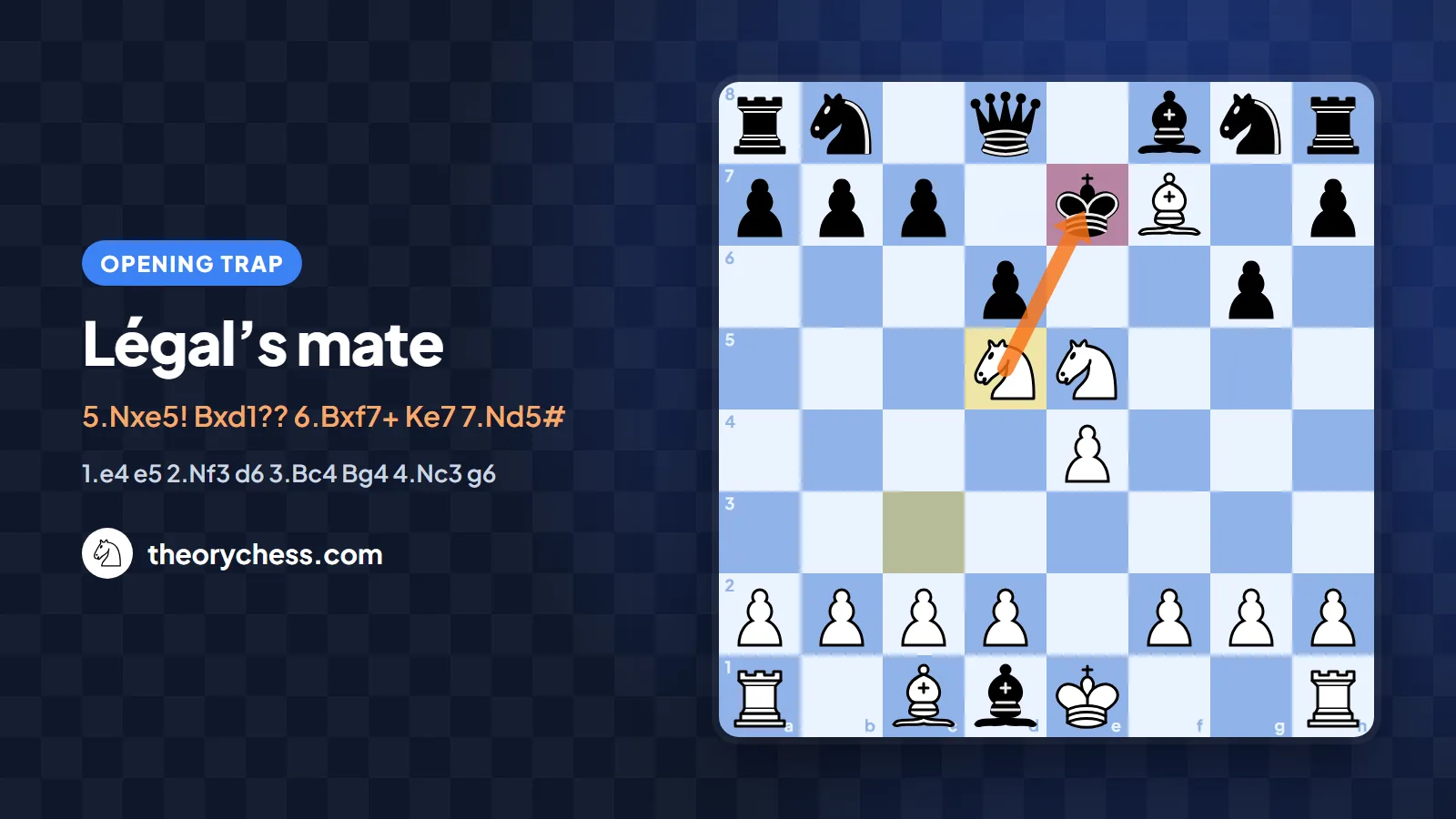
Légal’s mate is one of the oldest known opening traps in chess, and it still wins games at every level. White moves a pinned knight and deliberately leaves the queen hanging. If Black grabs the “gift”, three minor pieces (two knights and a bishop) mate the king on move seven. In this article we go through the trap move by move, explain why the pin is fake and show how to avoid it as Black.
Where does Légal’s mate come from?
The trap is named after Sire de Légal, one of the strongest French players of the 18th century and the leading master of the famous Café de la Régence in Paris. According to the story, Légal played this mate in a game around 1750. Almost three centuries later, the idea works exactly the same way: always ask whether a pinned piece is really stuck.
The trap usually comes from the Philidor Defense (1.e4 e5 2.Nf3 d6). Black sets up a solid but slightly passive structure, while White develops quickly and aims at f7.
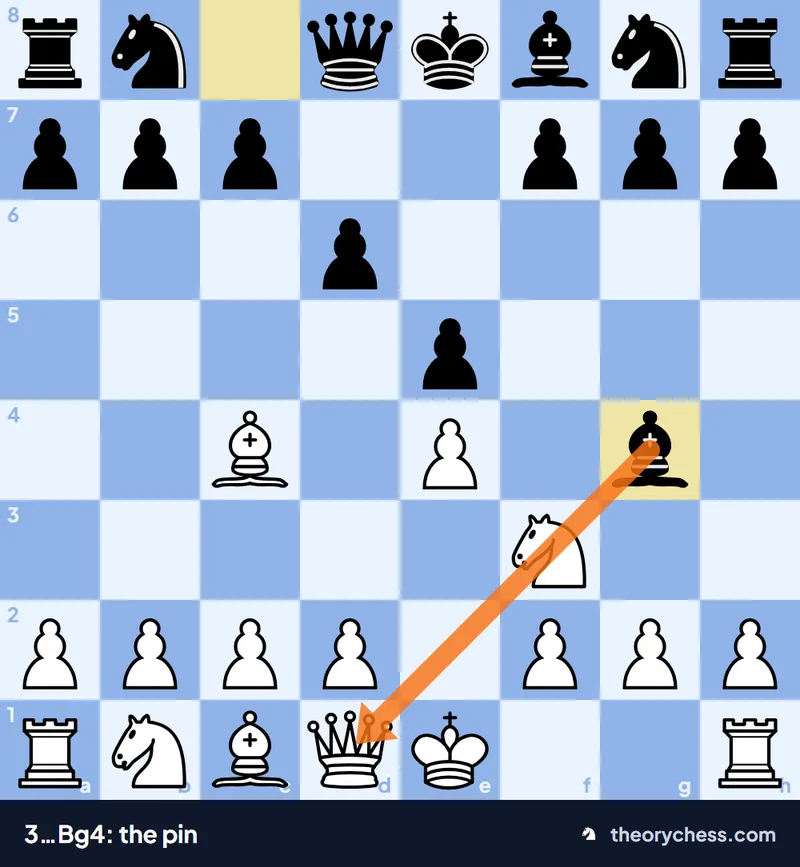
3…Bg4: Black pins the f3-knight to the queen on d1.
The trap move by move
3.Bc4 Bg4: the pin
With 3.Bc4 White puts the bishop on the diagonal aimed at f7. Black answers 3…Bg4, pinning the f3-knight in front of the queen. It looks as if the knight can no longer move: if it does, the queen is left to the bishop on g4.
4.Nc3 g6?: a harmless-looking move
White develops with 4.Nc3. Black plays 4…g6? to fianchetto the bishop. It doesn’t look dangerous, but it adds no defender to e5 and leaves the d5-square weak. Stockfish already rates White clearly better here.
5.Nxe5!: the fake pin
Here is the trap: 5.Nxe5! The knight ignores the pin and takes on e5. Now both the knight on e5 and the bishop on c4 are aimed at f7. The queen on d1 is undefended, and Black can take it.
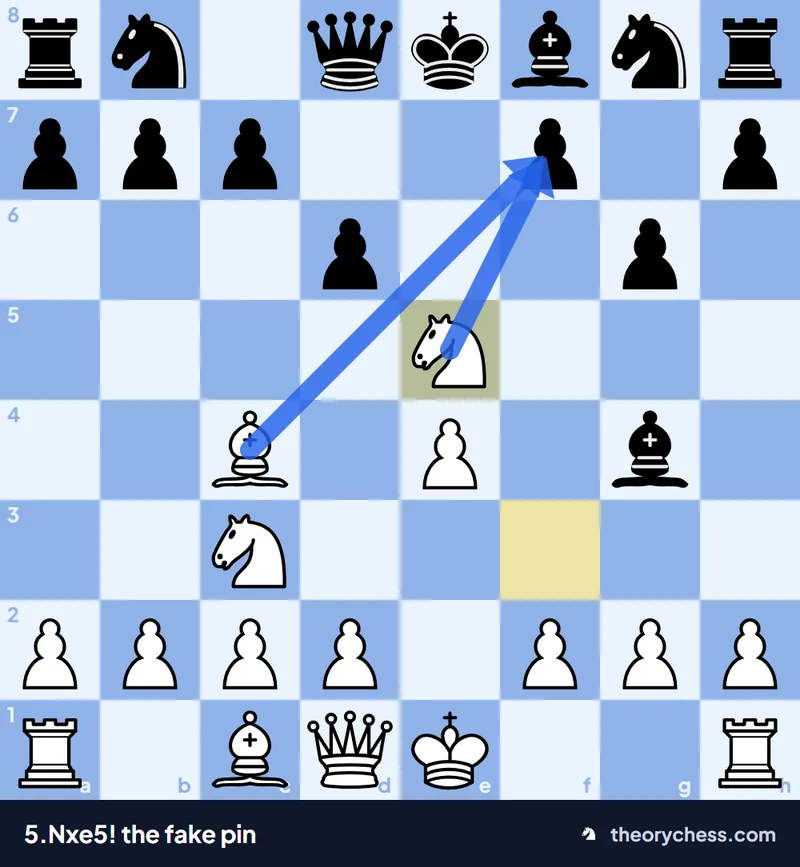
5.Nxe5!: the queen is hanging, but knight and bishop are both aimed at f7.
5…Bxd1?? 6.Bxf7+ Ke7 7.Nd5#
Black takes the queen: 5…Bxd1??. That is the losing move. 6.Bxf7+ gives check, Black’s only move is 6…Ke7, and then comes 7.Nd5#.
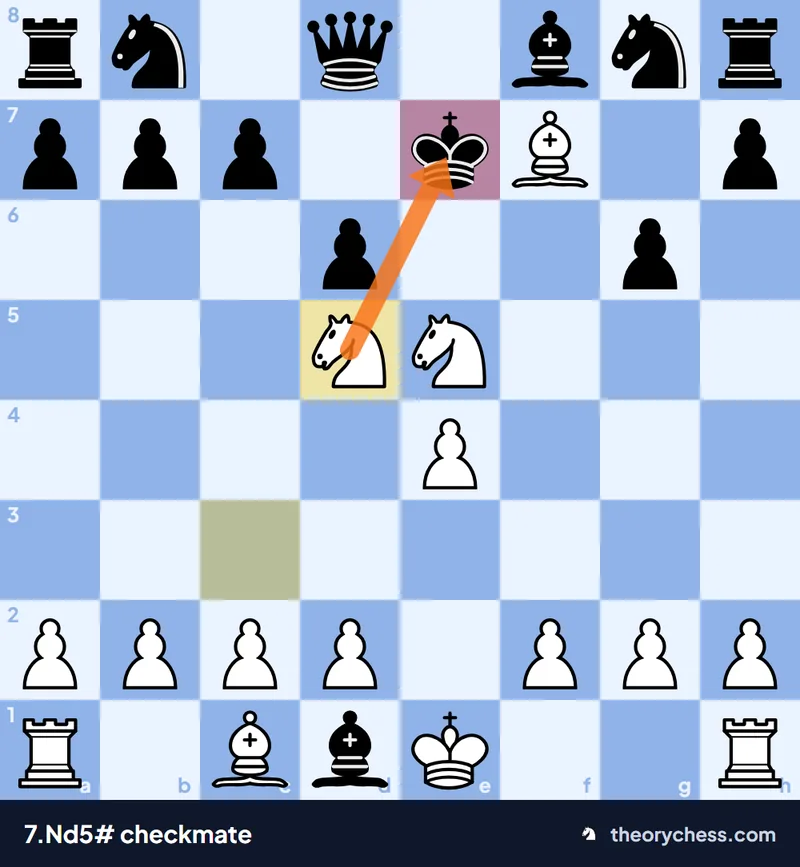
7.Nd5#: two knights and a bishop build a mating net without the queen.
The whole sequence: 1.e4 e5 2.Nf3 d6 3.Bc4 Bg4 4.Nc3 g6 5.Nxe5 Bxd1 6.Bxf7+ Ke7 7.Nd5#.
Why is it mate?
- The knight on d5 checks the king on e7. A knight check can’t be blocked.
- The bishop on f7 takes away escape squares. It covers e8 and e6.
- The knight on e5 covers the rest. It controls d7 and f7, and Black’s own pieces and the knights take care of d8, f8, d6 and f6.
The beauty of this mate is that White finishes without the strongest piece on the board. The queen is gone, but three minor pieces working together are enough.
What should Black play?
After 5.Nxe5 the best move is to leave the queen alone and take the knight with 5…dxe5. White wins the bishop back with 6.Qxg4 and is a pawn up. That’s unpleasant for Black, but far better than getting mated.
The real mistake is 4…g6?. Developing moves like 4…Nc6 or 4…Nf6 give a normal game. After 4…Nc6 in particular the same idea fails: if 5.Nxe5?, then 5…Nxe5! takes the knight, keeps the pin alive and wins a piece. In other words, the trap only works when e5 is not defended well enough.
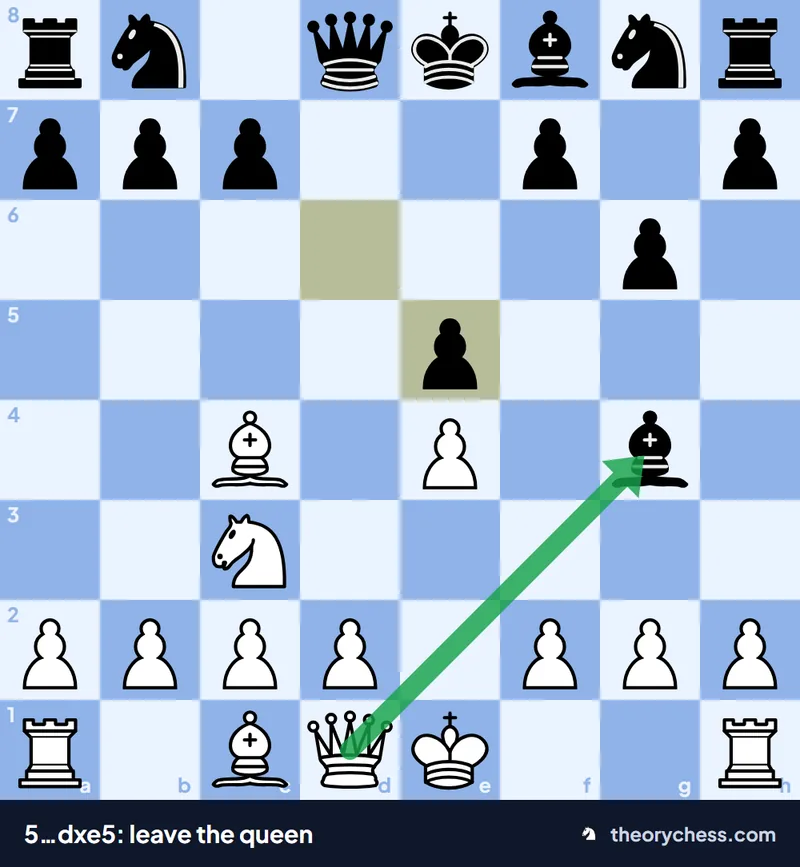
5…dxe5: not taking the queen saves Black from mate.
Key moments at a glance
| Move | What happens | Lesson |
|---|---|---|
| 3…Bg4 | Black pins the knight to the queen. | A pin is not a permanent advantage. |
| 4…g6? | e5 stays weak and development lags. | Develop your pieces first in the opening. |
| 5.Nxe5! | The knight breaks the pin and offers the queen. | A pinned piece can sometimes move. |
| 5…Bxd1?? | Black takes the queen. | A free queen isn’t always free. |
| 6.Bxf7+ Ke7 7.Nd5# | Mate with three minor pieces. | Pieces working together beat a lone queen. |
| 5…dxe5 | Black only loses a pawn. | Count your opponent’s threats first. |
What this trap teaches
The lesson of Légal’s mate is simple: if your opponent “gives” you the queen, ask why. Taking a free queen is usually right, but checking your opponent’s checks and threats first takes a few seconds. Be extra careful whenever a bishop and a knight are both aimed at f7. For another classic aimed at f7, see the Blackburne Shilling trap, and for this week’s other trap, read the Dutch Defense trap.
Frequently asked questions
How many moves does Légal’s mate take?
White mates on move seven with 7.Nd5#. Black’s fatal mistake is 5…Bxd1??.
Does Légal’s mate only happen in the Philidor?
The best-known version is in the Philidor Defense, but the same idea (moving the pinned knight, leaving the queen, then Bxf7+ and a knight mate) can appear in other openings with Bc4, Nc3 and …Bg4.
What if Black doesn’t take the queen?
After 5…dxe5 6.Qxg4 White is a pawn up with the better position. Black’s loss is small and the game goes on.
How can I set this trap in my own games?
Play 1.e4 e5 2.Nf3 d6 3.Bc4 as White. If Black pins your knight with …Bg4 and doesn’t defend e5 well enough, look at Nxe5. But be careful: with a black knight on c6, Nxe5 just loses a piece.
Practise it on TheoryChess
Reading a trap and spotting it over the board are two different things. On TheoryChess you can play every line of the Philidor Defense trainer against Stockfish, with an explanation for every theory move, then test yourself with the Philidor quiz. To learn more about the Bc4 openings, read our practical guide to the Italian Game. Every opening is waiting in the opening catalogue.
Keep reading
· 5 min read
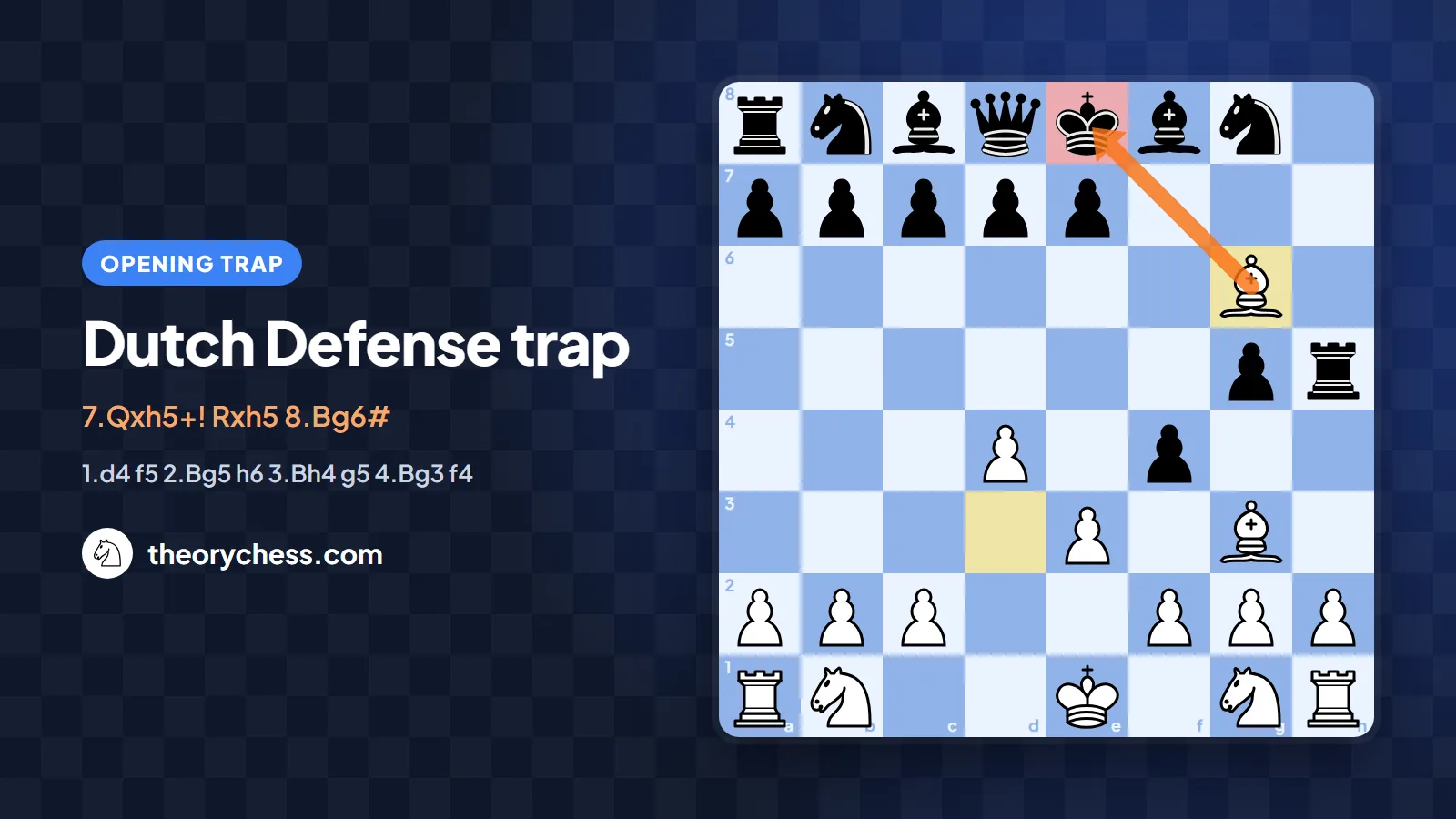
The Dutch Defense trap: a queen sacrifice and Bg6# in 8 movesIn the Dutch Defense, chasing White’s bishop after 2.Bg5 ends in a queen sacrifice and mate in eight: 6…Rh6?? 7.Qxh5+! Rxh5 8.Bg6#. The trap, why it works and the right defence.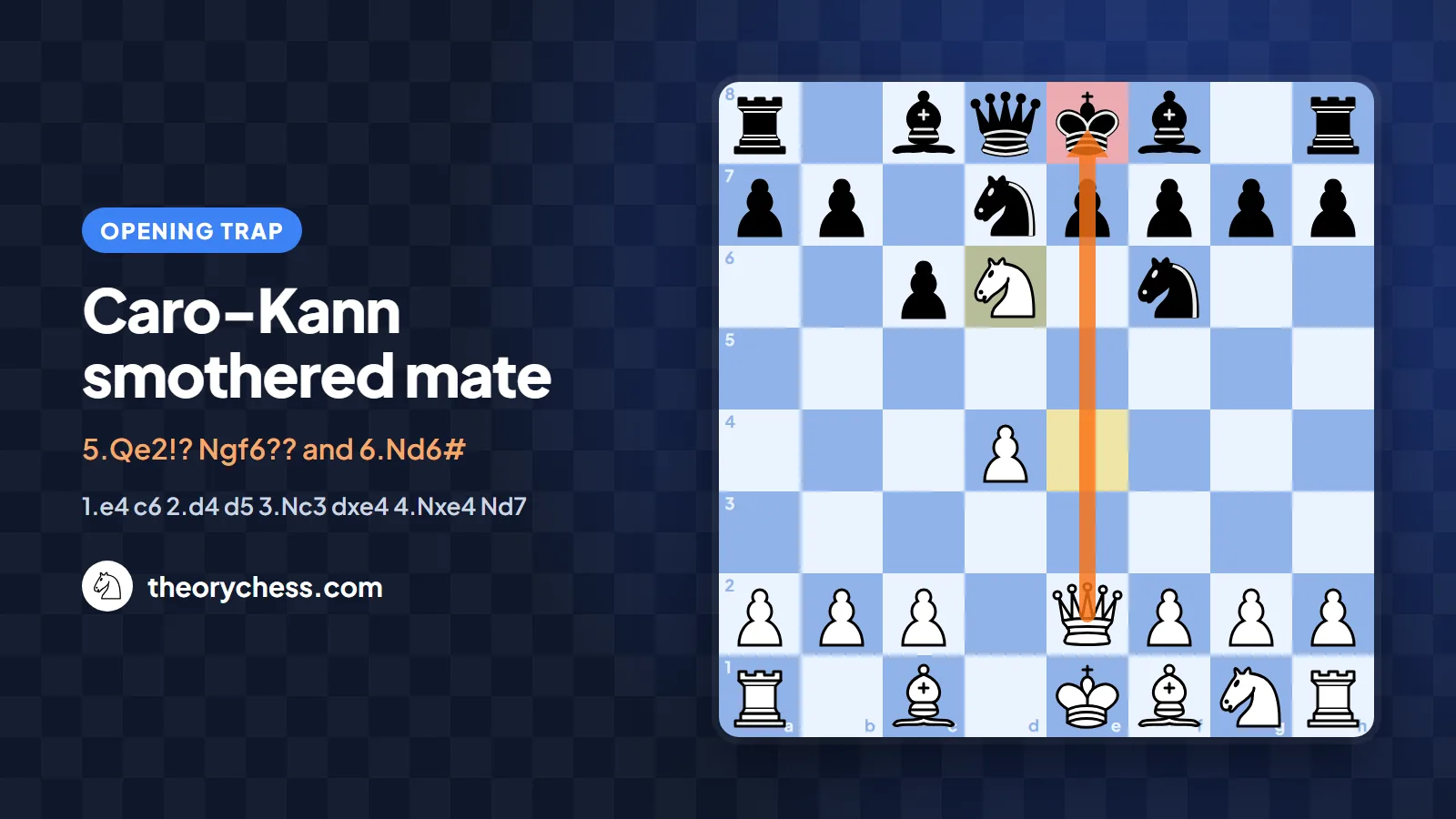
· 6 min read
The Caro-Kann smothered mate trap: Nd6# in 6 movesIn the Karpov Variation of the Caro-Kann, the natural-looking 5…Ngf6?? after 5.Qe2!? loses to 6.Nd6#, a smothered mate. The trap, why it works and the right defence.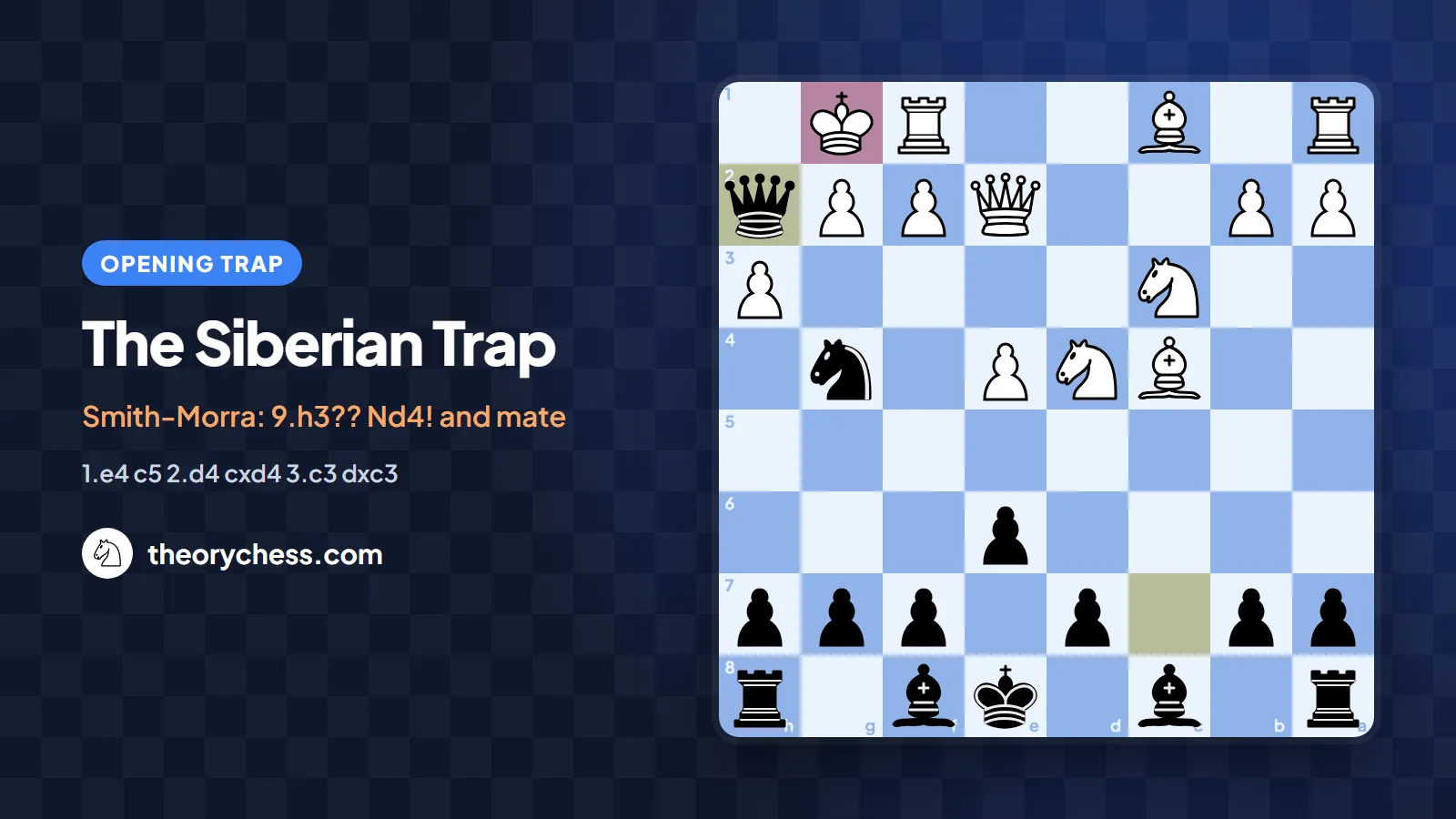
· 5 min read
The Siberian Trap: checkmate on h2 in the Smith-Morra GambitThe Siberian Trap in the Smith-Morra: 8…Ng4! 9.h3?? Nd4! and 10…Qh2#. Move by move, why it works and how White avoids it.