
The Caro-Kann smothered mate trap: Nd6# in 6 moves
In the Karpov Variation of the Caro-Kann, the natural-looking 5…Ngf6?? after 5.Qe2!? loses to 6.Nd6#, a smothered mate. The trap, why it works and the right defence.
6 min readBy Hasan Süzen
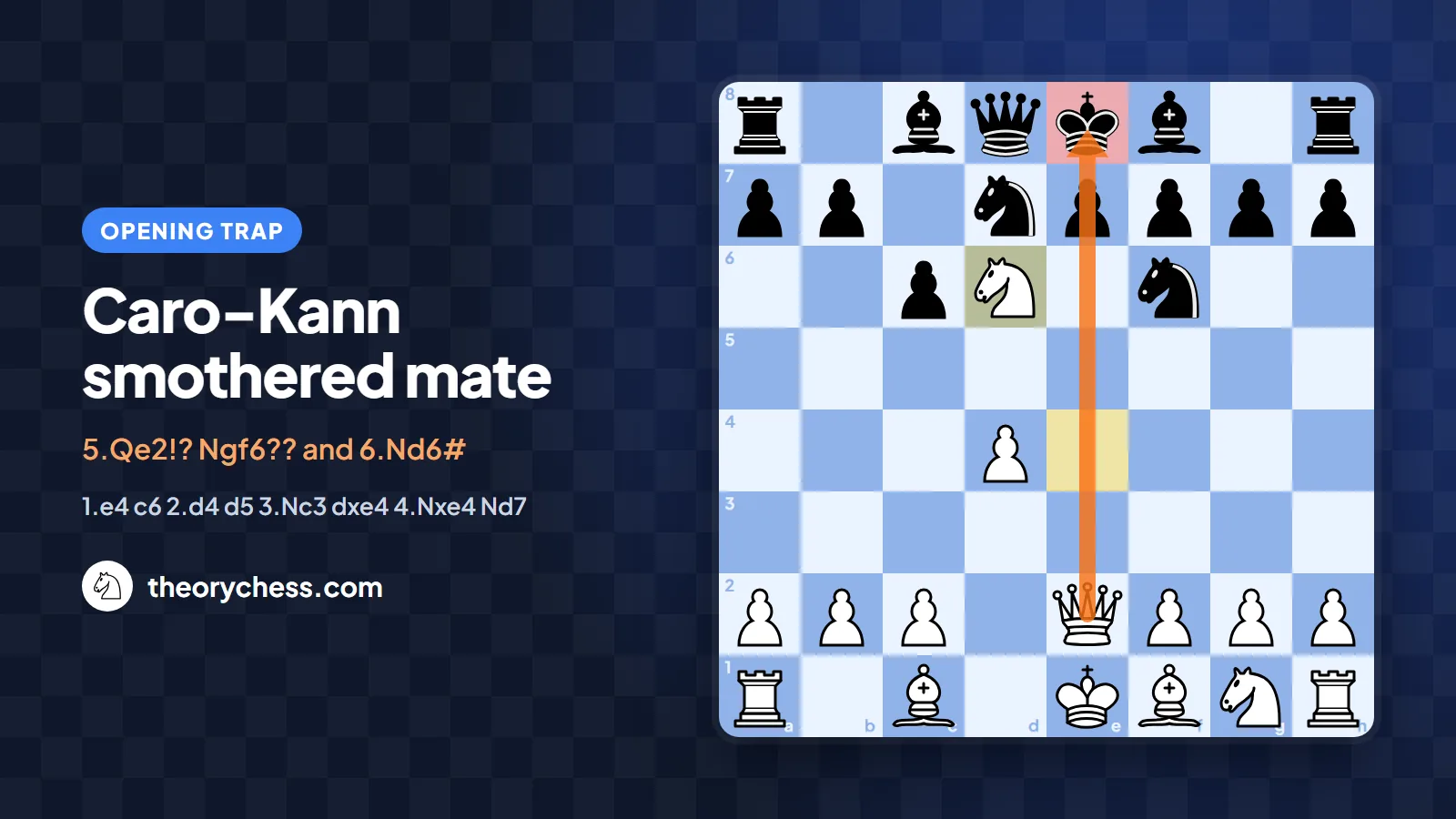
The Caro-Kann smothered mate trap is one of the shortest and prettiest opening mates in chess: White ends the game in six moves with a single knight jump. Black’s mistake looks so natural that even experienced players can walk into it in a fast game. In this article we go through the trap move by move, explain why the mate can’t be stopped and show how to avoid it as Black.
The Caro-Kann and the Karpov Variation
The Caro-Kann Defence starts with 1.e4 c6 and is known for being solid. Black prepares …d5 with c6, then challenges White in the centre. One of the main lines goes 2.d4 d5 3.Nc3 dxe4 4.Nxe4. Here one of Black’s most popular choices is 4…Nd7, named after former world champion Anatoly Karpov.
The idea behind 4…Nd7 is simple. Black wants a knight on f6, but after 4…Nf6 5.Nxf6+ the recapture with a pawn damages the structure. So Black first brings a knight to d7 to prepare …Ngf6: if White trades on f6, Black recaptures with a knight. It’s a logical, solid plan that is played all the time at every level.
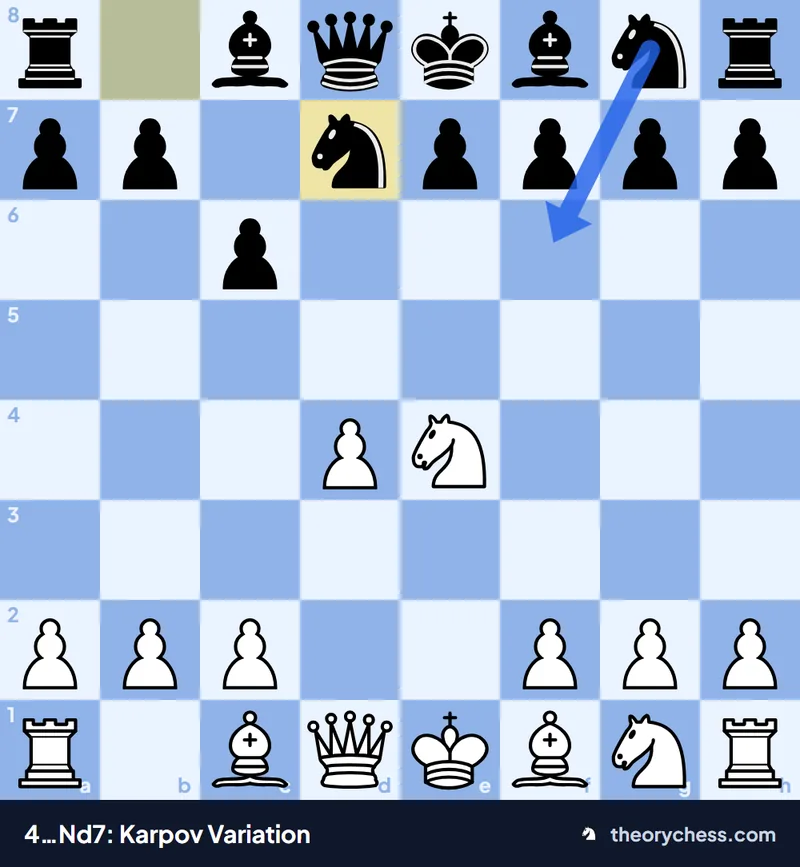
After 4…Nd7, Black gets ready to trade knights with …Ngf6.
The trap move by move
5.Qe2!?: a sneaky move
White usually plays 5.Nf3, 5.Ng5 or 5.Bc4 here. 5.Qe2!? is a lesser-known, sneaky alternative. The queen steps onto the e-file and doesn’t seem to threaten much. But once the knight on e4 moves away, the queen will look straight down the e-file at the e7-pawn and the king behind it.
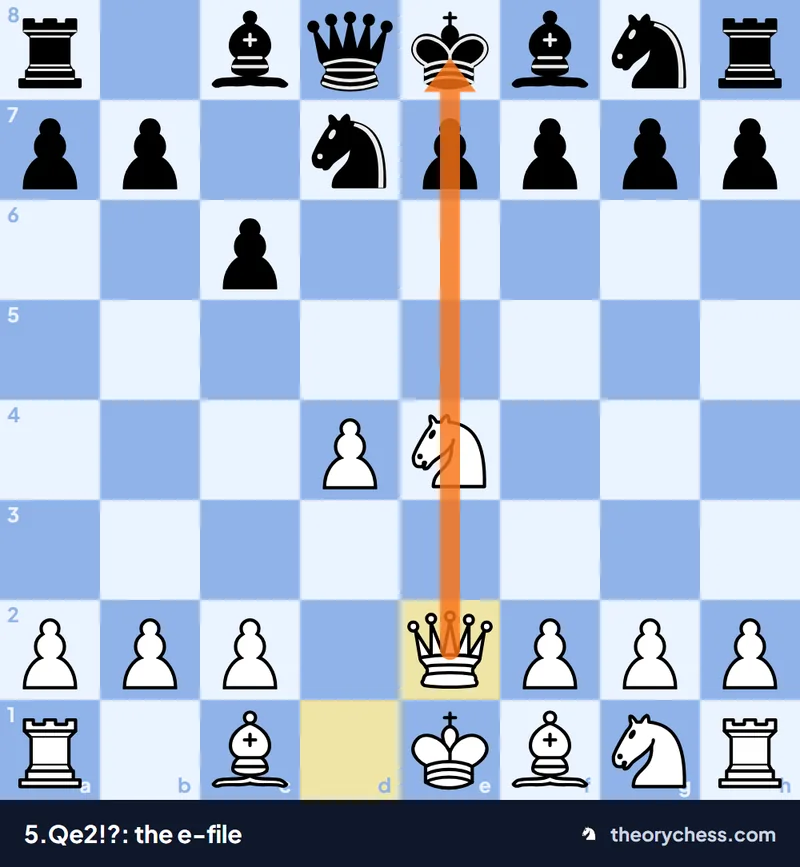
After 5.Qe2!? the e4-knight blocks the file; once it moves, the queen pins e7 to the king.
5…Ngf6?? and 6.Nd6#
Black carries on with the plan and plays 5…Ngf6??. It fits the Karpov Variation perfectly; in normal lines this is exactly what Black should do. In this position, though, it loses on the spot: 6.Nd6#.
The knight jumps to d6, gives check to the king on e8, and the game is over. Why?
- Nothing can take the knight. The e7-pawn seems to cover d6, but with the e4-knight gone the e-file is open: the pawn is pinned to the king by the queen on e2. The queen on d8 can’t reach d6 either, because its own knight sits on d7.
- The king has no squares. The queen is on d8, the bishop on f8, a knight on d7 and pawns on e7 and f7. The king is “smothered” by its own pieces, which is where the name comes from.
- Nothing can block. A knight check can’t be blocked.
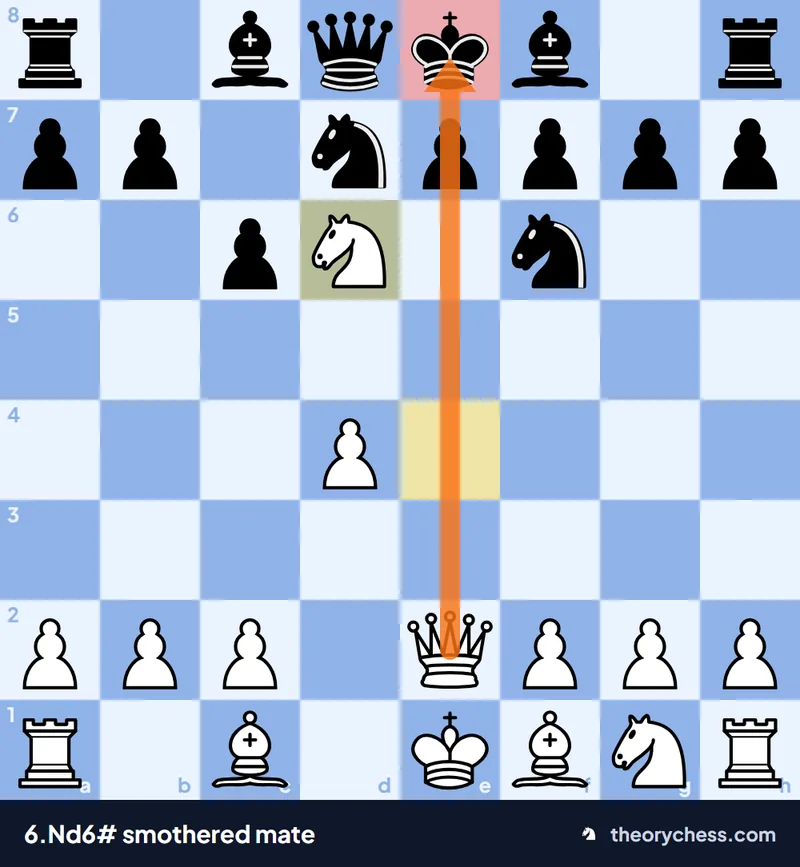
6.Nd6#: the e7-pawn is pinned and the king is boxed in by its own pieces.
The whole sequence: 1.e4 c6 2.d4 d5 3.Nc3 dxe4 4.Nxe4 Nd7 5.Qe2 Ngf6?? 6.Nd6#.
What should Black play?
After 5.Qe2!? the right reply is 5…Ndf6!. The d7-knight goes to f6 and challenges the e4-knight, while the g8-knight stays home and keeps covering e7. After this move 5.Qe2 has no sting left; the queen looks a little odd on e2 and Black develops comfortably. Stockfish even rates Black slightly better here. Objectively 5.Qe2 isn’t a good move: all of its value comes from the trap.
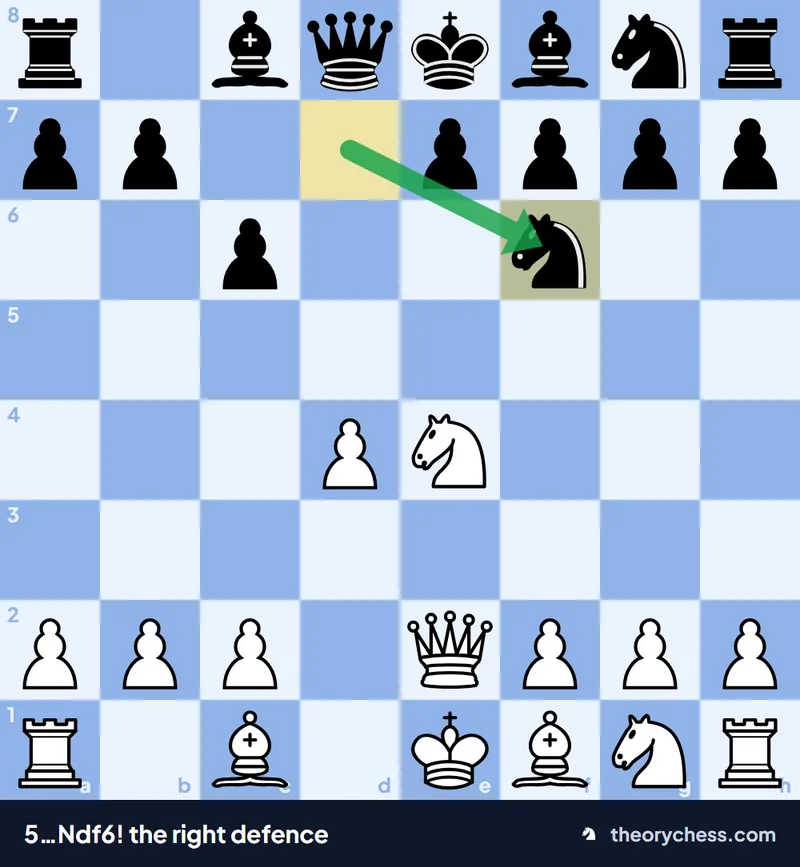
With 5…Ndf6! Black challenges the e4-knight and the trap is gone.
Another danger in the Karpov Variation: 5.Ng5
The weak spot of 4…Nd7 is always the same: for a few moves the d7-knight gets in the way of the pieces that defend e6 and f7. One of White’s sharpest tries is 5.Ng5. The knight eyes f7 and e6 straight away and again asks Black for an accurate move order. The main line goes 5…Ngf6 6.Bd3 e6 7.N1f3, and here the hasty 7…h6? is a serious mistake: 8.Nxe6! sacrifices the knight on e6 and leaves Black’s king stuck in the centre.
This line made chess history. In 1997 Garry Kasparov played exactly this variation in the final game of his match against IBM’s Deep Blue, went for 7…h6?, was hit by 8.Nxe6! and lost very quickly. An idea that caught the world champion is a warning for anyone who plays 4…Nd7: develop first, and only then spend time on moves like …h6.
The shared lesson is the same: the Karpov Variation is solid, but it demands respect for move order. Against 5.Qe2 play …Ndf6; against 5.Ng5, develop before …h6. In both cases what loses for Black is a “usual move” played one move too early.
Key moments at a glance
| Move | What happens | Lesson |
|---|---|---|
| 4…Nd7 | Black prepares …Ngf6. | A solid plan, but move order matters. |
| 5.Qe2!? | The queen lines up on the e-file, ready to pin e7 once the knight moves. | Always check which file the enemy queen is on. |
| 5…Ngf6?? | The king’s last flight square is gone and d6 is undefended. | The “usual move” isn’t right in every position. |
| 6.Nd6# | Smothered mate. | A pinned pawn defends nothing. |
| 5…Ndf6! | The right defence; the trap fizzles out. | Deal with the threat first, then follow your plan. |
What this trap teaches
This trap is the clearest example of playing an opening on autopilot. 5…Ngf6 is the right move in almost every Karpov Variation line; the only difference here is White’s queen on e2. Asking “what did my opponent’s last move change?” stops traps like this before they happen. For another “only one move is wrong” story, see the Englund Gambit trap, and for a list of the classics, read opening traps every club player should know.
Frequently asked questions
How many moves does the Caro-Kann smothered mate take?
White mates on move six with 6.Nd6#. Black’s mistake is 5…Ngf6??.
Is 5.Qe2 a good move?
Objectively, no. After 5…Ndf6! Black is comfortable. 5.Qe2 is a trap move, and if the trap doesn’t work it gives White no advantage.
What is a smothered mate?
A mate given by a knight when the king’s escape squares are all blocked by its own pieces. Because a knight check can’t be blocked, these mates often come out of nowhere in a single move.
How can I remember this as Black without memorising it?
One check is enough: when White’s queen is on the e-file and a knight sits on e4, look at d6 before playing …Ngf6. If the knight can land on d6, play …Ndf6 first.
Practise it on TheoryChess
Reading a trap and spotting it over the board are two different things. On TheoryChess you can play every line of the Caro-Kann trainer, including the Karpov Variation, against Stockfish, with an explanation for every theory move, then test yourself with the Caro-Kann quiz. For a trap down the h-file in the Ruy Lopez, read about the Fishing Pole trap. Every opening is waiting in the opening catalogue.
Keep reading
· 5 min read
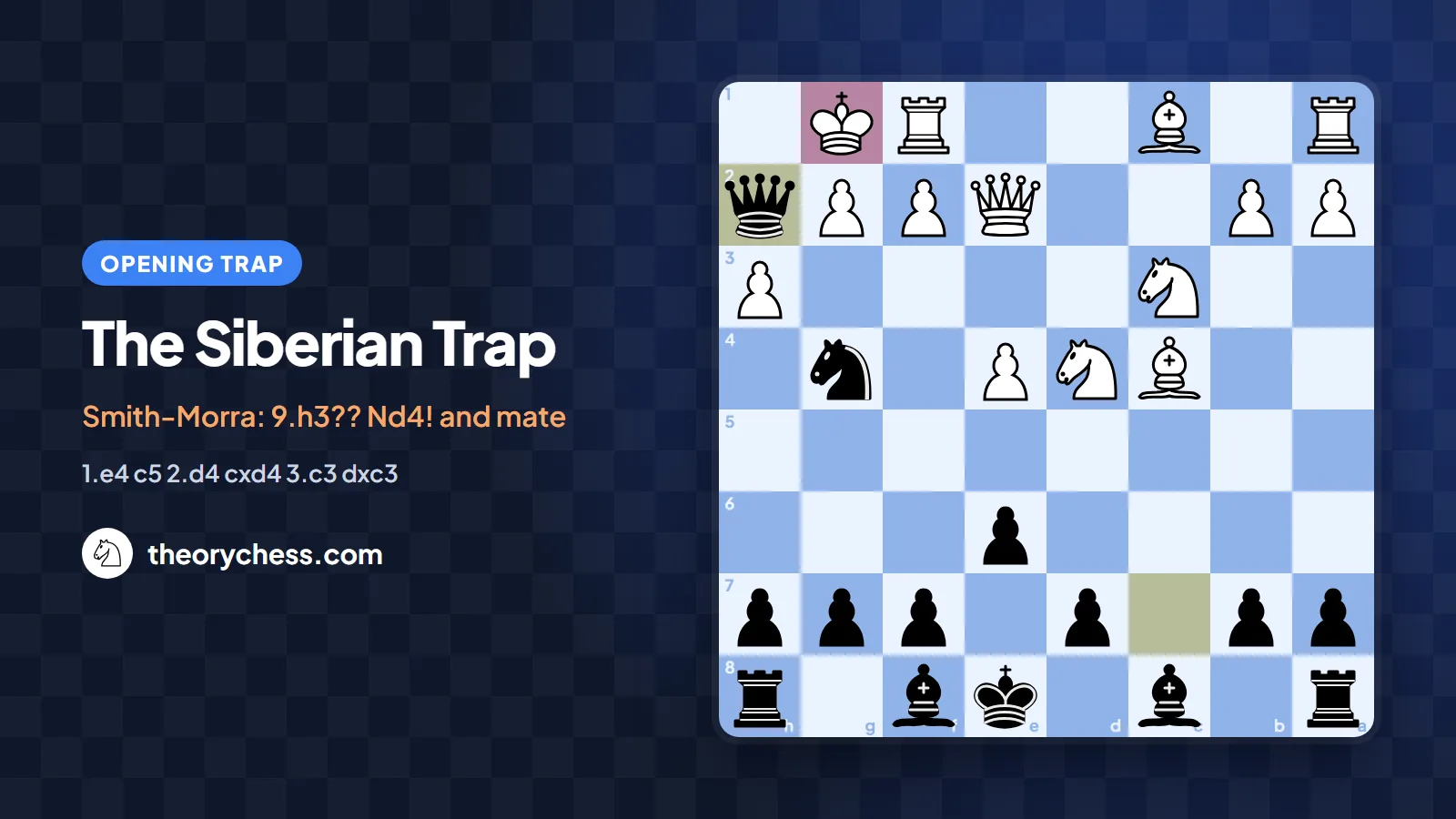
The Siberian Trap: checkmate on h2 in the Smith-Morra GambitThe Siberian Trap in the Smith-Morra: 8…Ng4! 9.h3?? Nd4! and 10…Qh2#. Move by move, why it works and how White avoids it.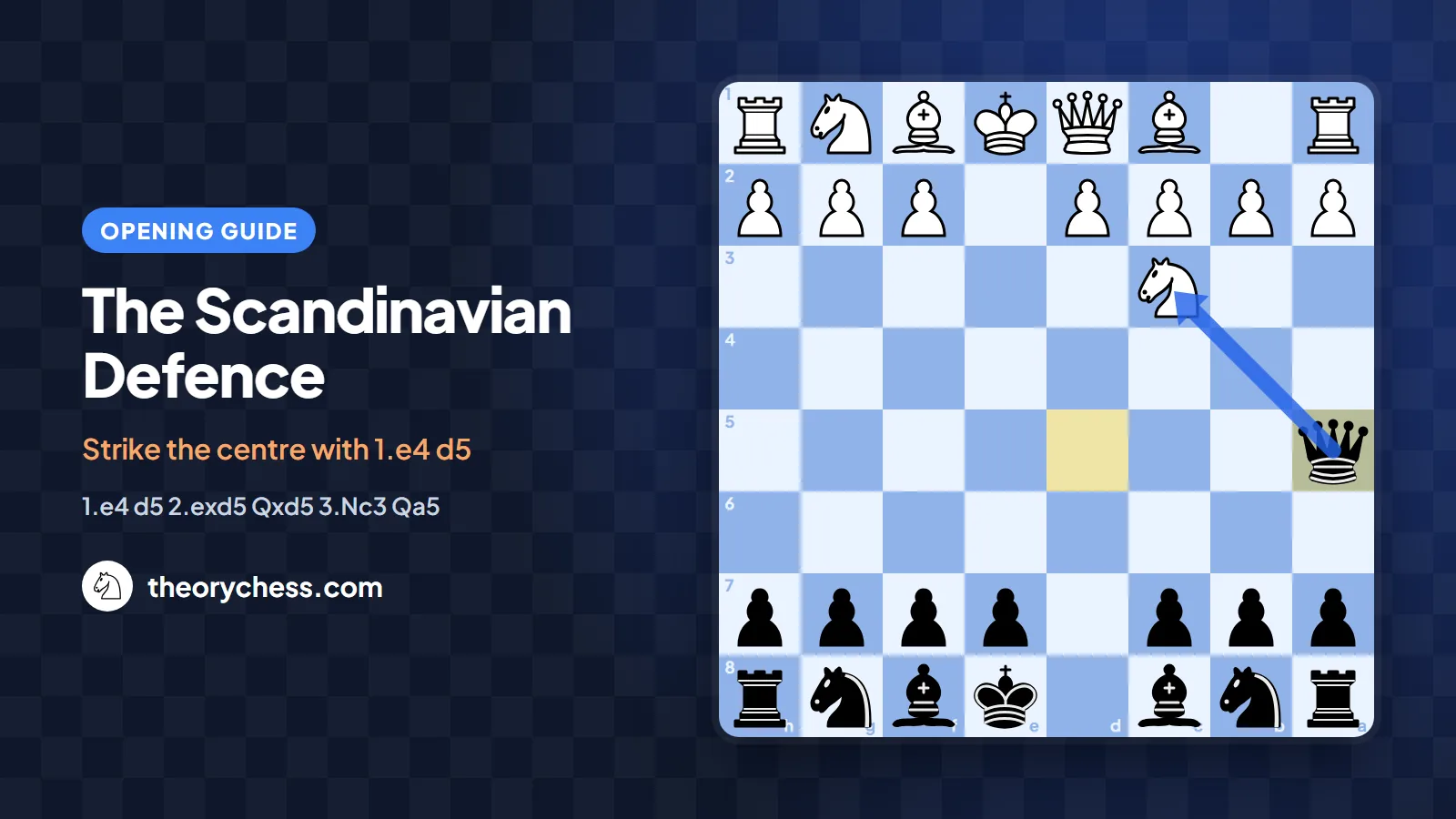
· 5 min read
The Scandinavian Defence: a practical guide to 1.e4 d5The Scandinavian Defence strikes at the centre with 1…d5. Main line 3…Qa5, the alternatives, typical plans and common mistakes.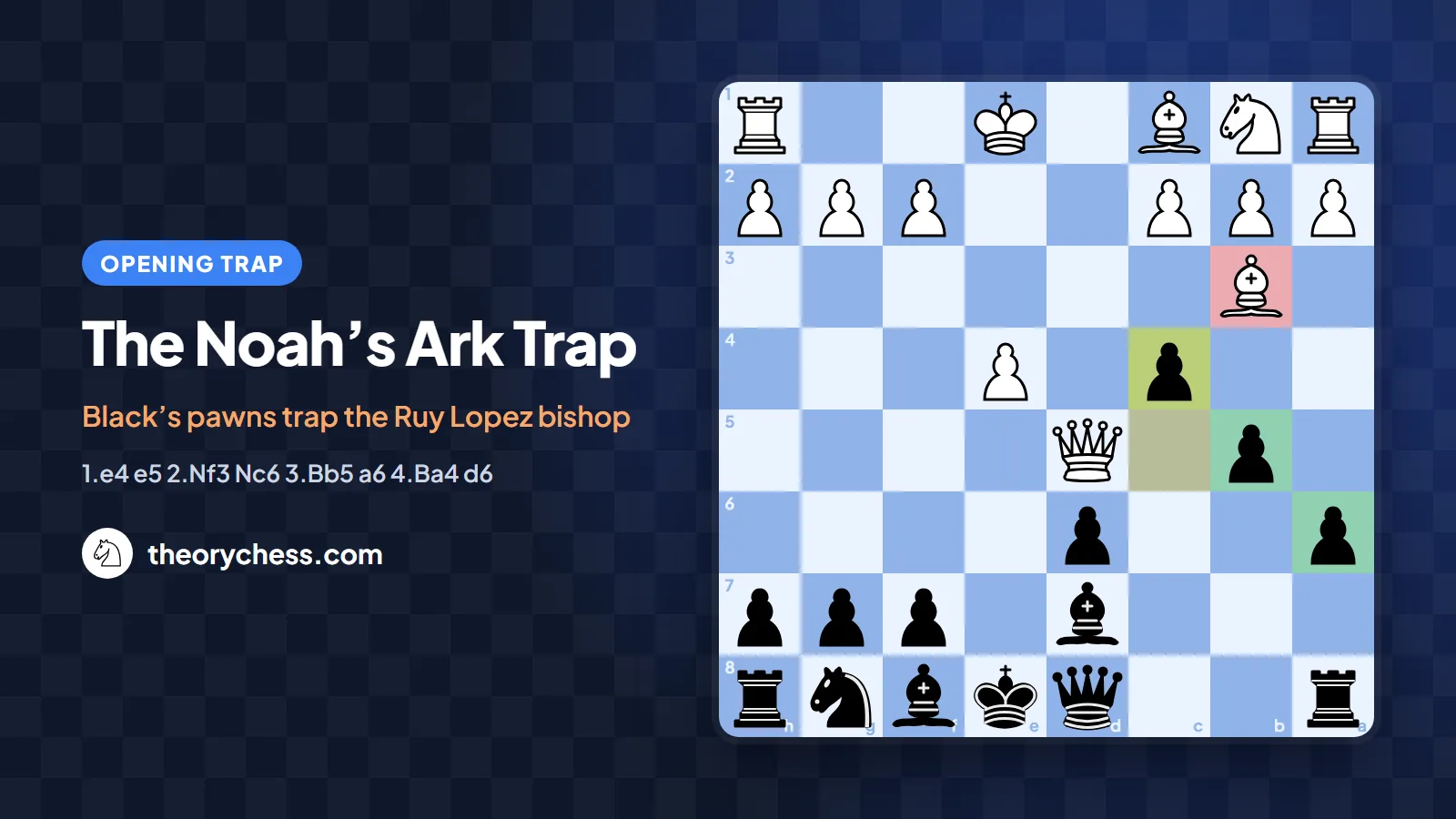
· 6 min read
The Noah’s Ark Trap: how Black traps the bishop in the Ruy LopezThe Noah’s Ark Trap in the Ruy Lopez, move by move: after 8.Qxd4?? c5! and …c4, White’s b3-bishop is trapped by Black’s pawns. How to set it and avoid it.