
The Dutch Defense trap: a queen sacrifice and Bg6# in 8 moves
In the Dutch Defense, chasing White’s bishop after 2.Bg5 ends in a queen sacrifice and mate in eight: 6…Rh6?? 7.Qxh5+! Rxh5 8.Bg6#. The trap, why it works and the right defence.
5 min readBy Hasan Süzen
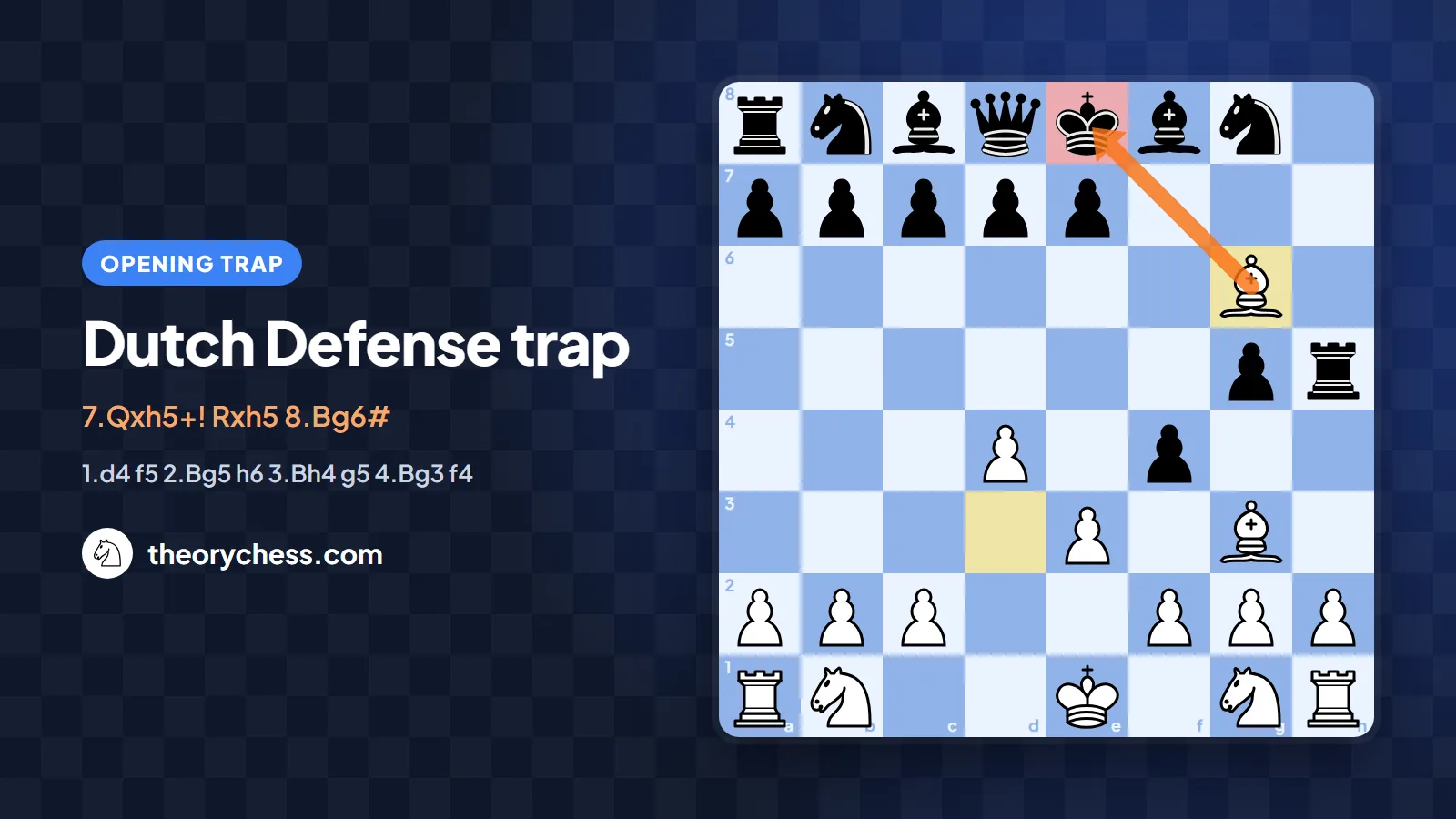
The Dutch Defense trap is a classic example of how expensive a hasty pawn storm in the opening can be. While chasing White’s bishop, Black strips the king of all its cover, and White sacrifices the queen to mate on move eight with a single bishop move. In this article we go through the trap move by move, explain why the mate can’t be stopped and show how to avoid the disaster as Black.
What is the Dutch Defense?
The Dutch Defense starts with 1.d4 f5. Black takes control of e4 from the very first move and steers the game into an unbalanced, fighting structure. The opening is named after the Dutch player Elias Stein, who recommended it in the 18th century, and it’s still a favourite of players who play to win.
But 1…f5 has a price: the h5–e8 diagonal and the f7-square around Black’s king are weakened. That’s why White often meets the Dutch with sharp, king-hunting tries. One of them is 2.Bg5.
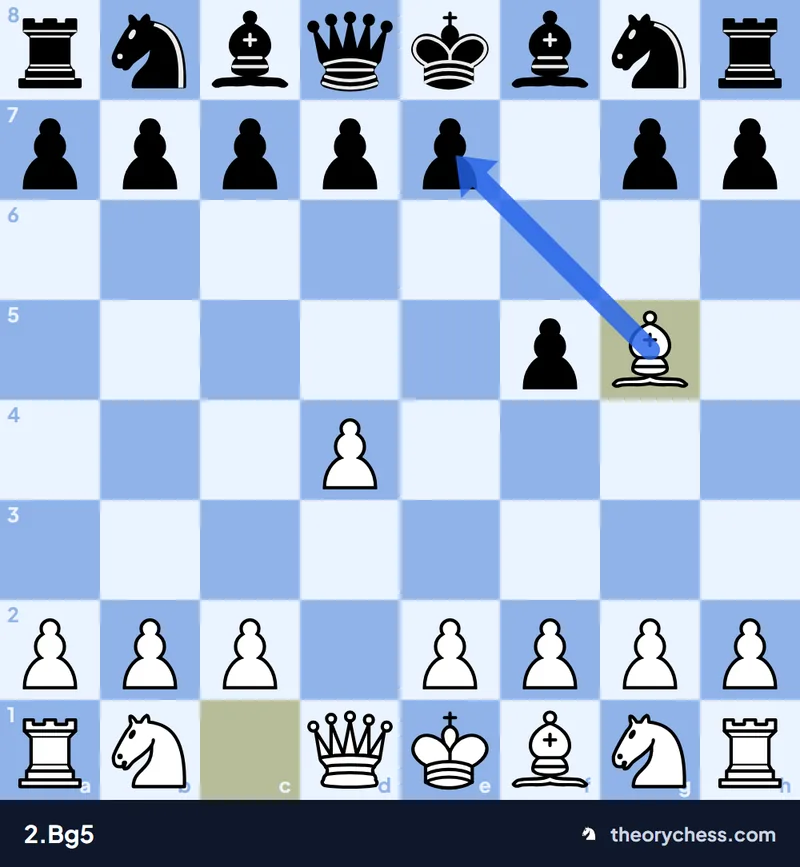
2.Bg5: White asks Black to make an early decision.
The trap move by move
2…h6 3.Bh4 g5 4.Bg3 f4: chasing the bishop
Black’s natural reaction to 2.Bg5 is to chase the bishop: 2…h6 3.Bh4 g5 4.Bg3. So far so normal; this line is played in practice. The trouble starts with the next move: 4…f4? Black wants to trap the bishop for good and follows up with 5.e3 h5, threatening …h4. The bishop really is about to be caught.
But every one of those pawn moves came from in front of Black’s king. The f-, g- and h-pawns have all advanced, and the king on e8 has no pawn shield left. Stockfish already rates White clearly better here.
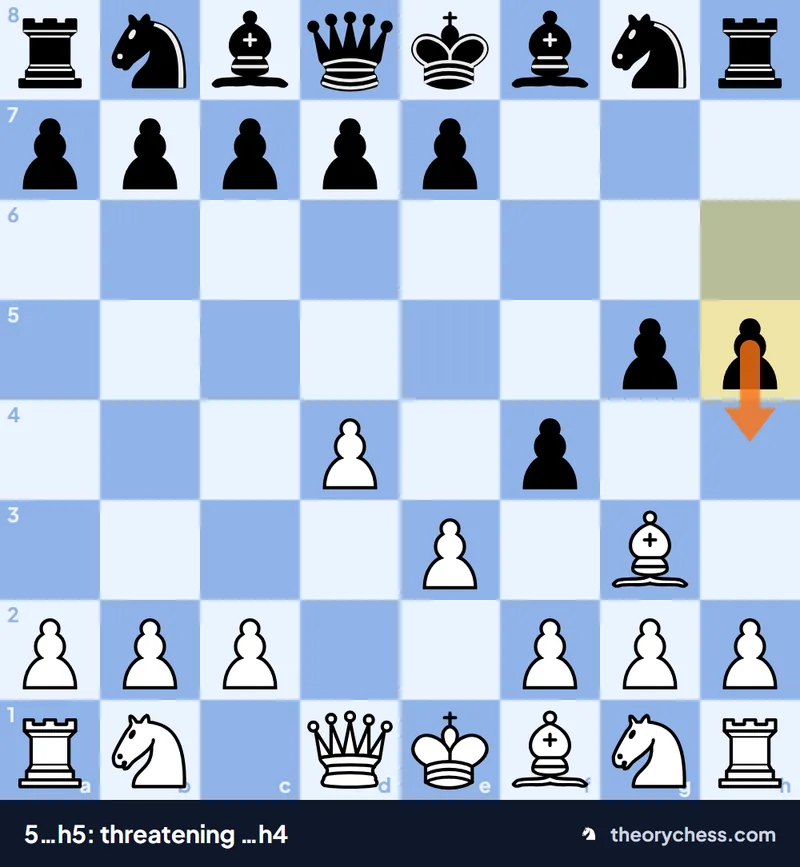
5…h5: the bishop is nearly trapped, but Black’s king is wide open.
6.Bd3!: the threat is Bg6#
White doesn’t bother saving the bishop and plays 6.Bd3!. The threat is mate in one: Bg6#. A bishop on g6 checks the king on e8 through f7; with no pawn on f7 nothing can block, and the king has no squares.
6…Rh6?? and the queen sacrifice
Black sees the threat and guards g6 with 6…Rh6??. It looks sensible, but now nothing defends the h5-pawn, and the d1–h5 diagonal is open because the e-pawn has moved to e3. White strikes: 7.Qxh5+!!
The queen gives check from h5 to e8. Black’s only move is to take it: 7…Rxh5. But the moment the rook leaves h6, g6 is undefended again: 8.Bg6#.
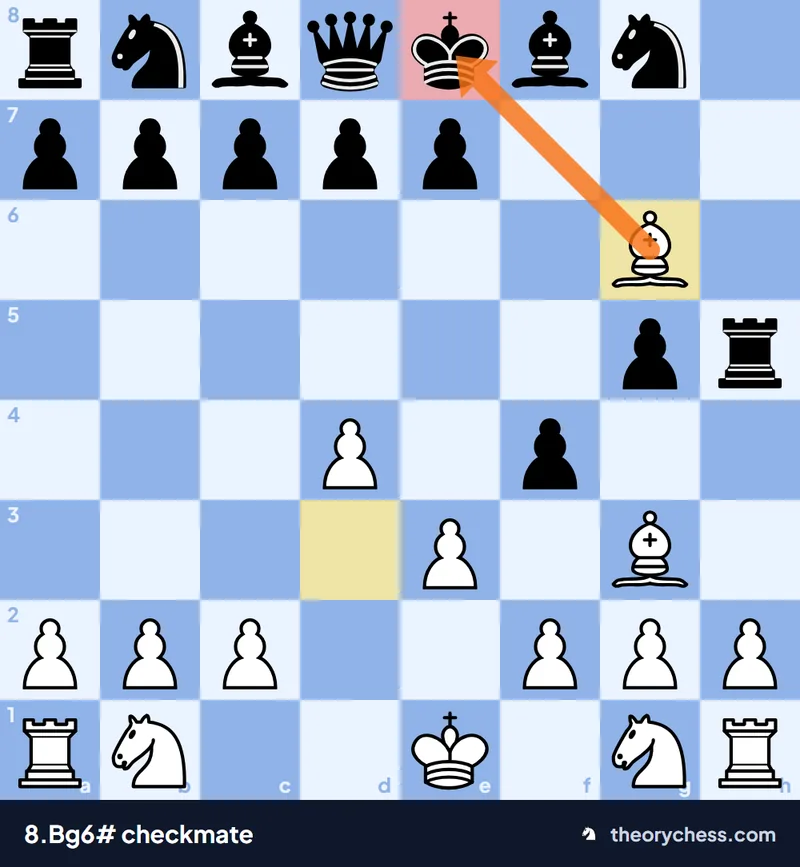
8.Bg6#: f7 is open and the king has nowhere to go.
The whole sequence: 1.d4 f5 2.Bg5 h6 3.Bh4 g5 4.Bg3 f4 5.e3 h5 6.Bd3 Rh6?? 7.Qxh5+! Rxh5 8.Bg6#.
Why is it mate?
- The f7-square is empty. In the Dutch the f-pawn moves on move one, so no pawn shields the king on the e8–h5 diagonal.
- The king has no squares. The queen is on d8, the bishop on f8 and pawns on d7 and e7, while the bishop covers f7.
- The only defender is overloaded. The rook on h6 has to guard both g6 and h5. The queen sacrifice drags it away from g6.
What should Black play?
After 6.Bd3 the best defence is 6…d5!. It doesn’t guard g6, but it gives the king an escape square on d7: after 7.Bg6+ Kd7 there is no mate and Black plays on. White is still better, though; the real mistake came earlier.
The real problem is 4…f4?. After 4.Bg3, Stockfish prefers developing moves such as 4…c5, 4…Bg7 or 4…d6, and in those lines Black’s game is perfectly normal. Developing pieces instead of chasing the bishop keeps the weaknesses in front of the king from being punished.
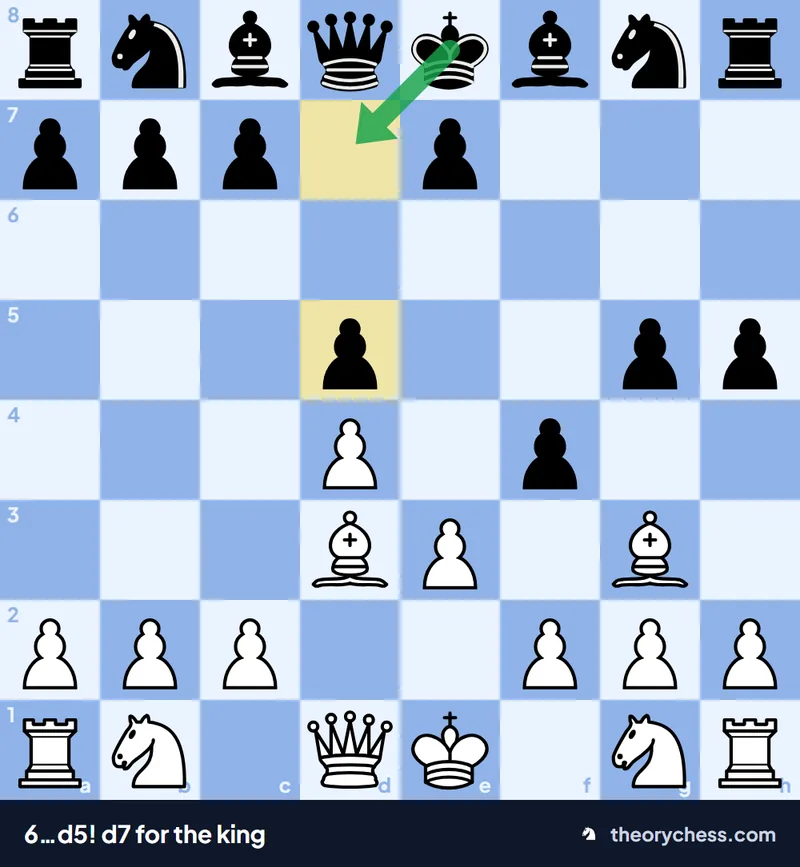
6…d5!: g6 isn’t guarded, but the king can run to d7.
A second Dutch trap: the Korchnoi Gambit
The same theme, an open h5–e8 diagonal and a weak g6-square, shows up in another line. With 1.d4 f5 2.h3 Nf6 3.g4!? White gives up a pawn. After 3…fxg4 4.hxg4 Nxg4 5.Qd3 the queen eyes g6 again. Here 5…Nf6?? looks like a natural retreat, but 6.Rxh7! wins: if 6…Rxh7 or 6…Nxh7, then 7.Qg6#. The right defence is 5…g6, shutting the g6-square with a pawn.
Key moments at a glance
| Move | What happens | Lesson |
|---|---|---|
| 2.Bg5 | White asks for an early decision. | A sharp try; play carefully. |
| 4…f4? | Black chases the bishop and opens the king. | In the opening, develop instead of pushing pawns. |
| 6.Bd3! | The threat is Bg6#. | Open diagonals are dangerous for the king. |
| 6…Rh6?? | The rook tries to guard both g6 and h5. | Overloaded pieces invite sacrifices. |
| 7.Qxh5+! Rxh5 8.Bg6# | Queen sacrifice and mate. | Deflect the defender, then strike. |
| 6…d5! | The king gets the d7-square. | Sometimes the best defence is an escape square. |
What this trap teaches
The Dutch isn’t a bad opening; world champions have played it. But because 1…f5 already weakens the king, pushing the g- and h-pawns as well is very risky. Chasing a piece is tempting, but no pawn move can be taken back. For another “one piece, two jobs” story, see the Caro-Kann smothered mate trap, and for a list of the classics, read opening traps every club player should know.
Frequently asked questions
How many moves does the Dutch Defense trap take?
White mates on move eight with 8.Bg6#. Black’s last mistake is 6…Rh6??, but the real error is 4…f4?.
Is 2.Bg5 a good move against the Dutch?
Yes, it’s a serious option. If Black answers solidly with 2…g6, 2…h6 or 2…Nf6 the game is balanced; the danger is pushing the pawns too far to chase the bishop.
Is the Dutch Defense good for beginners?
If you like fighting chess, yes, but you have to watch your king more closely than usual. Develop, castle and fight for the centre first; pawn storms come later.
How can I remember this as Black?
One check is enough: once the f-pawn has moved, the h5–e8 diagonal and the g6-square are always in danger. Before pushing the g- and h-pawns, look at whether White’s queen and bishop can reach those squares.
Practise it on TheoryChess
Reading a trap and spotting it over the board are two different things. On TheoryChess you can play every main line of the Dutch Defense trainer against Stockfish, with an explanation for every theory move, then test yourself with the Dutch Defense quiz. For another classic in the 1.d4 openings, read about the Elephant Trap in the Queen’s Gambit. Every opening is waiting in the opening catalogue.
Keep reading
· 5 min read
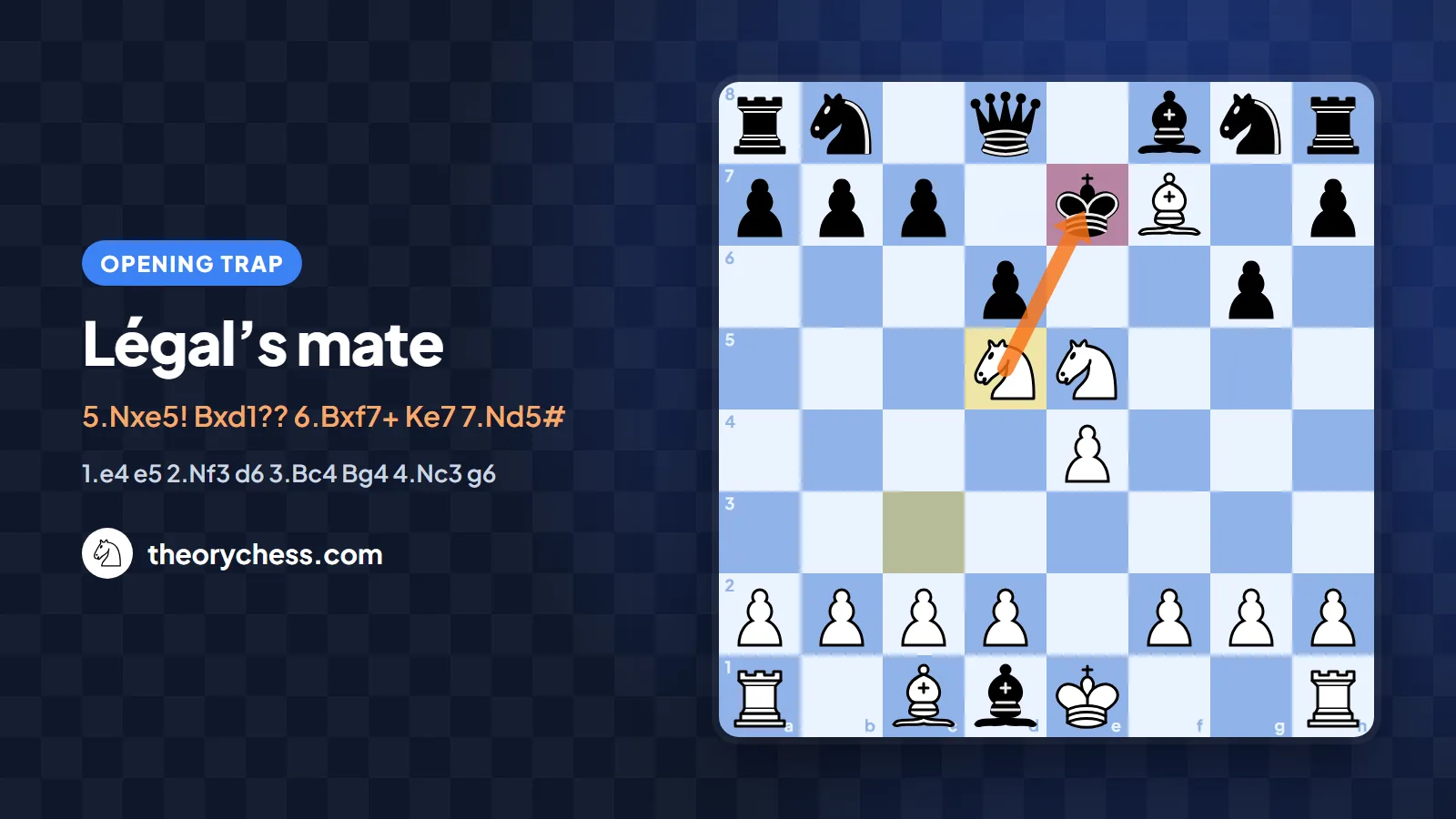
Légal’s mate: give up the queen and mate in 7 with three minor piecesLégal’s mate is one of the oldest opening traps in chess: White ignores the pin and leaves the queen hanging, and if Black takes it, 6.Bxf7+ Ke7 7.Nd5# is mate. The trap, why it works and the right defence.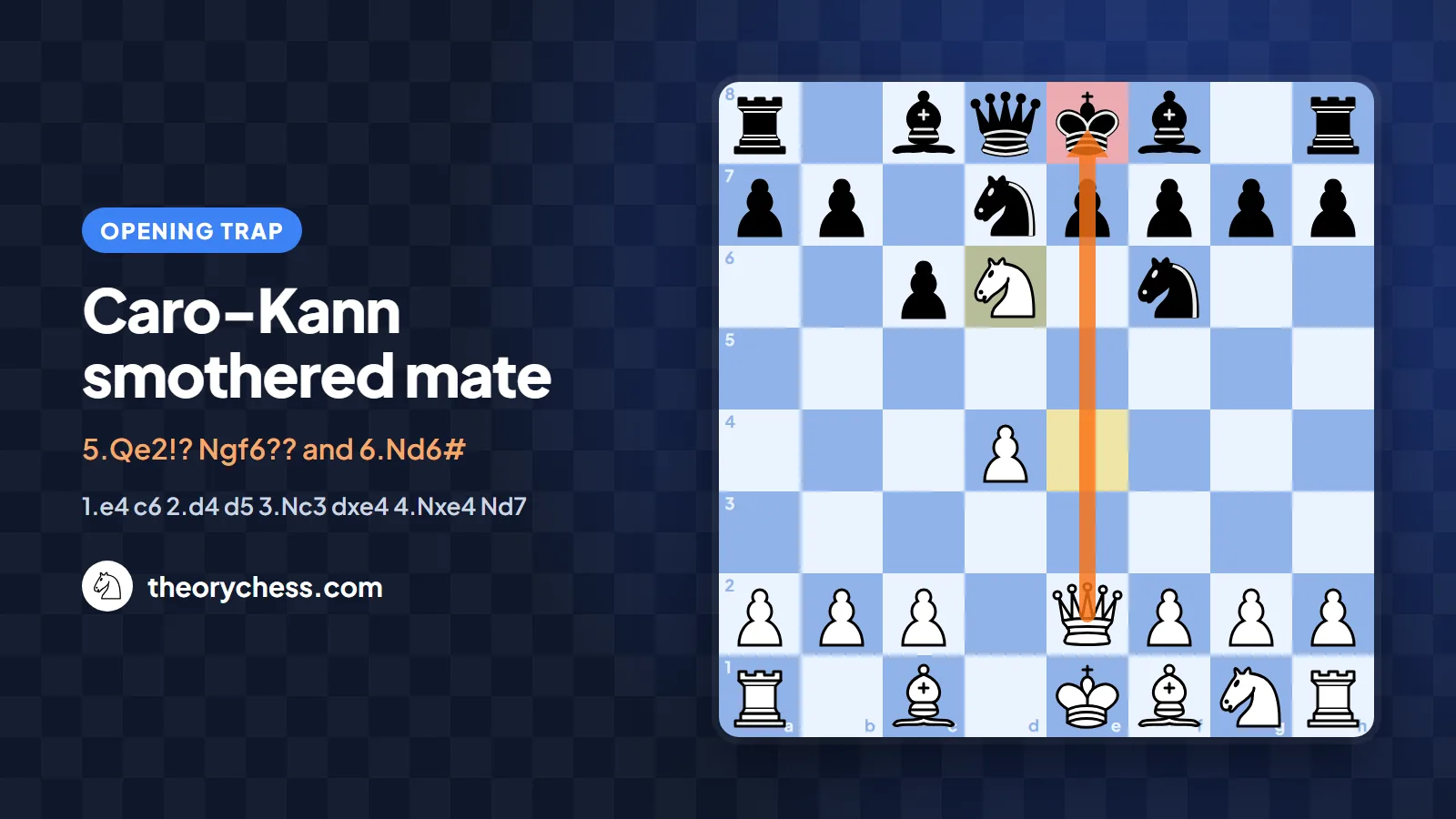
· 6 min read
The Caro-Kann smothered mate trap: Nd6# in 6 movesIn the Karpov Variation of the Caro-Kann, the natural-looking 5…Ngf6?? after 5.Qe2!? loses to 6.Nd6#, a smothered mate. The trap, why it works and the right defence.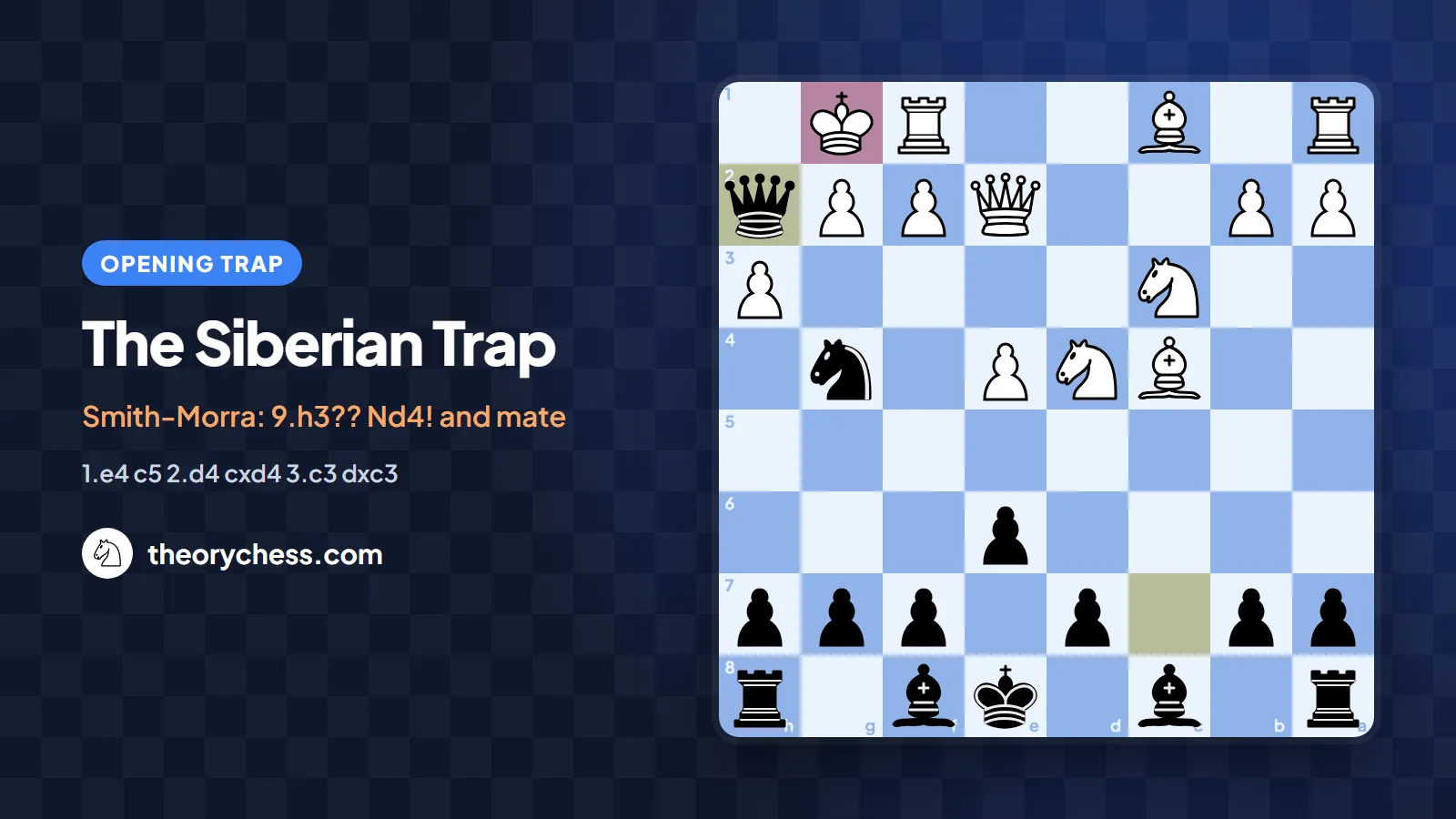
· 5 min read
The Siberian Trap: checkmate on h2 in the Smith-Morra GambitThe Siberian Trap in the Smith-Morra: 8…Ng4! 9.h3?? Nd4! and 10…Qh2#. Move by move, why it works and how White avoids it.