
The Magnus Smith Trap: give up a bishop, win the queen in the Sicilian
In the Sozin Sicilian, 6…g6 7.Nxc6 bxc6 8.e5! dxe5?? loses the queen to 9.Bxf7+! Kxf7 10.Qxd8. The trap, why it works and the right reply, 8…Ng4!
5 min readBy Hasan Süzen
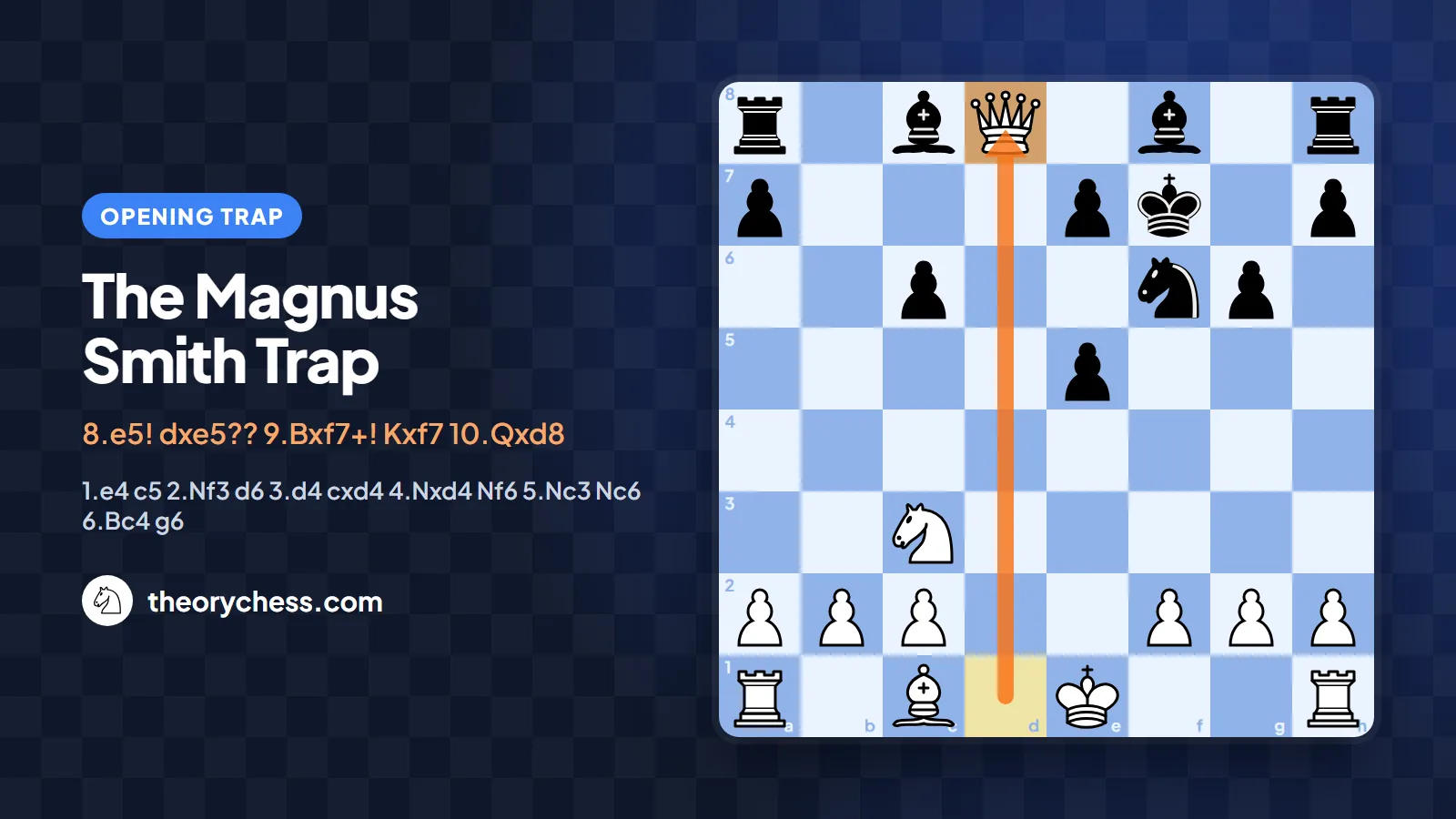
The Magnus Smith Trap is one of the neatest short traps in the Sicilian Defense. White pushes a pawn in the center and Black reaches out to take it. That single move opens the d-file, and White sacrifices a bishop to take Black’s queen off the board. In this article we go through the trap move by move, explain why it works and show what Black should play instead.
How is the trap set?
We start from a common position in the Open Sicilian Defense: 1.e4 c5 2.Nf3 d6 3.d4 cxd4 4.Nxd4 Nf6 5.Nc3 Nc6. Here White plays 6.Bc4, putting the bishop on the diagonal aimed at f7 (the Sozin idea). You can read about the basics in our Sicilian for beginners guide.
Black’s most solid reply is 6…e6, blunting the bishop. Going for a Dragon setup with 6…g6 gives White the idea 7.Nxc6 bxc6 8.e5!. The move doesn’t lose by itself, but Black now has to find the right answer.
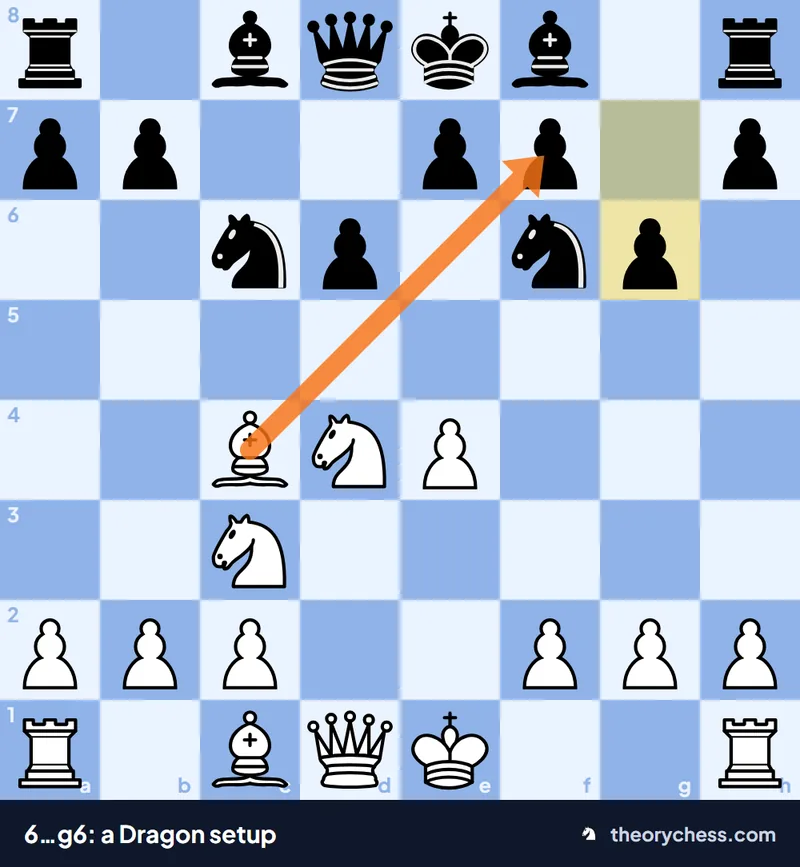
6…g6: Black goes for a Dragon setup while the bishop eyes f7.
The trap move by move
7.Nxc6 bxc6 8.e5!: a strike in the center
White trades knights first: 7.Nxc6 bxc6. Then comes 8.e5!. The pawn attacks the knight on f6 and bumps into the d6-pawn at the same time. Stockfish also picks 8.e5 as the best move here.
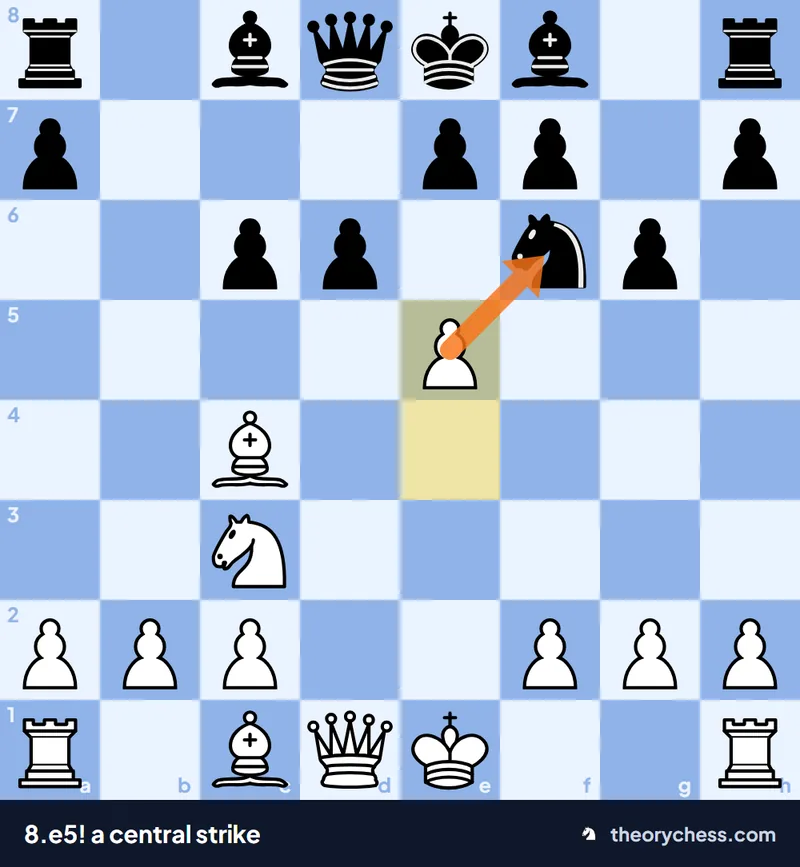
8.e5!: the pawn hits the knight, but should Black take it?
8…dxe5??: the d-file opens
The natural reaction is to take: 8…dxe5?? It looks like a free pawn, but with the d6-pawn gone the d-file is open. Nothing stands between the queen on d1 and the queen on d8. The only piece defending the d8-queen is the king on e8, because the bishop on c8 blocks the rook on a8.
9.Bxf7+! Kxf7 10.Qxd8
9.Bxf7+! takes on f7 with check. Black’s only legal move is 9…Kxf7, since d7 is covered by the queen on d1 and f8 is occupied by Black’s own bishop. The moment the king leaves the queen’s side, 10.Qxd8 follows: White gives up a bishop and wins a queen. Stockfish has White almost seven pawns up.
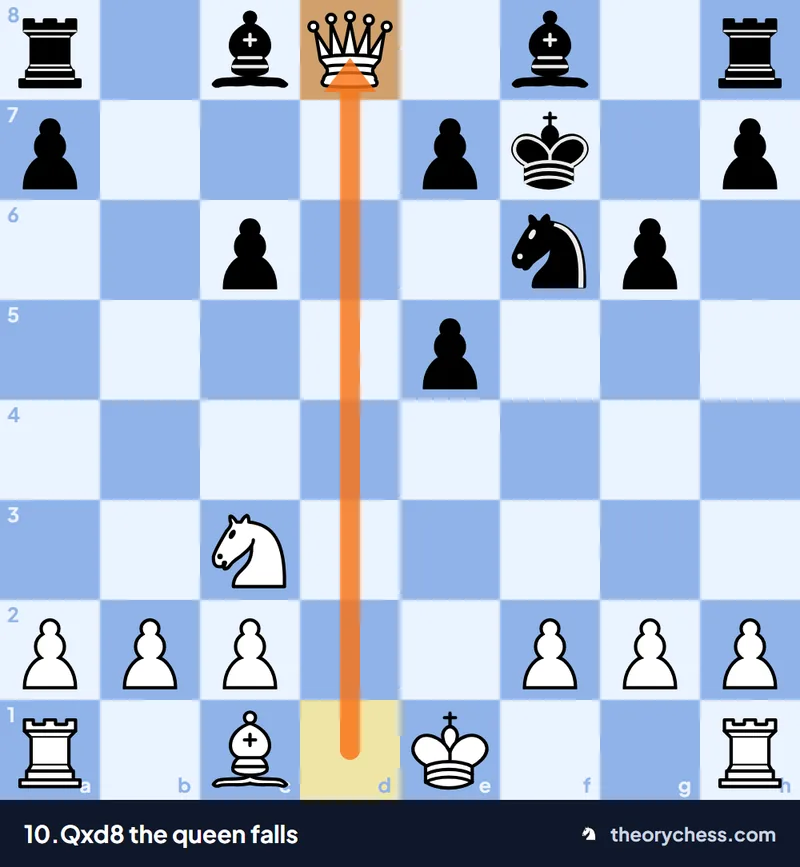
10.Qxd8: the king has been dragged away and the queen falls.
The whole sequence: 1.e4 c5 2.Nf3 d6 3.d4 cxd4 4.Nxd4 Nf6 5.Nc3 Nc6 6.Bc4 g6 7.Nxc6 bxc6 8.e5 dxe5 9.Bxf7+ Kxf7 10.Qxd8.
What should Black play?
The right move is 8…Ng4!. The knight escapes, puts pressure on the e5-pawn, and because the d6-pawn stays put, the d-file stays closed. White is still a little better (about half a pawn according to Stockfish), but the game goes on. The main continuations are 9.exd6 and 9.Bf4.
8…d5? doesn’t escape either: after 9.exf6 dxc4 10.Qf3 White is clearly better.
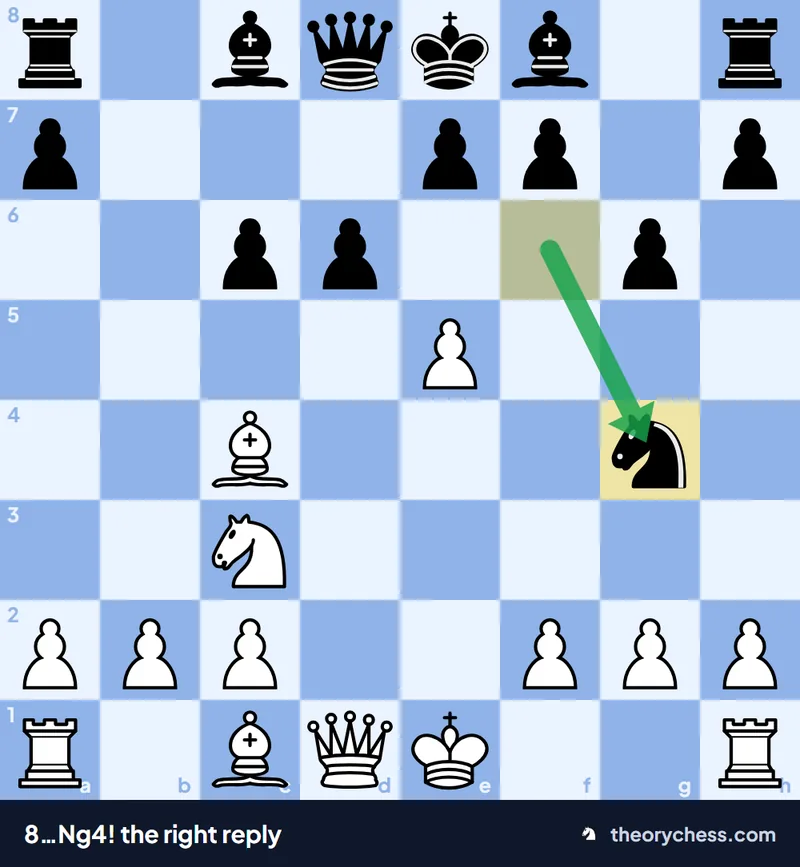
8…Ng4!: the knight escapes and the d-file stays closed.
Why is it called the Magnus Smith Trap?
The trap is named after Magnus Smith (1869–1934), a three-time Canadian champion. The name isn’t entirely deserved, though: according to chess historian Edward Winter’s research, the idea 8.e5 dxe5 9.Bxf7+ was already in print when Smith was 12 years old. Smith’s real contribution was the move 9.Bf4, which he proposed after 8…Ng4.
Key moments at a glance
| Move | What happens | Lesson |
|---|---|---|
| 6.Bc4 | The bishop lands on the diagonal to f7. | The Sozin idea targets f7. |
| 6…g6 | Black goes for a Dragon setup. | 6…e6 blunts the bishop and is more solid. |
| 8.e5! | The pawn attacks the knight. | Central strikes open lines. |
| 8…dxe5?? | The d-file opens. | Check the files before grabbing a pawn. |
| 9.Bxf7+! Kxf7 10.Qxd8 | The king is dragged away, the queen falls. | Remove a piece’s only defender. |
| 8…Ng4! | The knight escapes and the file stays closed. | Threats first, material second. |
What this trap teaches
The lesson isn’t that taking pawns is bad. It’s that a pawn is sometimes doing more than being a pawn: the d6-pawn was closing the d-file and keeping the queens apart. The moment it moves, the queens face each other and the whole calculation changes.
In similar positions, two questions are enough. First: which file or diagonal does this move open? Second: who defends my queen, and can that piece be dragged away? Here both answers point to the disaster in advance. The queen is defended only by the king, and a check on f7 pulls the king away.
There’s an important note for White too: 8.e5 isn’t just a trap move, it’s the best move in the position. Even after the right reply White stays slightly better, so you risk nothing by trying it. That’s what the best traps look like: if your opponent doesn’t fall for it, you still have a good position.
Frequently asked questions
How many moves does the Magnus Smith Trap take?
White takes the queen on move ten with 10.Qxd8. Black’s mistake is 8…dxe5??.
Is 6…g6 a bad move?
It doesn’t lose, but it gives White an easy game. Stockfish prefers 6…e6.
Does this only happen in the Sicilian?
This move order is specific to the Sicilian, but the idea is general: when queens face each other on an open file, a check that drags away the queen’s only defender can be decisive.
How can I remember this as Black?
When the d6-pawn is the only thing closing the d-file, look at who defends your queen before capturing with it.
Practise it on TheoryChess
Reading a trap and spotting it over the board are two different things. On TheoryChess you can play the Open Sicilian lines in the Sicilian trainer against Stockfish, then test yourself with the Sicilian quiz. For another famous Sicilian trap, read about the Siberian Trap, and for another trap that punishes an exposed king, see the Dutch Defense trap. Every opening is waiting in the opening catalogue.
Keep reading
· 5 min read
The Fried Liver Attack: sacrifice the knight, drag the king outIn the Two Knights Defense, 5…Nxd5? runs into 6.Nxf7! Kxf7 7.Qf3+ Ke6 8.Nc3, with Black’s king stuck in the center. The attack move by move, Black’s best defence and the right reply, 5…Na5!
· 5 min read
The Tennison Gambit trap: play …h6?? and lose your queenIn the Tennison Gambit (1.Nf3 d5 2.e4) Black’s natural-looking 5…h6?? loses the queen: 6.Nxf7! Kxf7 7.Bg6+!! gives check, opens the d-file and 8.Qxd8 follows. The trap, why it works and the right defence.
· 5 min read
The King’s Gambit Declined trap: take this pawn and lose your rookDeclining the King’s Gambit with 2…Bc5 sets a nasty trap: if White plays 3.fxe5??, then 3…Qh4+ 4.g3 Qxe4+ wins the rook on h1, and 4.Ke2 runs into 4…Qxe4# mate. The trap, why it works and the right move.