
The Petrov Defense trap: why copying your opponent loses the queen
In the Petrov Defense, copying with 3…Nxe4? after 3.Nxe5 lets White play 4.Qe2!, and 4…Nf6?? loses the queen to 5.Nc6+! The trap move by move and the right replies, 3…d6! and 4…Qe7!
5 min readBy Hasan Süzen
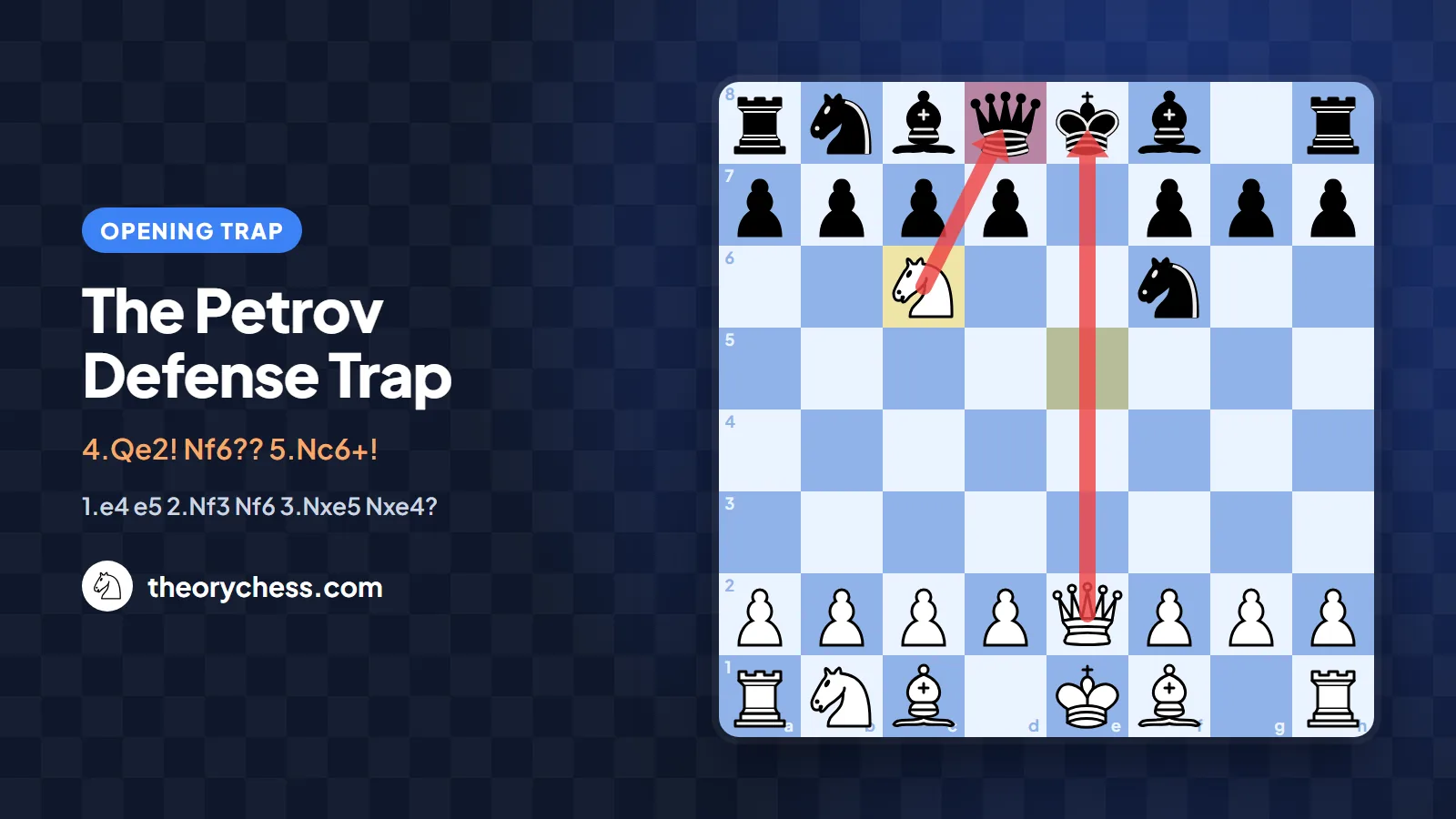
The Petrov Defense trap is one of the clearest examples of why copying your opponent’s moves is dangerous. White takes on e5, Black takes on e4 without a second thought, and a couple of moves later the e-file is open and a single knight move gives check and attacks the queen at the same time. In this article we go through the trap move by move, explain why it works and show Black’s right replies.
What is the Petrov Defense?
The Petrov Defense, also known as the Russian Game, starts with 1.e4 e5 2.Nf3 Nf6. Instead of defending the e5-pawn, Black counterattacks e4. The opening has a reputation for being very solid, but only if Black knows a few move orders. White’s most common reply is 3.Nxe5, taking the pawn straight away.
This is the moment where many players go wrong. White has taken a pawn, so the obvious idea is to take one back. It feels fair, it feels symmetrical, and it is exactly what the trap is waiting for.
The trap move by move
3…Nxe4?: copying White
White took a pawn, so Black takes one too: 3…Nxe4? The symmetry looks logical. The move doesn’t lose by force, but Stockfish prefers 3…d6. The problem is that the position is only symmetrical on the surface. It is White’s move, and White can attack the knight on e4 with the queen while lining up on the e-file against Black’s king.
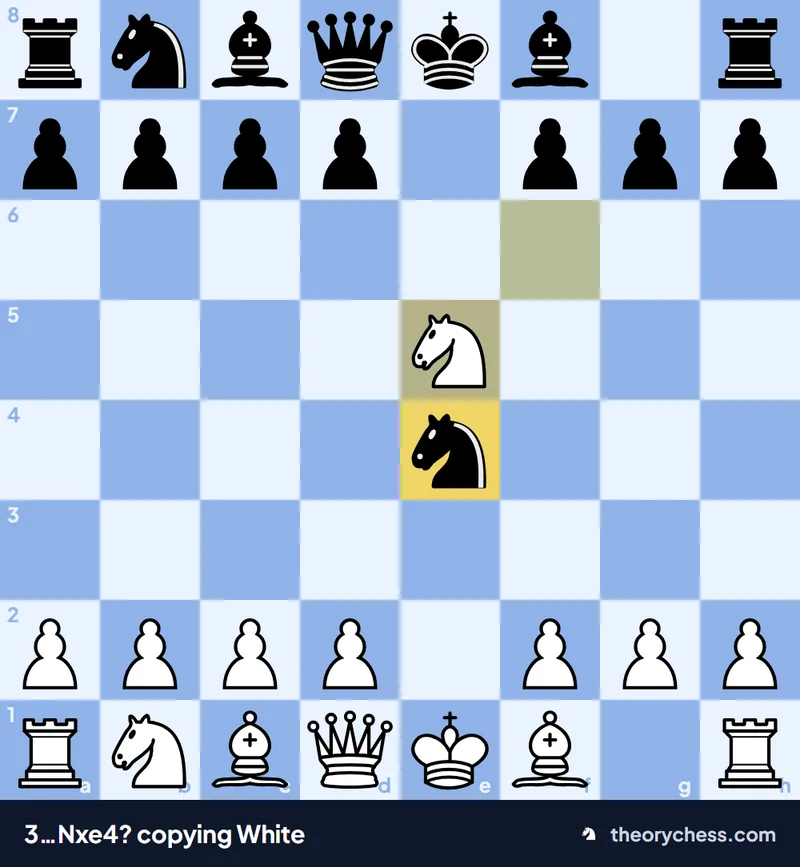
3…Nxe4?: a symmetrical position, but White is to move.
4.Qe2!: the queen on the e-file
4.Qe2! attacks the knight on e4. More importantly, the queen now stands behind the knight on e5, on the same file as Black’s king on e8. If the e4-knight retreats, the only piece left between the white queen and the black king is White’s own knight, and every knight move becomes a discovered check.
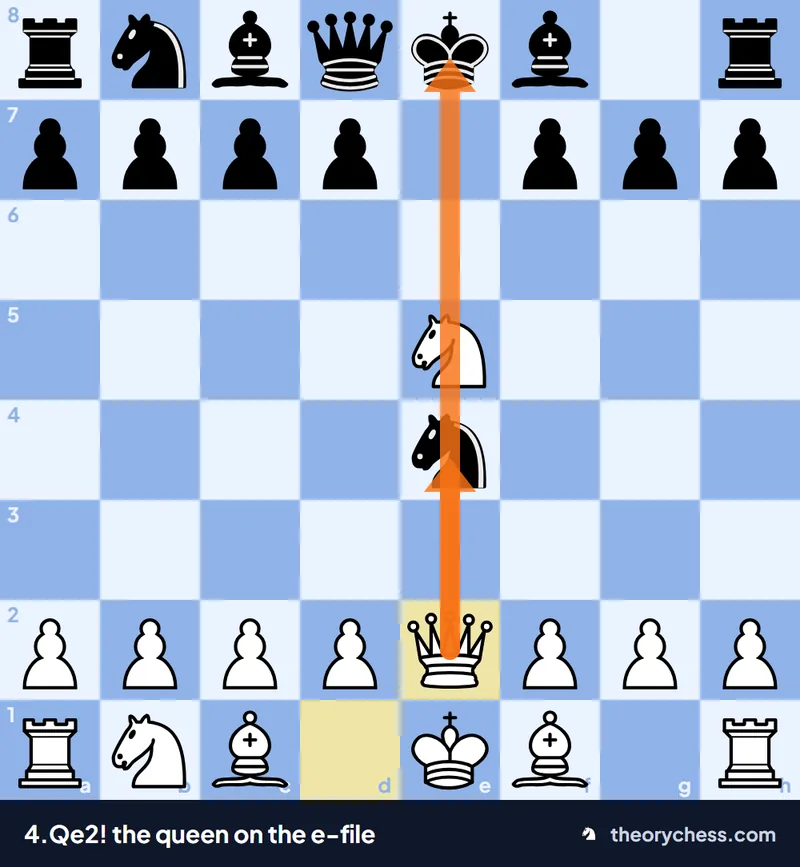
4.Qe2!: the queen eyes the knight and the e-file.
4…Nf6??: the retreat
Saving the knight looks completely natural: 4…Nf6?? But now only the knight on e5 stands between the queen on e2 and the king on e8.
5.Nc6+!: the discovered check
5.Nc6+! The knight jumps to c6. The queen on e2 gives check down the open e-file, and at the same time the knight on c6 attacks the queen on d8. Black has to answer the check first. After 5…Be7 6.Nxd8 the queen is gone, and 5…Qe7 is no better because of 6.Nxe7. Stockfish puts White about seven pawns up. 5.Ng6+ also wins material, but much less than 5.Nc6+.
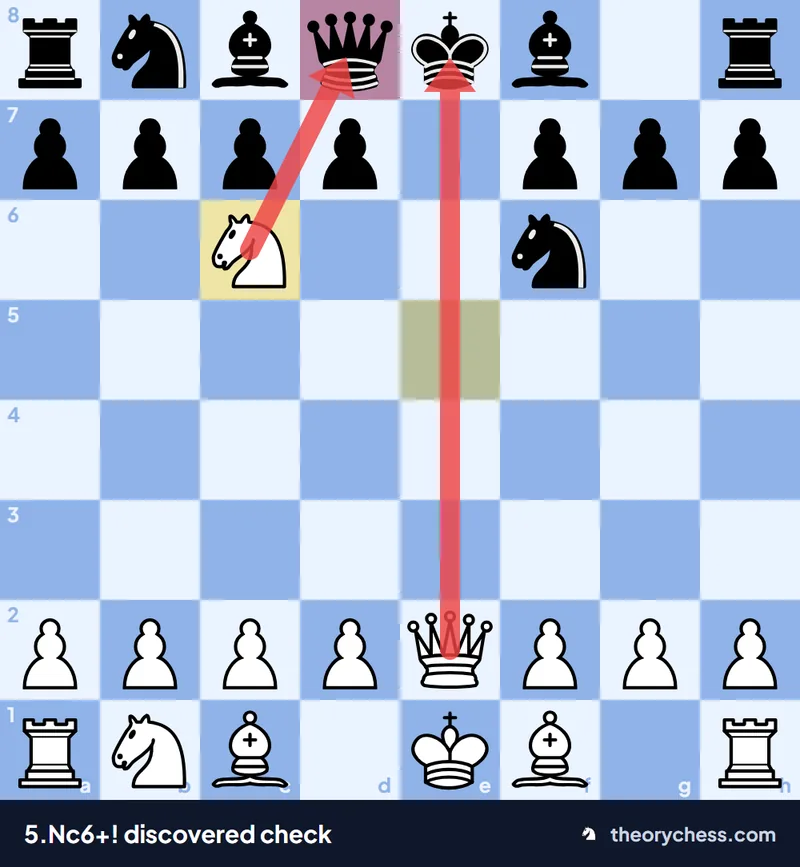
5.Nc6+!: check from the queen, attack from the knight.
The whole sequence: 1.e4 e5 2.Nf3 Nf6 3.Nxe5 Nxe4 4.Qe2 Nf6 5.Nc6+ Be7 6.Nxd8.
Why does the trap work?
- Because it is White’s move, White is the first to break the symmetry.
- Once the e4-knight retreats, the e-file is open all the way to Black’s king.
- The knight on e5 gives check wherever it goes, so White can pick the square that does the most damage.
- A discovered check creates two threats at once, and Black can only answer one of them.
What should Black play?
The real answer is not to copy at all: 3…d6! First Black kicks the knight away from e5, and only then takes on e4. After 4.Nf3 Nxe4 we are in the main line of the Petrov, and Black has a solid position.
If you have already played 3…Nxe4, there is still a way out: 4…Qe7! Black blocks the e-file with the queen, so there is no discovered check. After 5.Qxe4 d6 6.d4 dxe5 7.dxe5 White is a pawn up, but the engine sees White as only slightly better (around +0.6). Other moves such as 4…d6 or 4…d5 are clearly worse.
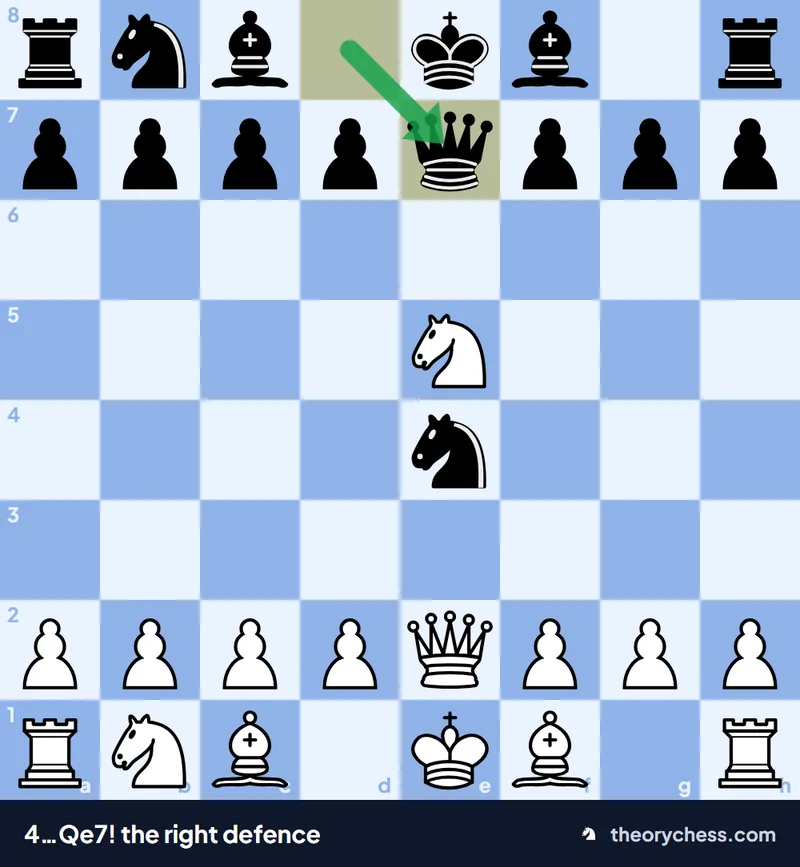
4…Qe7!: the queen blocks the e-file and the discovered check is gone.
Key moments at a glance
| Move | What happens | Lesson |
|---|---|---|
| 3…Nxe4? | Black copies White. | Symmetry makes you forget whose move it is. |
| 4.Qe2! | The queen eyes the knight and the e-file. | Aim at a king on an open file. |
| 4…Nf6?? | The e-file opens. | Before you retreat, check which line opens. |
| 5.Nc6+! | Discovered check and an attack on the queen. | A discovered check creates two threats. |
| 3…d6! | The right move order. | Kick the knight first, take the pawn second. |
| 4…Qe7! | The queen blocks the file. | Close a dangerous line with your own piece. |
What this trap teaches
Copying is a way of not thinking. A move can be good in your opponent’s position and bad in yours, simply because you are a tempo behind. When your king is on an open file, every piece that stops blocking that file can hand your opponent a discovered check.
In the open games, the e-file and the f7-square always deserve attention. For another classic where a natural-looking move gets punished at once, read about Légal’s mate.
There is also a lesson about move orders. 3…Nxe4 and 3…d6 followed by 4…Nxe4 reach similar ideas, but one of them gives White a free tempo with the queen and the other doesn’t. In the opening, the order of your moves can matter as much as the moves themselves.
Frequently asked questions
Does 3…Nxe4 lose by force?
No. After 4.Qe2 Qe7 Black stays in the game, but the position is less comfortable than after 3…d6.
Can Black save the queen after 5.Nc6+?
No. 5…Be7 6.Nxd8 and 5…Qe7 6.Nxe7 both lose the queen.
Is the Petrov Defense a good opening?
Yes. Played with the right move order it is very solid. The key is knowing to play 3…d6 after 3.Nxe5.
Does this trap work in blitz?
Very often. 4…Nf6 looks like a natural way to save the knight, and in a fast game the open e-file is easy to miss.
Practise it on TheoryChess
The best way to learn a move order is to play it. On TheoryChess you can play the main lines in the Petrov Defense trainer against Stockfish, then test yourself with the Petrov quiz. For another trap where a free-looking pawn costs the queen, read about the French Advance trap, and for a wider list see opening traps every club player should know. Every opening is waiting in the opening catalogue.
Keep reading
· 6 min read
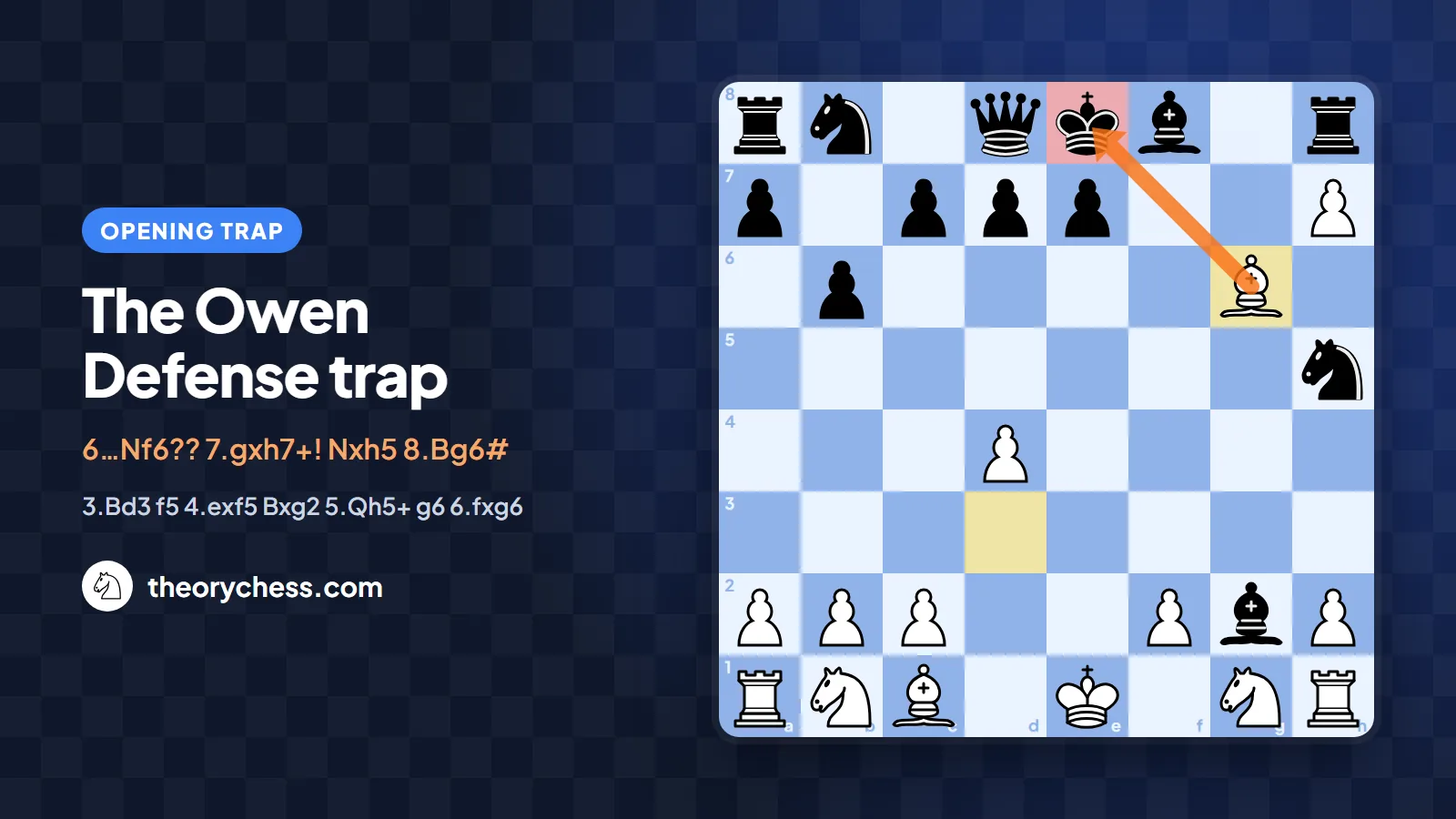
The Owen Defense trap: checkmate in eight after 3…f5?In the Owen Defense, 3…f5? opens the h5-e8 diagonal. After 4.exf5! Bxg2? 5.Qh5+ g6 6.fxg6 Nf6?? 7.gxh7+! Nxh5 8.Bg6# the game is over on move eight. The trap, why it works and the right reply, 3…e6.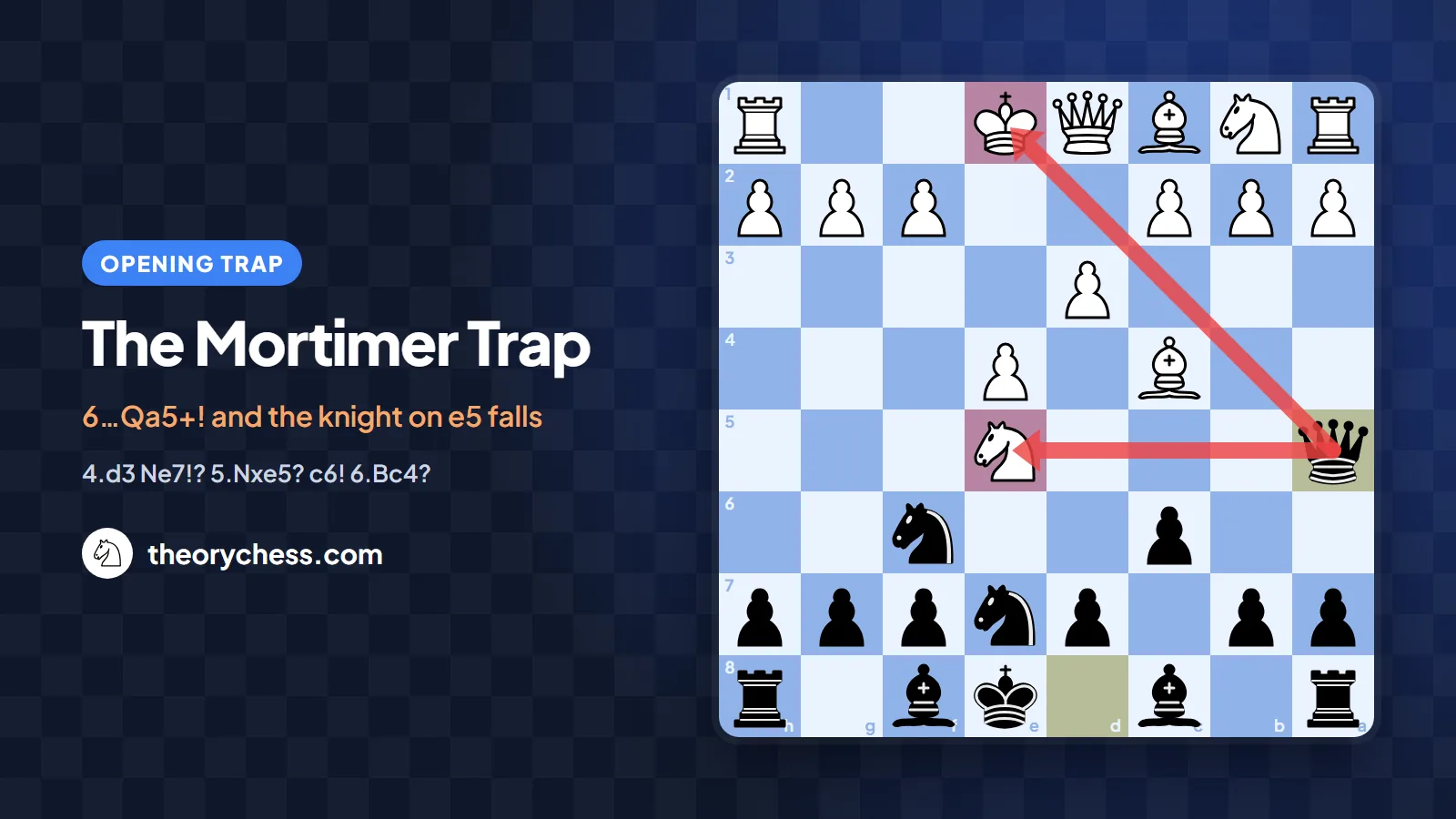
· 6 min read
The Mortimer Trap: how 6…Qa5+ wins a knight in the Ruy LopezIn the Berlin with 4.d3, 4…Ne7!? leaves the e5-pawn unguarded. After 5.Nxe5? c6! 6.Bc4? Qa5+! the queen hits the king and the knight on e5 at once. The trap move by move and the right plan, 5.Nc3.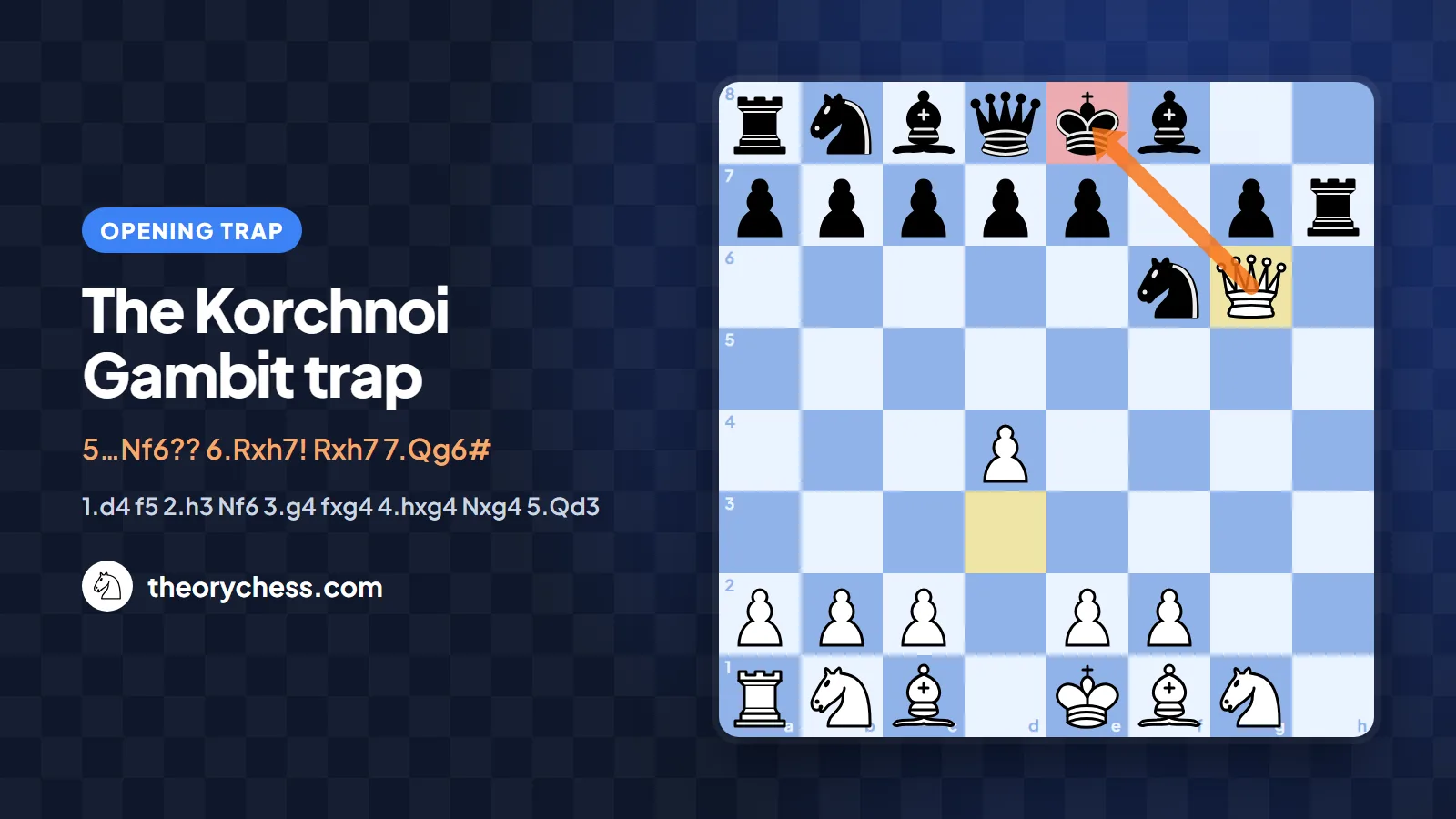
· 5 min read
The Korchnoi Gambit trap: open the h-file, mate on g6Against the Dutch, 1.d4 f5 2.h3 Nf6 3.g4!? gives up a pawn to open the h-file. After 5.Qd3 the natural 5…Nf6?? loses to 6.Rxh7! and 7.Qg6#. The trap move by move and the right reply, 5…g6!