
The Owen Defense trap: checkmate in eight after 3…f5?
In the Owen Defense, 3…f5? opens the h5-e8 diagonal. After 4.exf5! Bxg2? 5.Qh5+ g6 6.fxg6 Nf6?? 7.gxh7+! Nxh5 8.Bg6# the game is over on move eight. The trap, why it works and the right reply, 3…e6.
6 min readBy Hasan Süzen
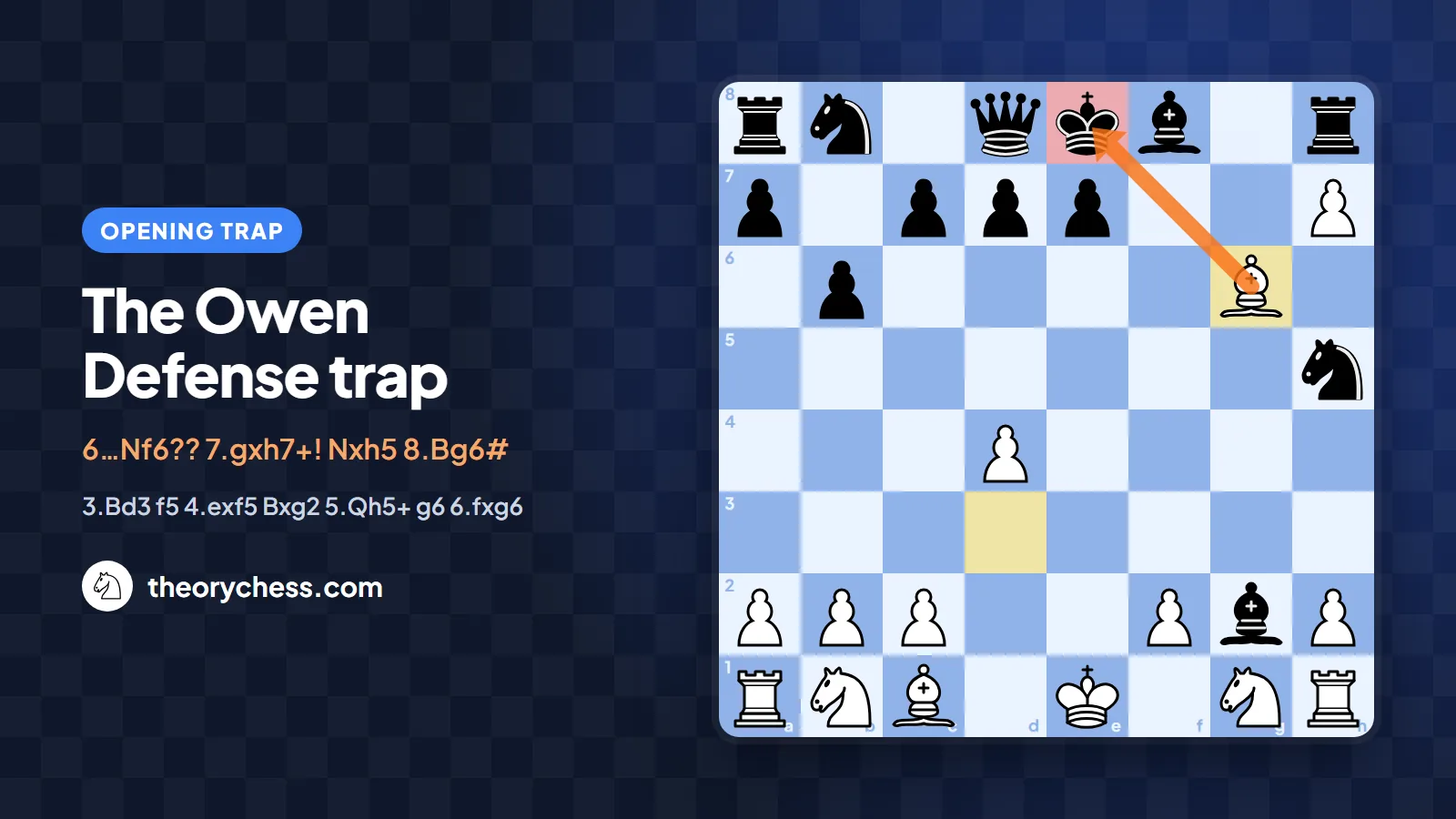
The Owen Defense trap is a short, brutal mating pattern from games that start 1.e4 b6. Black wants to attack White’s centre pawn early, pushes the f-pawn two squares and opens the diagonal in front of the king. A few natural-looking moves later White leaves the queen hanging and finishes the game with a bishop. In this article we go through the trap move by move, explain why it works and show what Black should play from the start.
What is the Owen Defense?
The Owen Defense starts with 1.e4 b6. It is named after the 19th-century English player John Owen. Black fianchettoes the bishop on b7, puts pressure on e4 from the long diagonal and chooses to challenge the centre from a distance instead of occupying it with pawns straight away.
A typical move order is 1.e4 b6 2.d4 Bb7 3.Bd3. White builds a two-pawn centre and the bishop on d3 defends e4. Black has perfectly solid options here; the problems start when Black tries to break e4 too quickly. If you are looking for a more classical and solid answer to 1.e4, the Caro-Kann Defense is a good place to start.
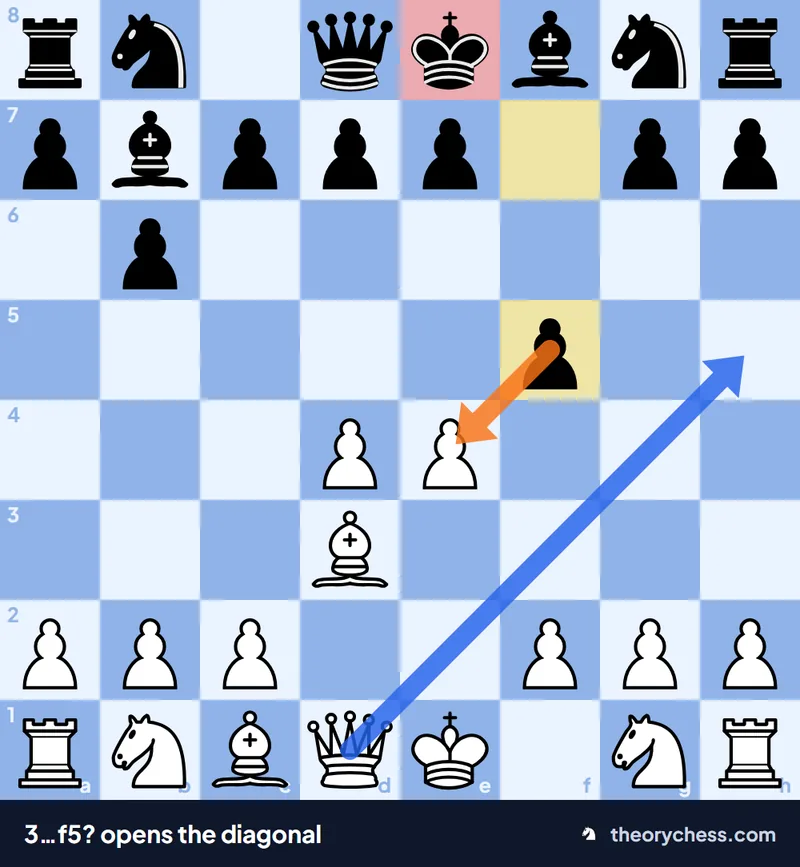
3…f5?: an attack on e4, but the h5-e8 diagonal is now open.
The trap move by move
3…f5? 4.exf5!: the pawn goes, the diagonal opens
At first sight 3…f5? makes sense: the bishop on b7 is already looking at e4, and the f-pawn attacks it a second time. But White simply takes: 4.exf5! According to Stockfish, White is about three pawns better after 3…f5. Black is now a pawn down, and the diagonal in front of the king on e8 is wide open.
4…Bxg2? 5.Qh5+ g6 6.fxg6: the king, not the rook
With the long diagonal now clear, Black takes back with 4…Bxg2? and attacks the rook on h1. White doesn’t bother saving it: 5.Qh5+! The only way to meet the check is 5…g6. Then comes 6.fxg6, and the pawn on g6 now eyes h7 while standing right in front of the queen, ready to unleash a discovered check.
6…Nf6??: hitting the queen, walking into mate
6…Nf6?? looks completely natural: the knight develops and attacks the queen on h5. But White makes no effort to save the queen: 7.gxh7+! When the pawn steps to h7, g6 is cleared and the queen on h5 gives check to the king on e8. It is a discovered check, and Black’s only legal move is to take the queen: 7…Nxh5.
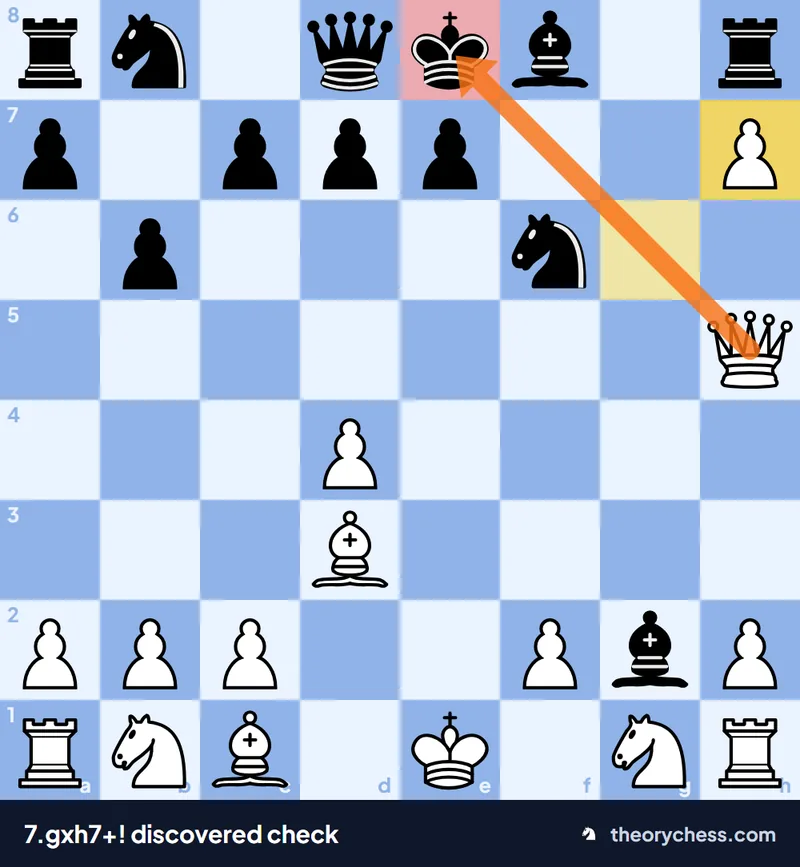
7.gxh7+!: the queen is hanging, but she is also the one giving check.
8.Bg6#: mate with the bishop
8.Bg6# ends the game. The bishop checks along the g6-e8 diagonal. The f7-square is empty but covered by the bishop, while d8, d7, e7 and f8 are all occupied by Black’s own pieces. The king can’t move, nothing can block, and nothing can take the bishop.
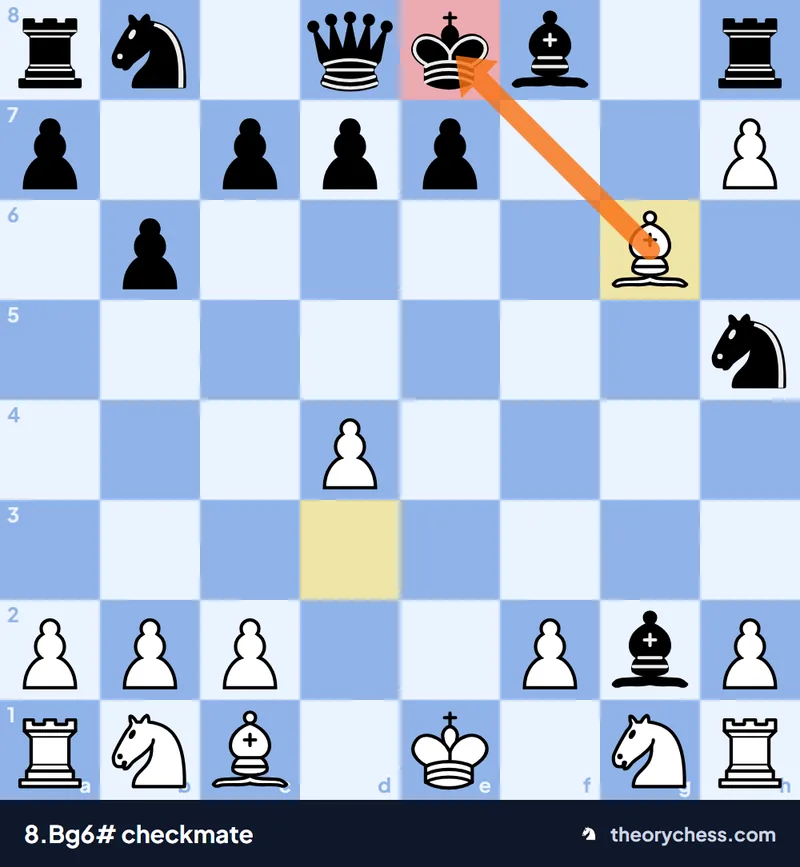
8.Bg6#: the black king is boxed in by its own pieces.
The whole sequence: 1.e4 b6 2.d4 Bb7 3.Bd3 f5 4.exf5 Bxg2 5.Qh5+ g6 6.fxg6 Nf6 7.gxh7+ Nxh5 8.Bg6#.
Why the trap works
- The f-pawn was the king’s shield: 3…f5 opened the e8-h5 diagonal, so White’s queen could give check in a single move.
- The rook was bait: after 4…Bxg2 the rook on h1 is attacked, but for White an attack on the king is worth far more than a rook.
- A discovered check beats a threat: 6…Nf6 attacked the queen, but 7.gxh7+ came with check, so Black never had time to carry out the threat.
- The king had no escape squares: the pieces on d8, d7, e7 and f8 kept the king locked in its own home.
What should Black play?
The best reply is not 3…f5 but calm development: 3…e6. It opens the f8-a3 diagonal for the bishop and keeps the diagonal in front of the king closed. According to Stockfish, after 3…e6, 3…d6 or 3…Nf6 White has only the usual small opening edge, and a normal game begins.
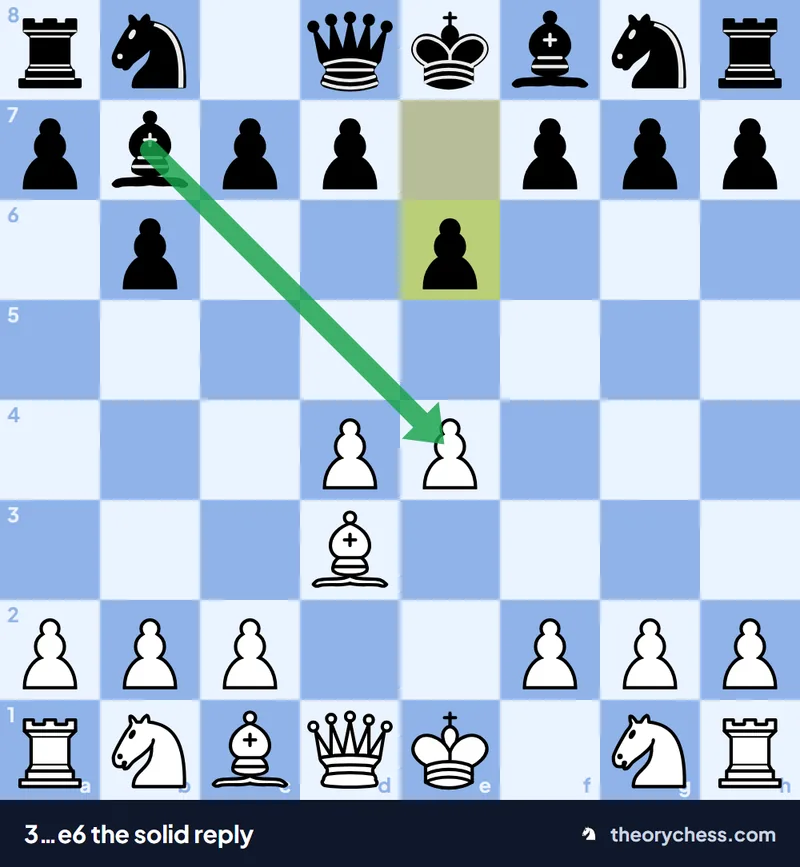
3…e6: the king is covered and the pressure on e4 stays.
Once 3…f5 has been played, Black is already in serious trouble. After 6.fxg6 the toughest move is 6…Bg7: the bishop clears f8, so after 7.gxh7+ the king can step to f8. Even then White is about three pawns ahead and Black is lost. 6…Nf6?? allows mate in two.
Key moments at a glance
| Move | What happens | Lesson |
|---|---|---|
| 3…f5? | Attacks e4 but opens the h5-e8 diagonal. | The f-pawn guards the king; don’t push it early. |
| 4…Bxg2? | Wins the pawn back and hits the rook. | Don’t chase material with an open king. |
| 5.Qh5+ g6 6.fxg6 | A discovered check is set up. | A pawn in front of the queen can be a weapon. |
| 6…Nf6?? | Attacks the queen, but 7.gxh7+ is coming. | Check your opponent’s checks first. |
| 8.Bg6# | The bishop mates a king boxed in by its own pieces. | A king without escape squares is in danger. |
| 3…e6! | Solid development and a normal game. | Develop first, attack later. |
What this trap teaches
The main lesson is the value of the f-pawn. In the opening, f7 (f2 for White) is the most sensitive point around the king, and pushing the f-pawn opens the h5-e8 diagonal to the enemy queen. You can see exactly the same mating pattern in the Dutch Defense trap: there too the f-pawn has advanced, and the game ends with Bg6#.
The second lesson is that attacking the opponent’s queen isn’t always safe. 6…Nf6 created a real threat on its own, but Black never checked White’s checking moves. Asking “Can my opponent give check?” before every move is enough to avoid this whole trap.
For White, the note is the opposite: the trap works because White ignored material twice, first the rook on h1, then the queen on h5. Against an exposed king, look for checks before rescuing your own pieces.
Frequently asked questions
Is the Owen Defense a bad opening?
No. With calm moves like 3…e6 it is a playable defence. The trap doesn’t come from the opening itself but from a hasty move like 3…f5.
What should Black play instead of 6…Nf6?
6…Bg7 is the toughest defence, because it frees the f8-square for the king. But White is still clearly winning; the real mistake came earlier, with 3…f5.
Should White save the rook after 4…Bxg2?
No. 5.Qh5+ is by far the strongest move; quiet moves that look after the rook throw away most of White’s advantage.
Where else does this mating pattern appear?
In any opening where the f-pawn advances early, and the Dutch Defense is the best-known example. For more short traps, see opening traps every club player should know.
Practise it on TheoryChess
Reading a trap and spotting it over the board are two different things. TheoryChess doesn’t have an Owen trainer yet, but if you want a solid answer to 1.e4, you can play the main lines in the Caro-Kann trainer against Stockfish, then test yourself with the Caro-Kann quiz. For another trap that ends with a mate on an exposed king, read about Légal’s mate. Every opening is waiting in the opening catalogue.
Keep reading
· 6 min read
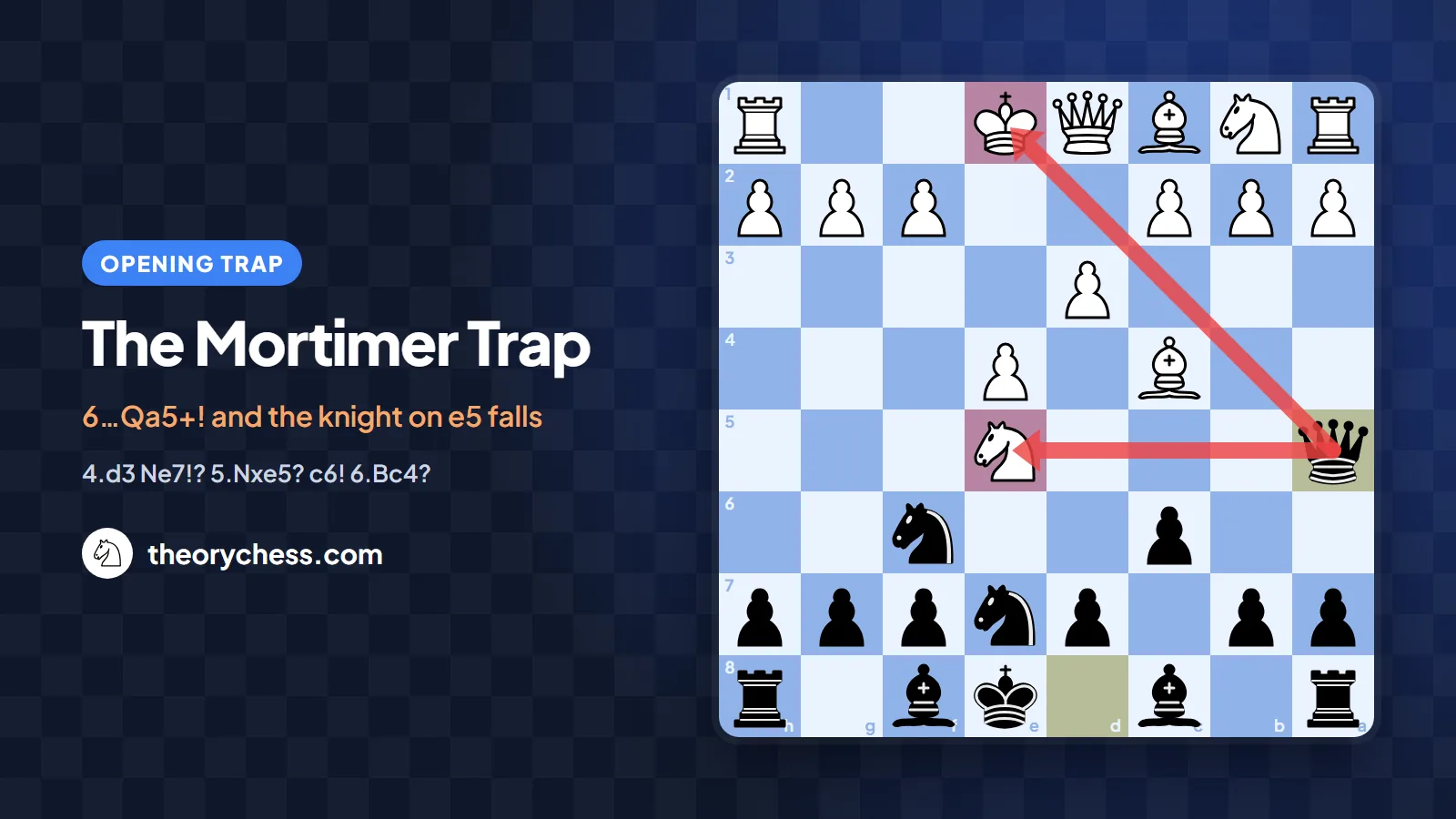
The Mortimer Trap: how 6…Qa5+ wins a knight in the Ruy LopezIn the Berlin with 4.d3, 4…Ne7!? leaves the e5-pawn unguarded. After 5.Nxe5? c6! 6.Bc4? Qa5+! the queen hits the king and the knight on e5 at once. The trap move by move and the right plan, 5.Nc3.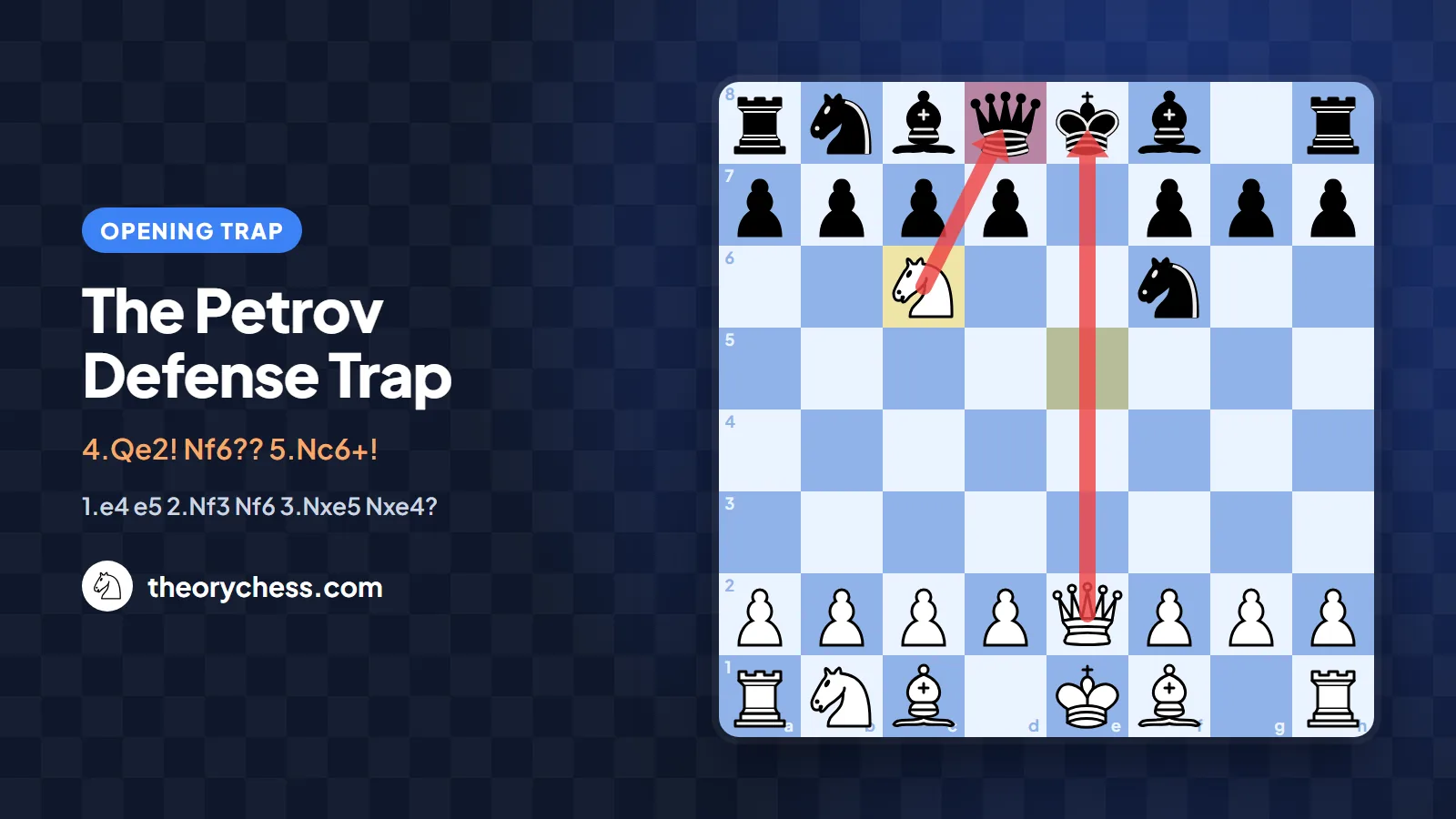
· 5 min read
The Petrov Defense trap: why copying your opponent loses the queenIn the Petrov Defense, copying with 3…Nxe4? after 3.Nxe5 lets White play 4.Qe2!, and 4…Nf6?? loses the queen to 5.Nc6+! The trap move by move and the right replies, 3…d6! and 4…Qe7!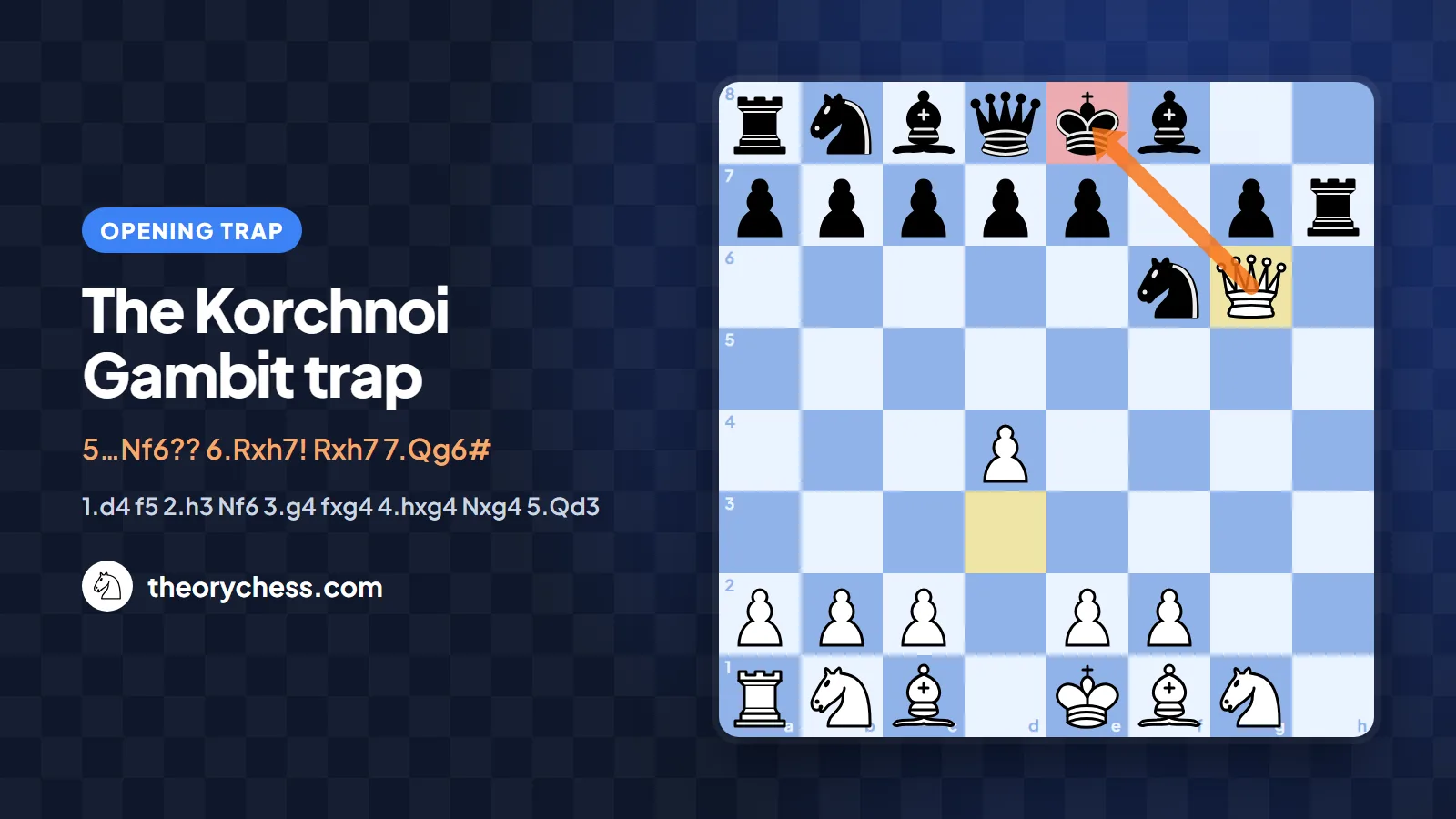
· 5 min read
The Korchnoi Gambit trap: open the h-file, mate on g6Against the Dutch, 1.d4 f5 2.h3 Nf6 3.g4!? gives up a pawn to open the h-file. After 5.Qd3 the natural 5…Nf6?? loses to 6.Rxh7! and 7.Qg6#. The trap move by move and the right reply, 5…g6!