
The Korchnoi Gambit trap: open the h-file, mate on g6
Against the Dutch, 1.d4 f5 2.h3 Nf6 3.g4!? gives up a pawn to open the h-file. After 5.Qd3 the natural 5…Nf6?? loses to 6.Rxh7! and 7.Qg6#. The trap move by move and the right reply, 5…g6!
5 min readBy Hasan Süzen
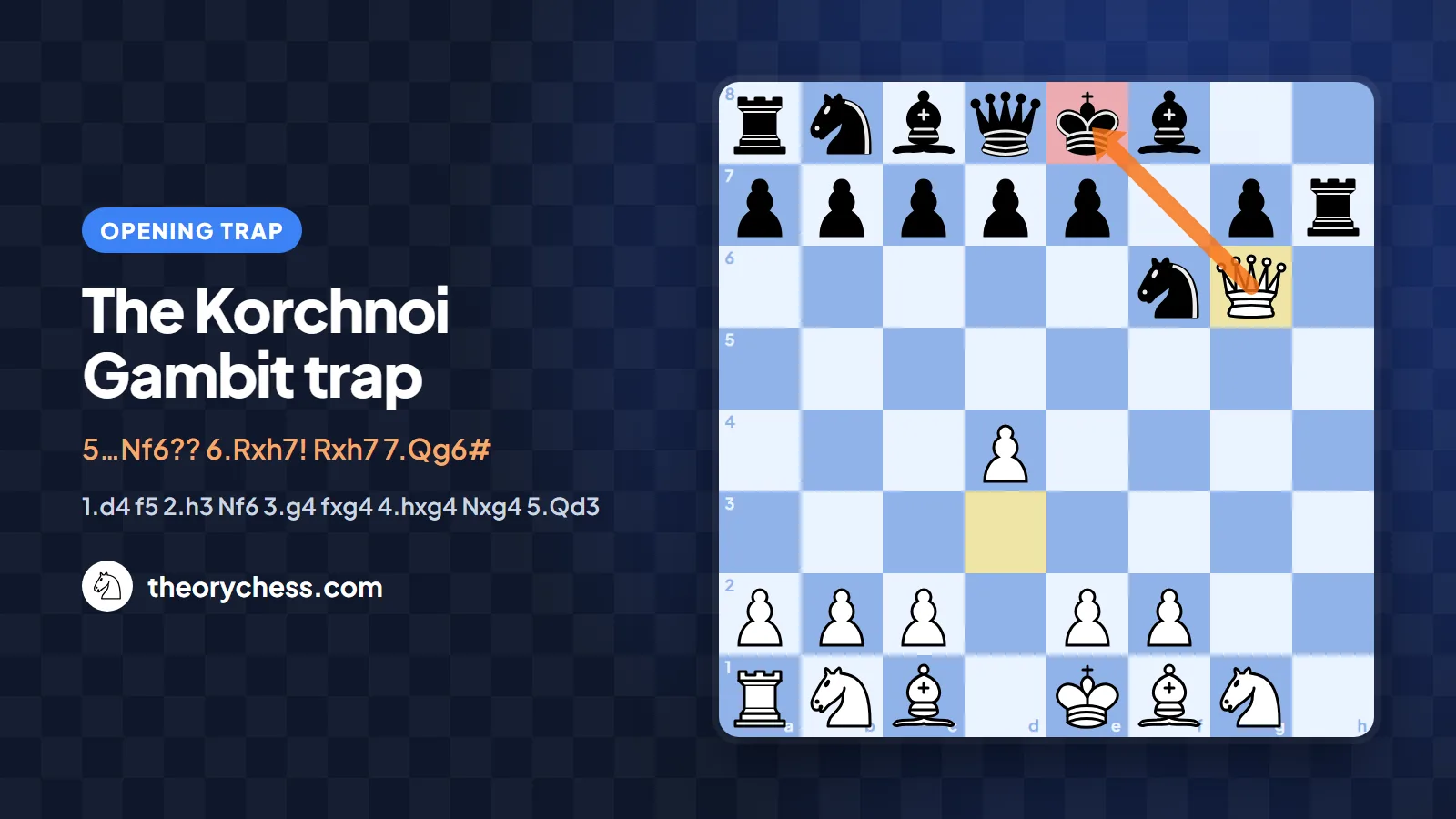
The Korchnoi Gambit trap is one of the quickest mating traps against the Dutch Defense. White gives up the g-pawn to open the h-file. When Black takes the pawn and then retreats the knight to its most natural square, White crashes in with the rook on h7 and mates with the queen on g6. In this article we go through the trap move by move, explain why it works and show Black’s correct defence.
What is the Korchnoi Gambit?
The Dutch Defense starts with 1.d4 f5. Black fights for the e4-square, but moving the f-pawn weakens the e8–h5 diagonal and the g6-square. White can go after that weakness with 2.h3 Nf6 3.g4!?. The idea is known as the Korchnoi Gambit, or Korchnoi Attack, after Viktor Korchnoi.
The logic is simple: if Black takes on g4, White recaptures with the h-pawn and the h-file opens. The rook on h1 joins the game without White even castling. Stockfish rates the position after 3.g4 as roughly level, so the gambit isn’t unsound, but it asks Black to be careful.
We covered the other famous Dutch trap, the line that starts with 2.Bg5 and ends with Bg6#, in our article on the Dutch Defense trap, where this gambit also gets a brief mention.
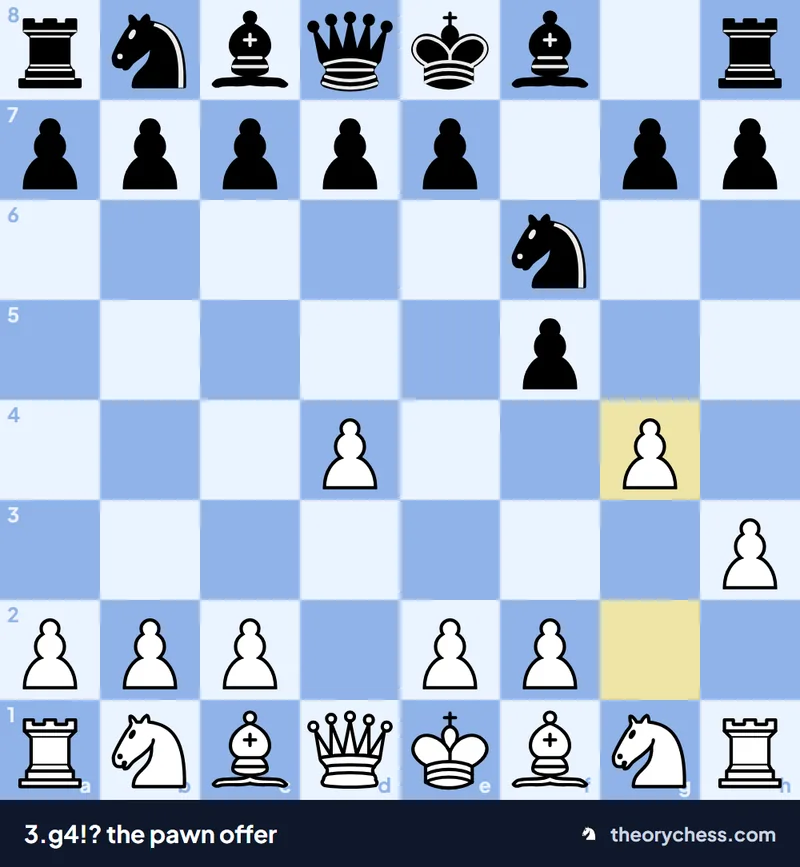
3.g4!?: White gives up a pawn to open the h-file.
The trap move by move
3…fxg4 4.hxg4 Nxg4: Black grabs the pawn
Black accepts the gambit: 3…fxg4 4.hxg4 Nxg4. Once White’s h-pawn has moved to g4, the h-file is open. The knight takes on g4 and Black is a pawn up.
5.Qd3: two targets
5.Qd3 puts the queen on the d3–g6 diagonal. Because the f-pawn has moved, g6 is the weakest square around Black’s king. At the same time the rook on h1 looks straight down the open h-file at the pawn on h7.
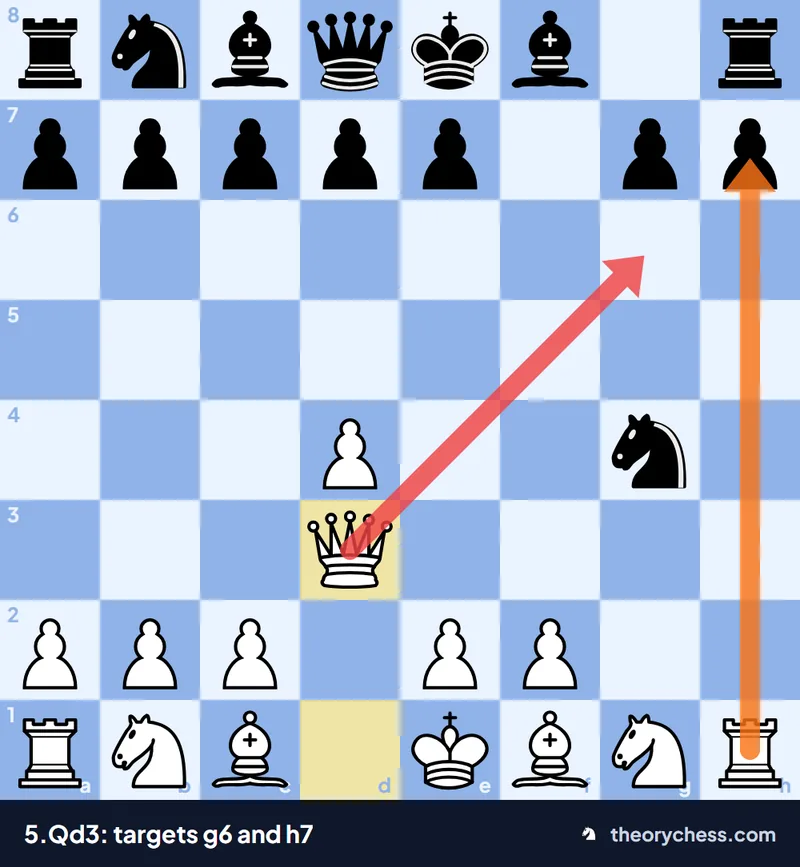
5.Qd3: the queen eyes g6, the rook eyes h7.
5…Nf6??: the natural retreat
The knight doesn’t feel comfortable on g4, so Black brings it back to the most natural square: 5…Nf6??. It looks solid, but the g6-square is still undefended.
6.Rxh7! and 7.Qg6#
6.Rxh7! takes the h7-pawn. If Black takes the rook, with 6…Rxh7 or 6…Nxh7, then 7.Qg6# follows at once. From g6 the queen sees all the way to e8, and f7 is empty because of 1…f5. Black’s own pawns stand on d7 and e7, the bishop stands on f8, and f7 is covered by the queen. The king has nowhere to go.
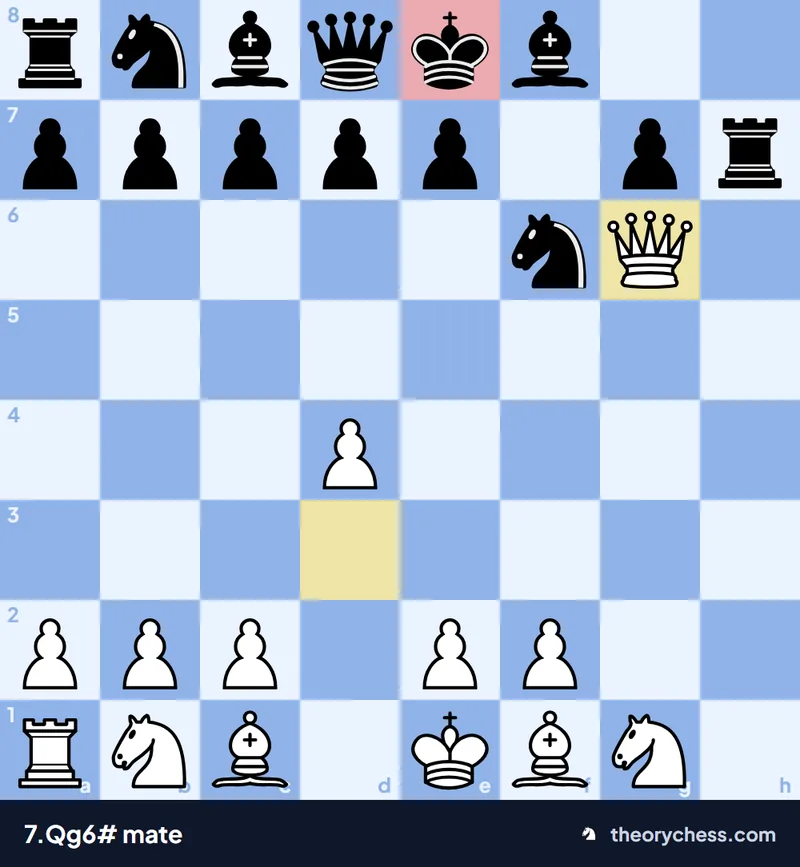
7.Qg6#: the king has no escape square.
The whole sequence: 1.d4 f5 2.h3 Nf6 3.g4 fxg4 4.hxg4 Nxg4 5.Qd3 Nf6 6.Rxh7 Rxh7 7.Qg6#.
Leaving the rook alone doesn’t save Black either. The engine’s toughest tries are 6…d5 and 6…e5, but after, for example, 6…e5 7.Qg6+ Ke7 8.Rxh8 White is about seven pawns up.
Why does the trap work?
- 1…f5 weakens the e8–h5 diagonal and the g6-square for the rest of the game.
- 3.g4 and 4.hxg4 open the h-file, so the rook joins the attack without castling.
- Black’s own pieces block the king: d7, e7 and f8 are all occupied.
- Once the h7-pawn falls, nothing is left to guard g6.
What should Black play?
The right move is 5…g6!. The pawn takes the g6-square away from the queen and cuts the diagonal. White is still a little better for the gambit pawn, about a pawn according to Stockfish, but it’s a normal fight again.
5…d5? isn’t enough: 6.Rxh7! comes anyway. There’s no mate this time, because after 6…Rxh7 7.Qg6+ the king can run to d7. But 8.Qxh7 wins the pawn back and White is clearly better.
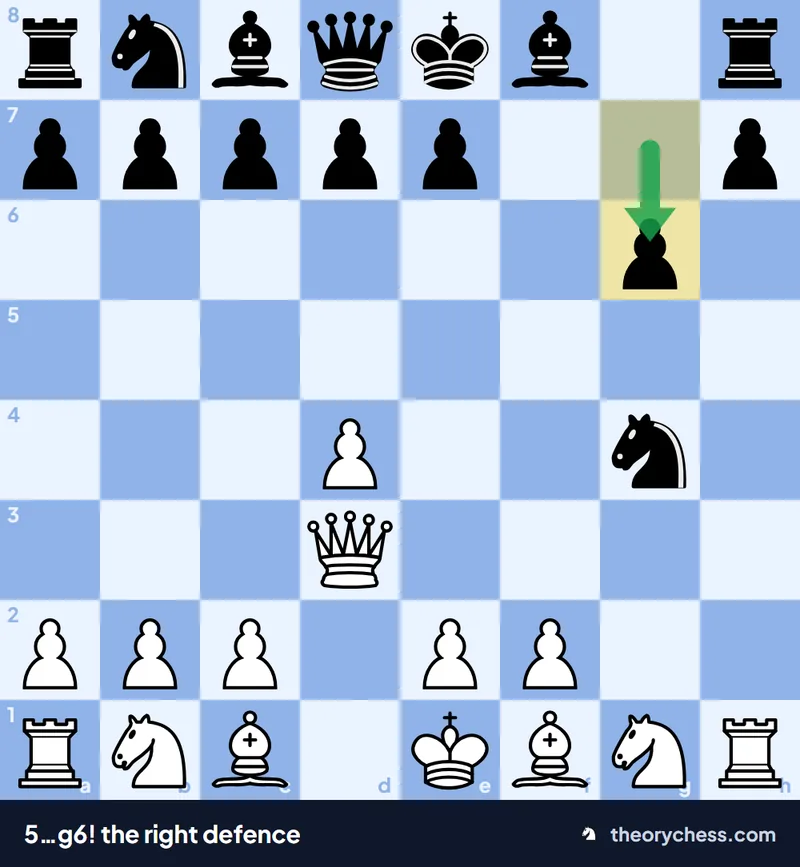
5…g6!: the weak square is shut with a pawn.
Key moments at a glance
| Move | What happens | Lesson |
|---|---|---|
| 3.g4!? | White gives up a pawn. | An open file can be worth a pawn. |
| 5.Qd3 | The queen eyes g6, the rook eyes h7. | Pile up on the weak square. |
| 5…Nf6?? | g6 is left unguarded. | Natural moves need a threat check too. |
| 6.Rxh7! and 7.Qg6# | Rook sacrifice and mate. | Remove the last defender. |
| 5…g6! | The g6-square is shut. | Plug a weak square with a pawn. |
What this trap teaches
The Dutch isn’t a bad opening, but 1…f5 leaves a permanent weakness in front of the king. When White opens lines with the g- and h-pawns, Black has to think about g6 and the e8–h5 diagonal on every single move.
The second lesson is about your own pieces around the king. The pawns on d7 and e7 and the bishop on f8 normally protect the king, but at the moment of mate they take away every escape square. To judge whether a king is safe, look not only at the attacking pieces but also at where the king could run.
For White, it’s worth remembering that 3.g4 is a real opening idea, not just a cheap shot. Against the right defence White still gets active play for the pawn, so the gambit is a reasonable practical weapon even when the trap doesn’t land.
Frequently asked questions
Does the Korchnoi Gambit win by force?
No. If Black defends correctly with 5…g6, White is only slightly better. But the chances of Black going wrong are high, especially in fast games.
Does Black have to accept the gambit?
No. Stockfish also rates moves such as 3…d5 and 3…e6 as good replies to 3.g4.
Why isn’t 5…d5 enough?
Because 6.Rxh7! still works. The king can escape to d7, so there’s no mate, but White wins the pawn back and stays clearly better.
Is this the same as the other Dutch trap?
The moves are different, but the theme is the same: an open e8–h5 diagonal and a weak g6-square.
Practise it on TheoryChess
Reading a mating trap and spotting it over the board are two different things. On TheoryChess you can play these lines in the Dutch Defense trainer against Stockfish, then test yourself with the Dutch Defense quiz. For another trap after 1.d4, read about the Englund Gambit trap, and for a wider list see opening traps every club player should know. Every opening is waiting in the opening catalogue.
Keep reading
· 6 min read
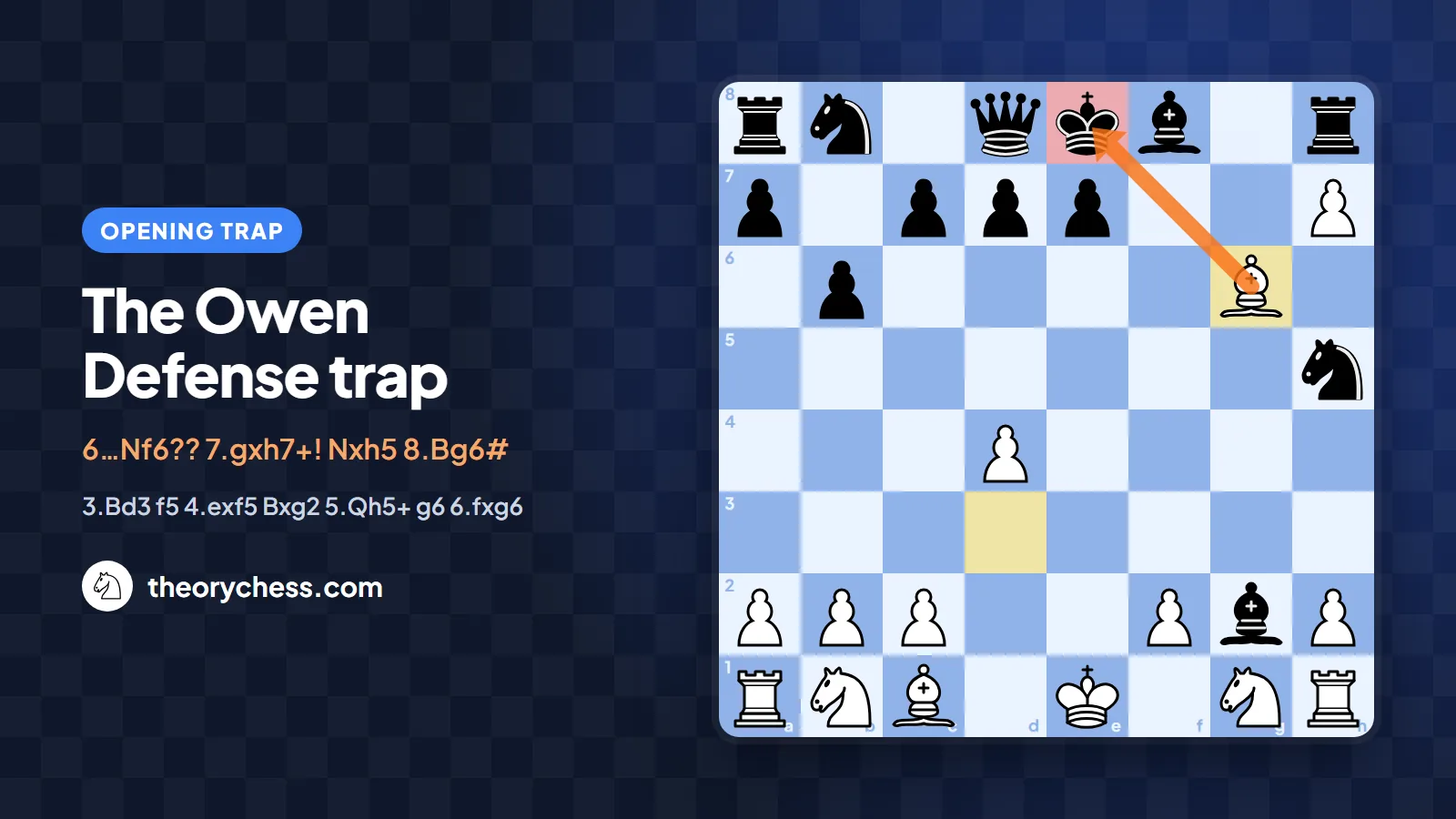
The Owen Defense trap: checkmate in eight after 3…f5?In the Owen Defense, 3…f5? opens the h5-e8 diagonal. After 4.exf5! Bxg2? 5.Qh5+ g6 6.fxg6 Nf6?? 7.gxh7+! Nxh5 8.Bg6# the game is over on move eight. The trap, why it works and the right reply, 3…e6.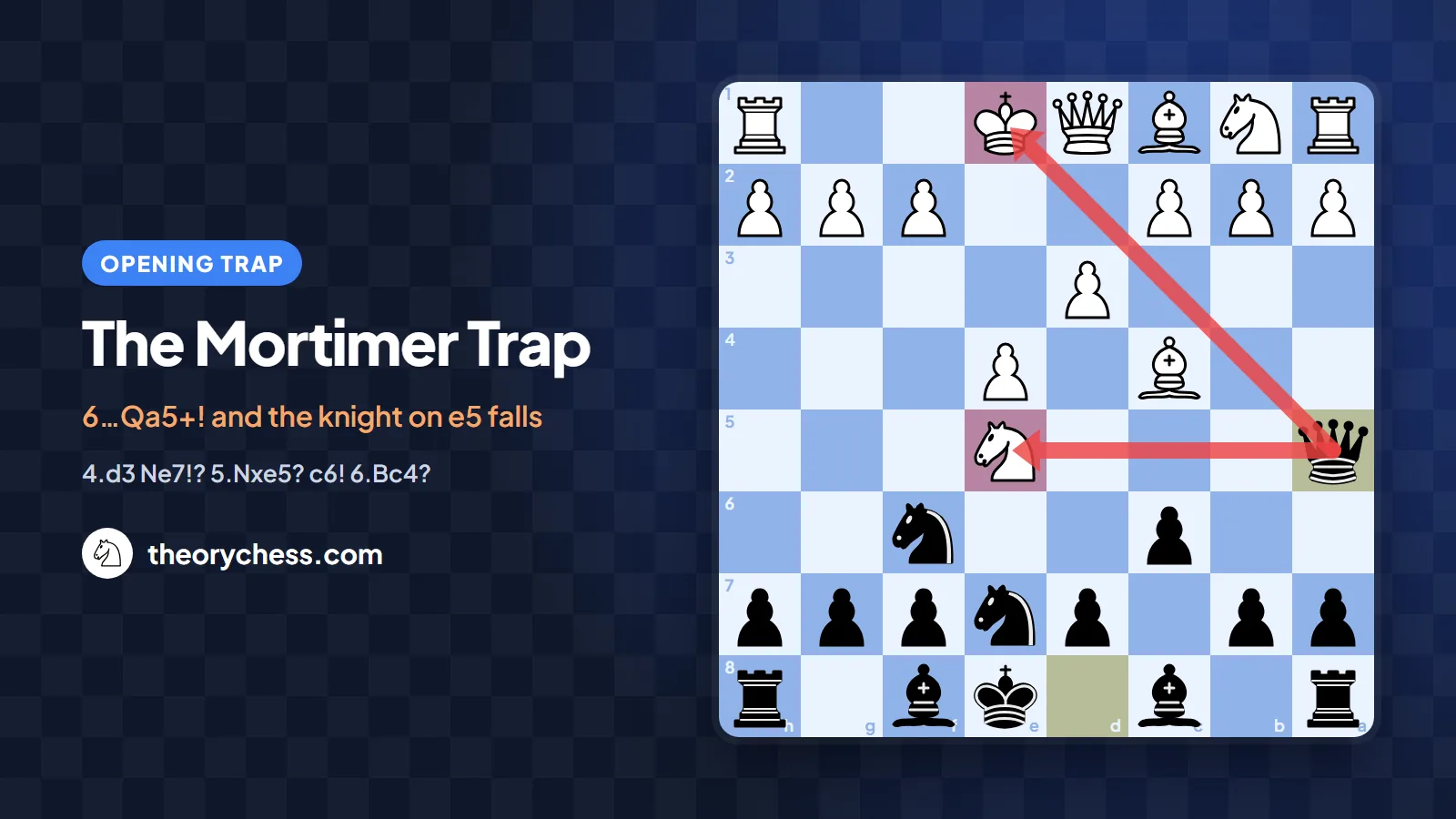
· 6 min read
The Mortimer Trap: how 6…Qa5+ wins a knight in the Ruy LopezIn the Berlin with 4.d3, 4…Ne7!? leaves the e5-pawn unguarded. After 5.Nxe5? c6! 6.Bc4? Qa5+! the queen hits the king and the knight on e5 at once. The trap move by move and the right plan, 5.Nc3.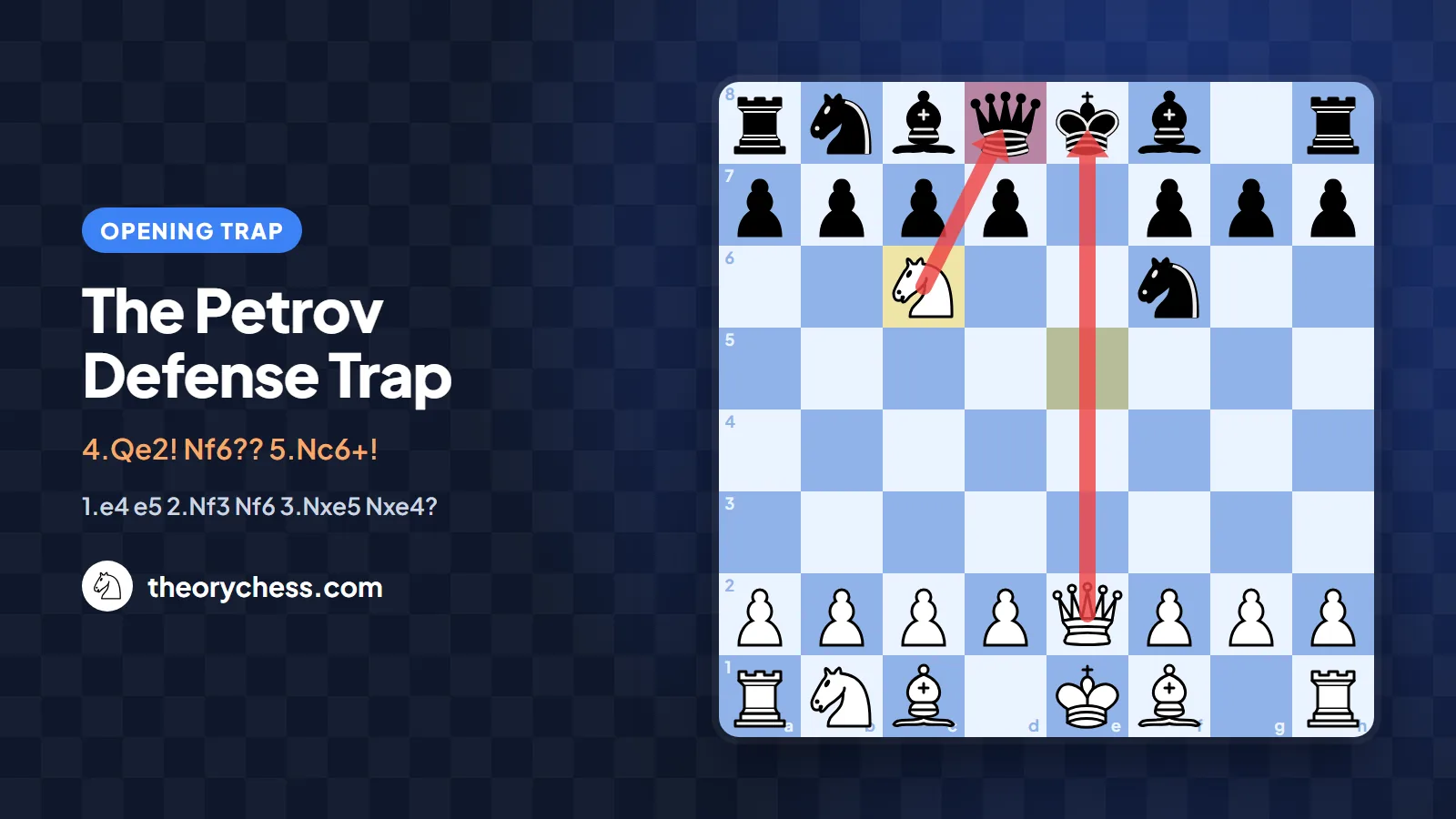
· 5 min read
The Petrov Defense trap: why copying your opponent loses the queenIn the Petrov Defense, copying with 3…Nxe4? after 3.Nxe5 lets White play 4.Qe2!, and 4…Nf6?? loses the queen to 5.Nc6+! The trap move by move and the right replies, 3…d6! and 4…Qe7!