
The French Advance trap: the free d4-pawn that costs a queen
In the Advance French, 6.Bd3 makes d4 look undefended. 7…Nxd4?? 8.Nxd4 Qxd4 runs into 9.Bb5+!, and the queen falls. The trap move by move, why it works and the right reply, 7…Bd7!
5 min readBy Hasan Süzen
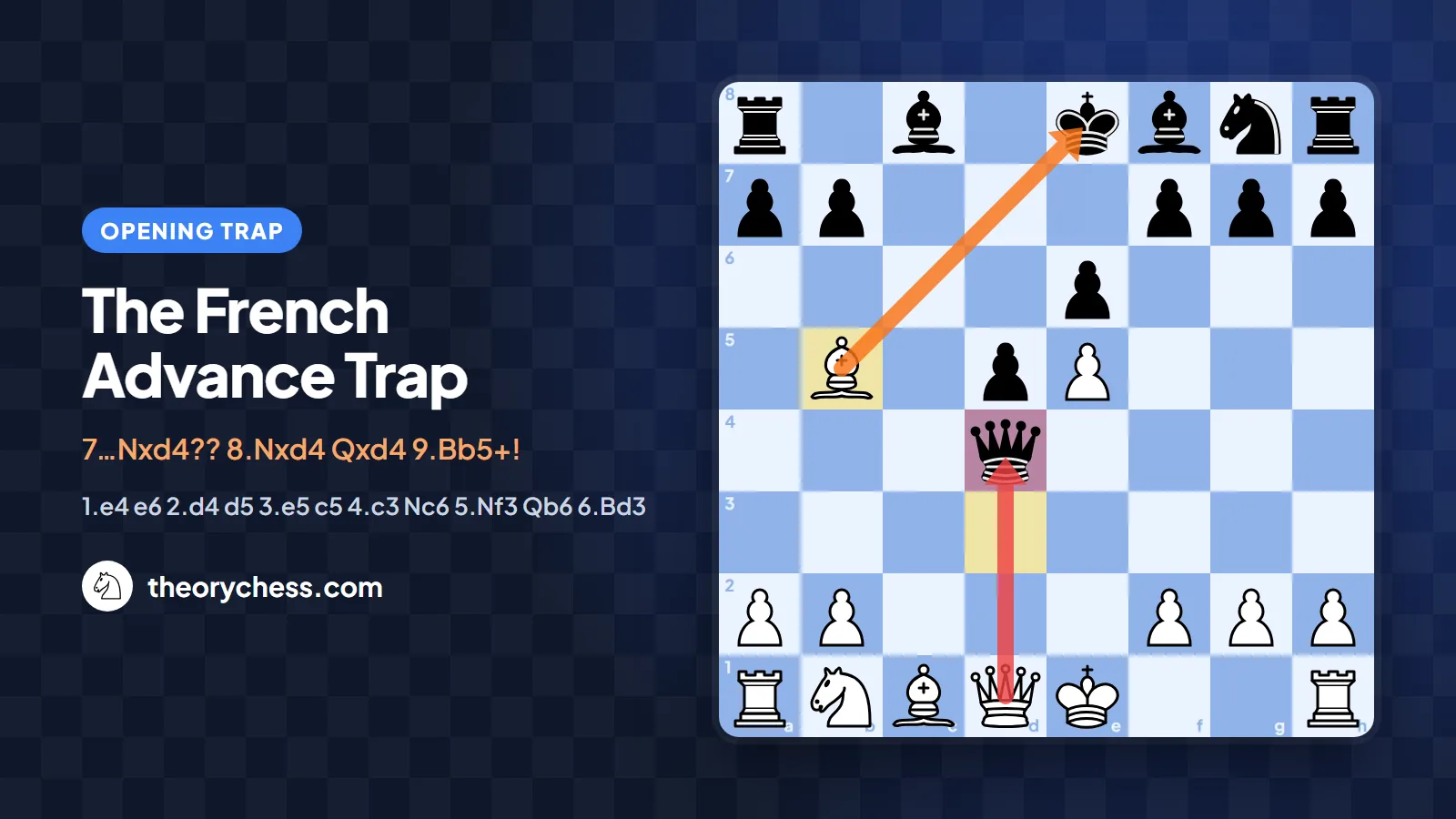
The French Advance trap is one of the most instructive traps in the French Defence. Black throws everything at the d4-pawn, and the moment it finally looks undefended, Black grabs it. One bishop check later, the free pawn has turned into a lost queen. In this article we go through the trap move by move, explain why it works and show what Black should play instead.
What is the Advance Variation?
The French Defence starts with 1.e4 e6 2.d4 d5. When White pushes on with 3.e5, we are in the Advance Variation. White gains space, and Black answers by attacking the base of the pawn chain: the pawn on d4. You can find the wider plans in our French Defence guide.
The typical move order is 3…c5 4.c3 Nc6 5.Nf3 Qb6. Now the c5-pawn, the knight on c6 and the queen on b6 all hit the same square. White defends d4 with the c3-pawn, the knight on f3 and the queen on d1.
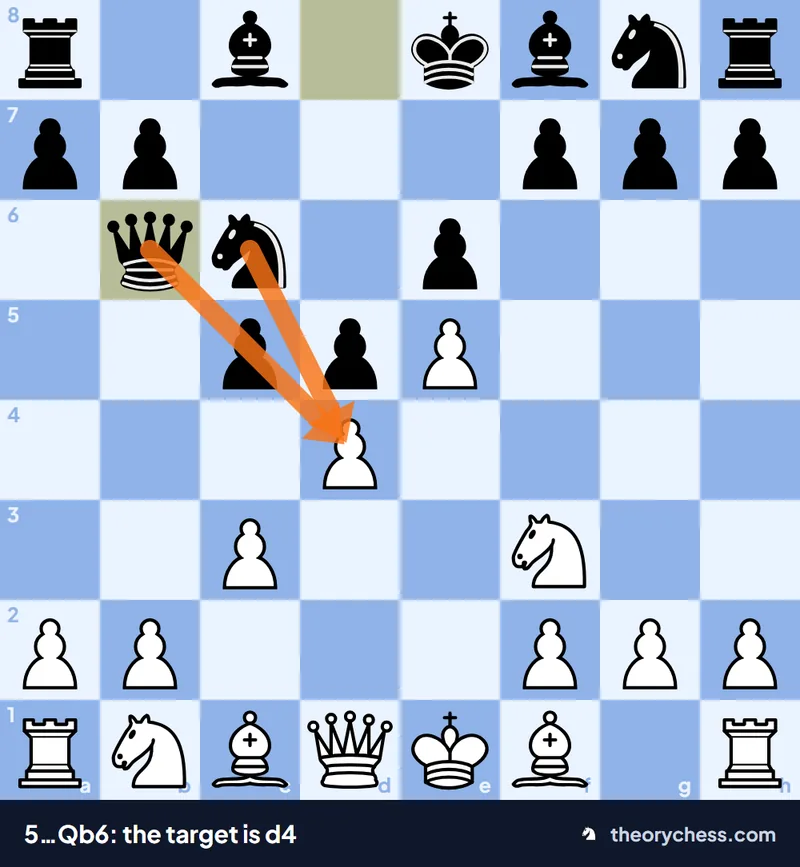
5…Qb6: Black’s queen and knight pile up on d4.
The trap move by move
6.Bd3: the bishop steps onto the d-file
6.Bd3 is a natural developing move that prepares castling, and Stockfish rates it about the same as 6.a3 and 6.Be2. But the bishop now stands between the queen on d1 and the d4-pawn. After 6…cxd4 7.cxd4, two black pieces attack d4 and, at first glance, only the knight on f3 defends it. The pawn looks free.
7…Nxd4?? 8.Nxd4 Qxd4: the “free” pawn
Black takes: 7…Nxd4?? After 8.Nxd4 there is no way back. If Black doesn’t recapture, a whole piece is gone for a pawn, and the engine already has White more than four pawns up. So Black plays the natural 8…Qxd4 and seems to be a pawn ahead.
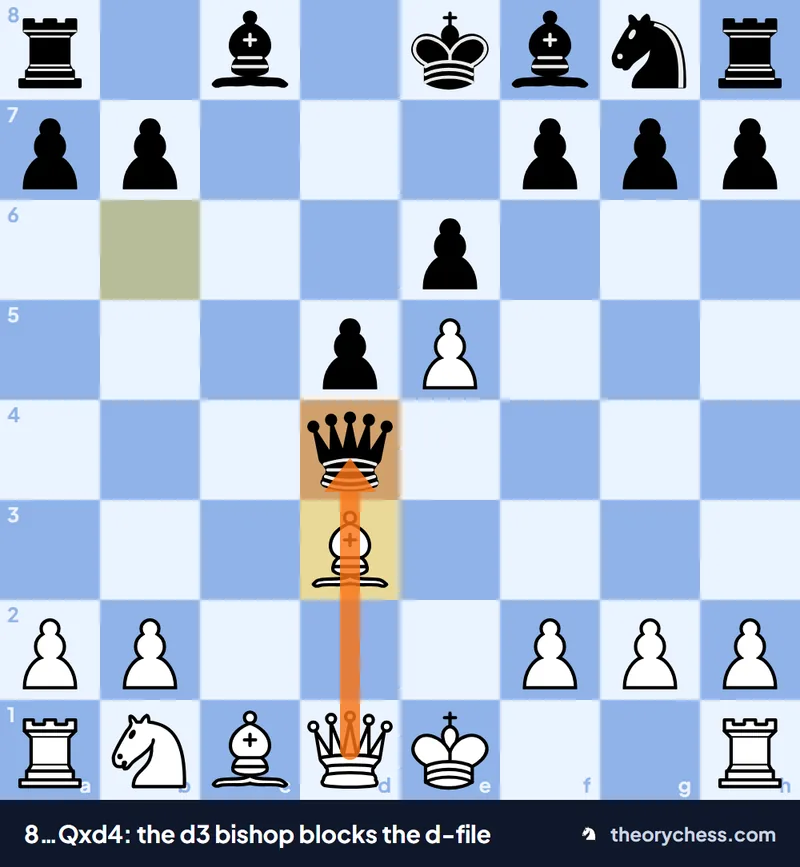
8…Qxd4: only the bishop on d3 stands between the two queens.
9.Bb5+!: the discovered attack
9.Bb5+! The bishop leaves the d-file with check and uncovers the queen on d1, which now attacks d4. Black has to deal with the check first, so there is no time to move the queen. After 9…Bd7 10.Bxd7+ Kxd7 11.Qxd4 White has won the queen. Stepping aside with 9…Kd8 or 9…Ke7 changes nothing: 10.Qxd4 follows at once. Black has nothing better than losing the queen, and Stockfish puts White about seven pawns up.
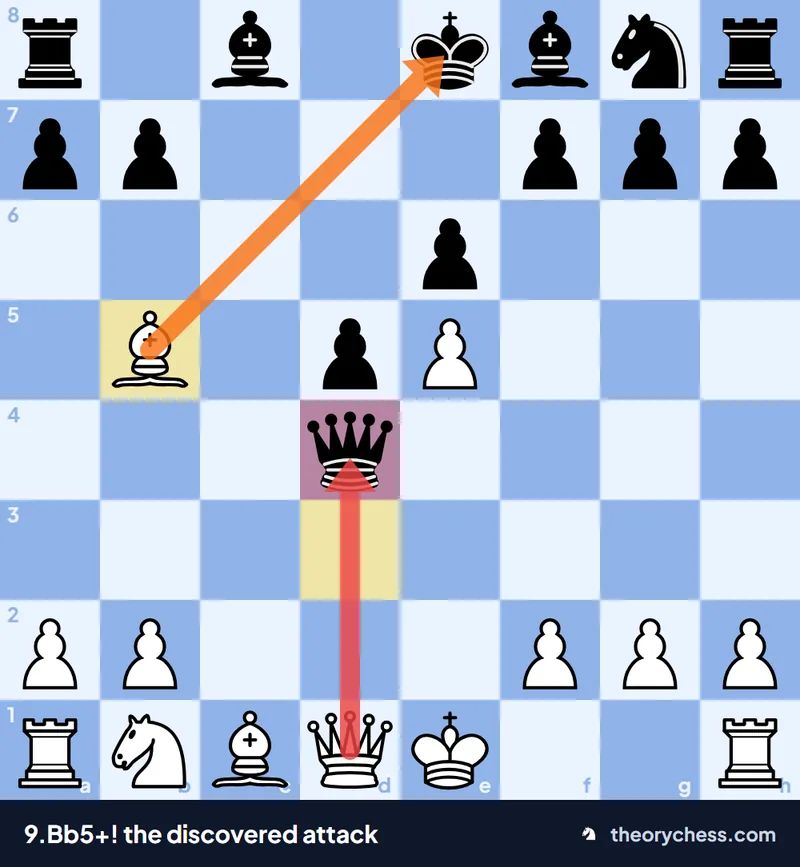
9.Bb5+!: check from the bishop, and the d-file is open.
The whole sequence: 1.e4 e6 2.d4 d5 3.e5 c5 4.c3 Nc6 5.Nf3 Qb6 6.Bd3 cxd4 7.cxd4 Nxd4 8.Nxd4 Qxd4 9.Bb5+ Bd7 10.Bxd7+ Kxd7 11.Qxd4.
Why does the trap work?
- The bishop on d3 hides the fact that the queen on d1 defends d4. The pawn looks undefended, but it isn’t.
- The bishop moves away with check. A check has to be answered first, so Black never gets the tempo to save the queen.
- Black’s queen on d4 has no defender of its own.
- The king on e8 sits on the b5–e8 diagonal, and nothing guards that diagonal.
What should Black play?
The right move is 7…Bd7!. The bishop closes the b5–e8 diagonal, so a later Bb5 can simply be met by …Bxb5 and the discovered attack is gone. Stockfish calls the position dead level.
After this, the pressure on d4 is real. White either restores the queen’s defence of d4 with a move like 8.Be2, or lets the pawn go as a gambit. In lines such as 8.O-O Nxd4 9.Nxd4 Qxd4 10.Nc3, White gets quick development for the pawn. The engine slightly prefers Black there, but the position is sharp and easy to go wrong in for both sides.
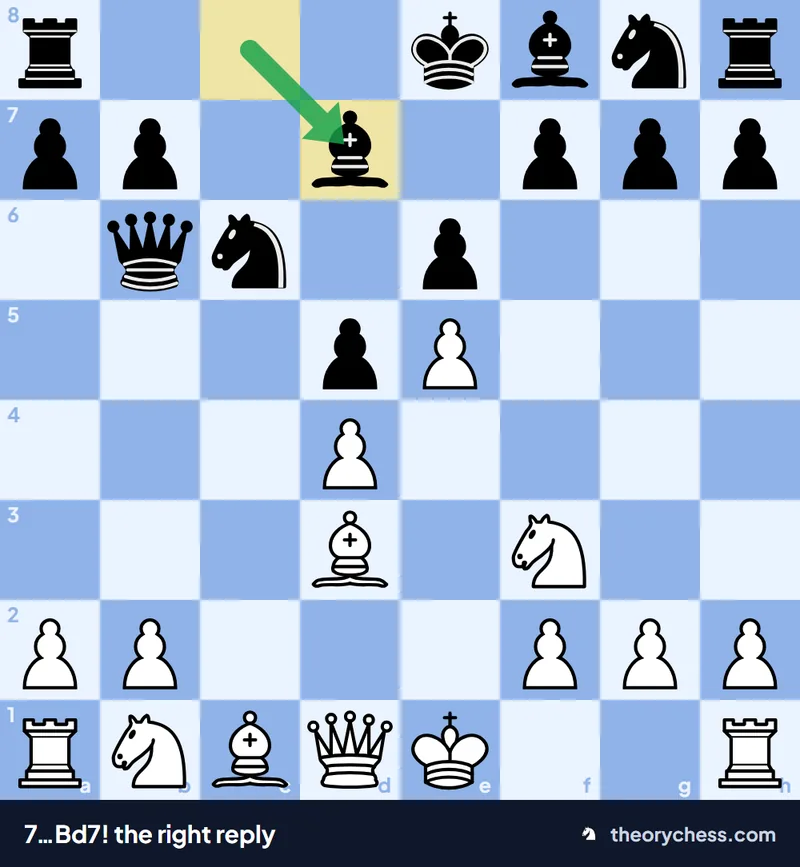
7…Bd7!: close the diagonal first, then think about d4.
Key moments at a glance
| Move | What happens | Lesson |
|---|---|---|
| 5…Qb6 | Black piles three units on d4. | Attack the base of the pawn chain. |
| 6.Bd3 | The bishop blocks the queen on the d-file. | A blocked line can still be a defence. |
| 7…Nxd4?? | Black grabs the “free” pawn. | Look for checks before you take. |
| 9.Bb5+! | The bishop checks and the queen sees d4. | A discovered attack with check can’t be parried. |
| 11.Qxd4 | White wins the queen. | An undefended queen is the biggest target. |
| 7…Bd7! | The diagonal is closed and the balance holds. | Remove the threat first. |
What this trap teaches
When you count how many times a square is defended, you have to count the pieces hiding behind other pieces too. The bishop on d3 was blocking the queen, but it was a piece that could step away in one move, and it could do so with check. When a piece moves off a line with check, the opponent never gets time to react to what it uncovers.
The same idea shows up in the Magnus Smith trap, where a pawn leaves the d-file and suddenly the queens face each other. In both cases the question is the same: if this piece moves, which line opens?
For White there is a practical point too. 6.Bd3 is a perfectly good move, so you lose nothing by playing it. If Black finds 7…Bd7, you simply play a normal game; if not, the queen is yours.
Frequently asked questions
Is 7…Nxd4 always a mistake?
In this exact position, yes. But once Black has played 7…Bd7, …Nxd4 becomes a real threat, because the Bb5+ trick no longer works.
Can Black escape after 9.Bb5+?
No. The engine shows that 9…Bd7, 9…Kd8 and 9…Ke7 all lose the queen, and even the best of them leaves Black about seven pawns down.
Should I play 6.Bd3 as White?
You can; the engine rates it alongside the other main moves. Just decide in advance whether you want to keep d4 or give it as a gambit after 7…Bd7.
Why does this trap catch so many players?
Because the idea is so natural. Black spends three moves aiming at d4, and when the pawn finally looks loose, taking it feels like the point of the whole plan. In fast games that is very easy to fall for.
Practise it on TheoryChess
Reading a trap and spotting it over the board are two different things. On TheoryChess you can play these lines in the French Advance trainer against Stockfish, then test yourself with the French Advance quiz. For a trap that punishes copying your opponent in the open game, read about the Petrov Defense trap, and for a wider list see opening traps every club player should know. Every opening is waiting in the opening catalogue.
Keep reading
· 6 min read
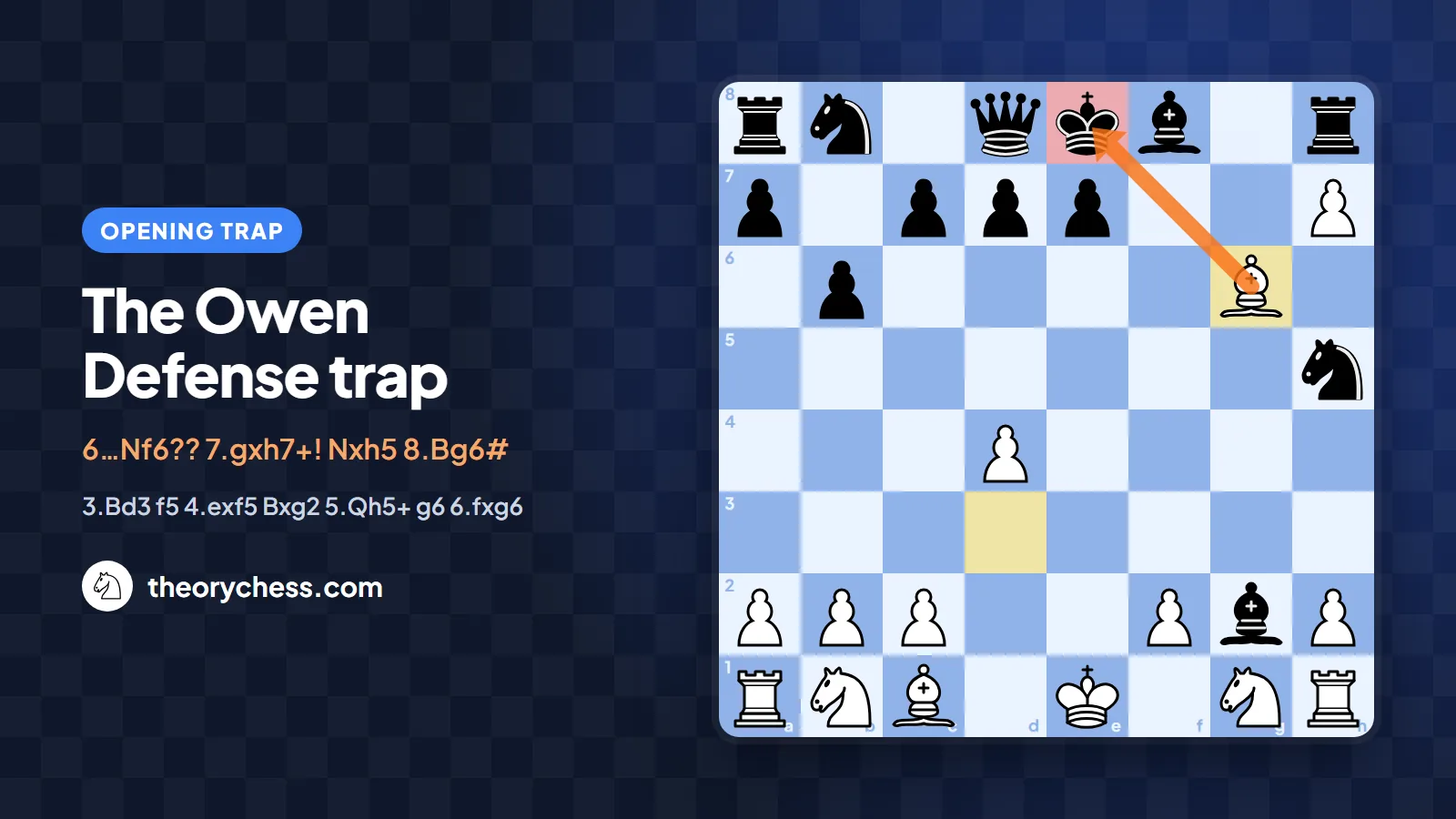
The Owen Defense trap: checkmate in eight after 3…f5?In the Owen Defense, 3…f5? opens the h5-e8 diagonal. After 4.exf5! Bxg2? 5.Qh5+ g6 6.fxg6 Nf6?? 7.gxh7+! Nxh5 8.Bg6# the game is over on move eight. The trap, why it works and the right reply, 3…e6.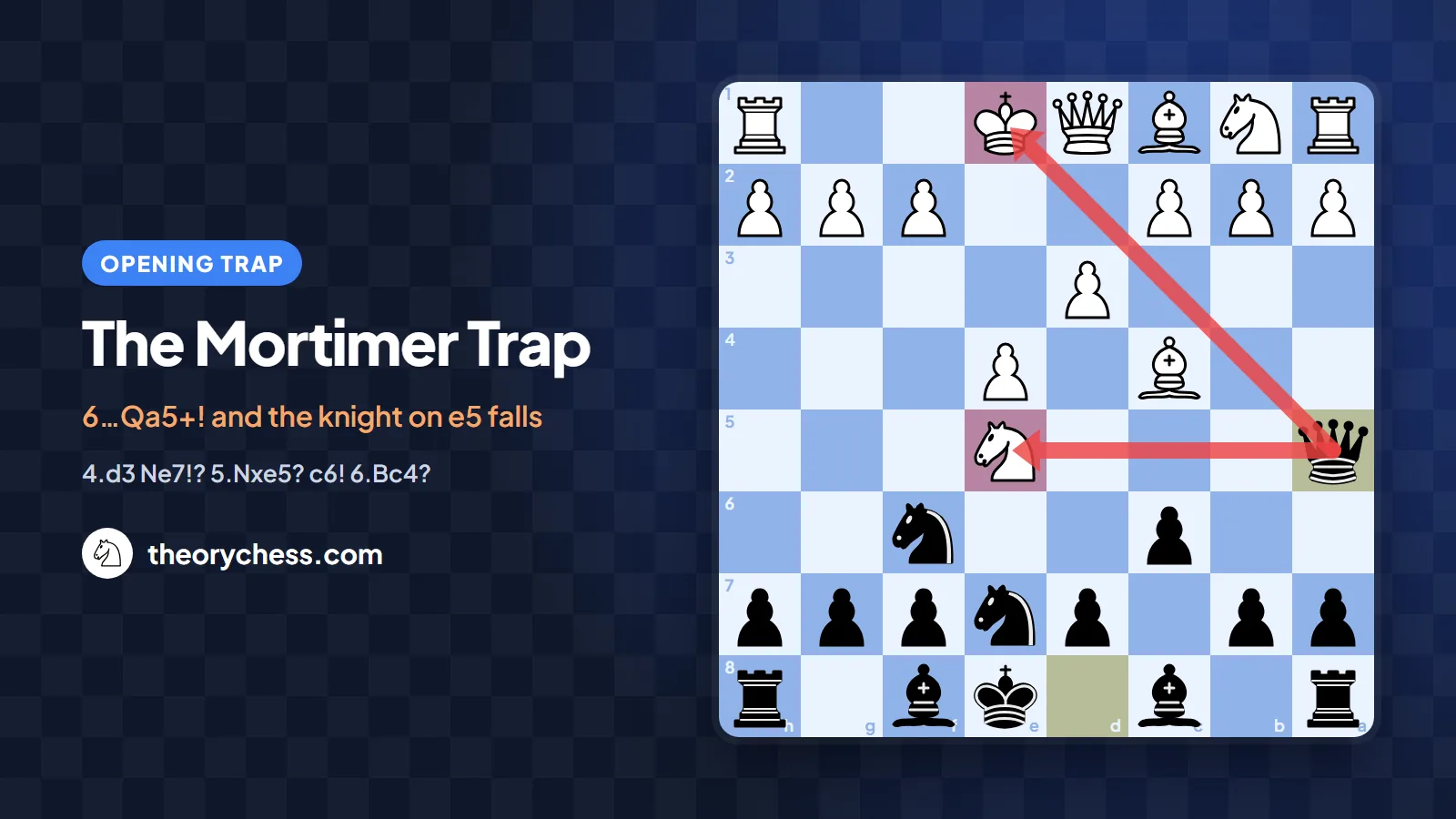
· 6 min read
The Mortimer Trap: how 6…Qa5+ wins a knight in the Ruy LopezIn the Berlin with 4.d3, 4…Ne7!? leaves the e5-pawn unguarded. After 5.Nxe5? c6! 6.Bc4? Qa5+! the queen hits the king and the knight on e5 at once. The trap move by move and the right plan, 5.Nc3.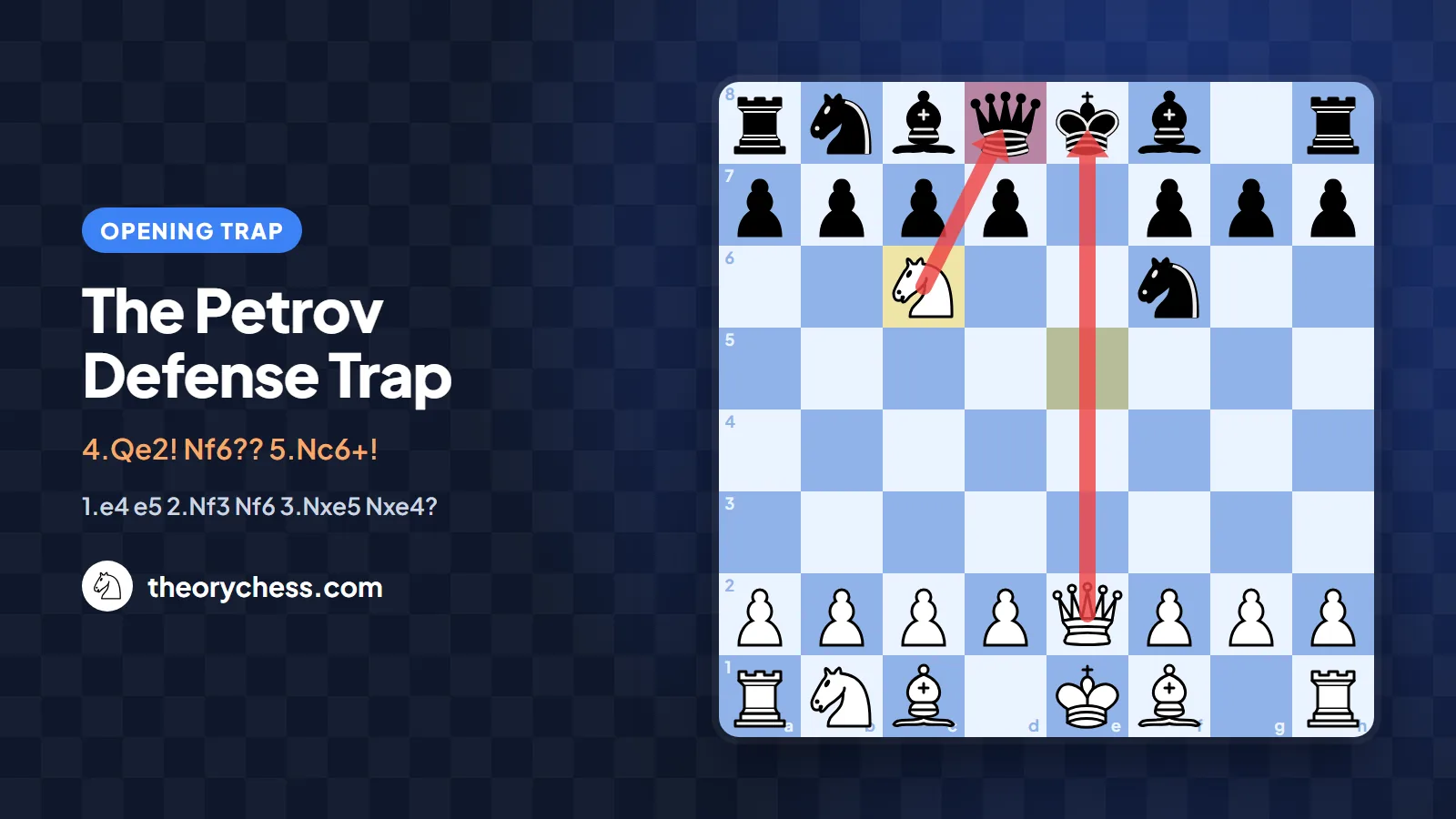
· 5 min read
The Petrov Defense trap: why copying your opponent loses the queenIn the Petrov Defense, copying with 3…Nxe4? after 3.Nxe5 lets White play 4.Qe2!, and 4…Nf6?? loses the queen to 5.Nc6+! The trap move by move and the right replies, 3…d6! and 4…Qe7!