
The Damiano Defense trap: why 2…f6? costs so much
1.e4 e5 2.Nf3 f6? defends e5 but opens the h5–e8 diagonal. After 3.Nxe5! fxe5?? 4.Qh5+ Black loses either the rook or the king’s safety. The trap move by move and the right reply, 3…Qe7!
5 min readBy Hasan Süzen
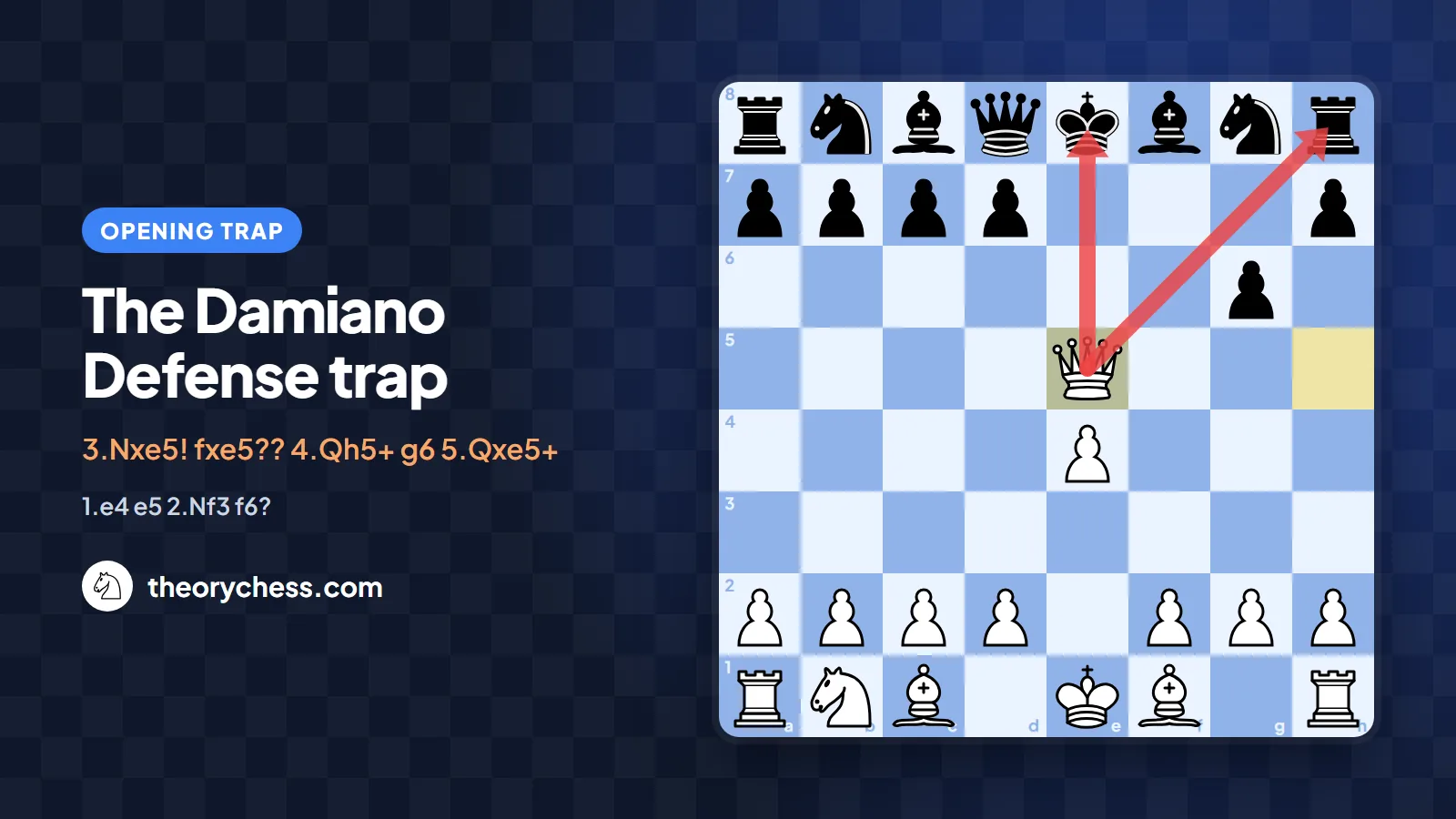
The Damiano Defense trap is one of the oldest and most instructive lessons in the opening. Black picks the shortest way to defend the e5-pawn and pushes the f-pawn one square. It looks like it does the job, but it opens a diagonal straight to the king and takes the best square away from the knight. White punishes it at once by giving up a knight on e5. In this article we go through the trap move by move, explain why it works and show how Black can get away with the least damage.
What is the Damiano Defense?
The Damiano Defense arises after 1.e4 e5 2.Nf3 f6?. White’s knight attacks e5 and Black defends the pawn with the f-pawn. The normal replies are 2…Nc6 or 2…d6; after 2…Nc6 3.Bc4, for example, you reach the Italian Game. Those moves defend e5 too, but they keep the king’s cover intact.
2…f6 has three problems. First, the h5–e8 diagonal is now open: if White’s queen reaches h5, it gives check straight away. Second, f6 is the natural square for the knight on g8, and the pawn has just taken it. Third, the f6-pawn only defends e5 on paper: the moment it recaptures there, the king is exposed.
The defence is named after Pedro Damiano, a 16th-century Portuguese author. The irony is that Damiano himself considered 2…f6 a bad move, so the opening carries the name of someone who didn’t recommend it.
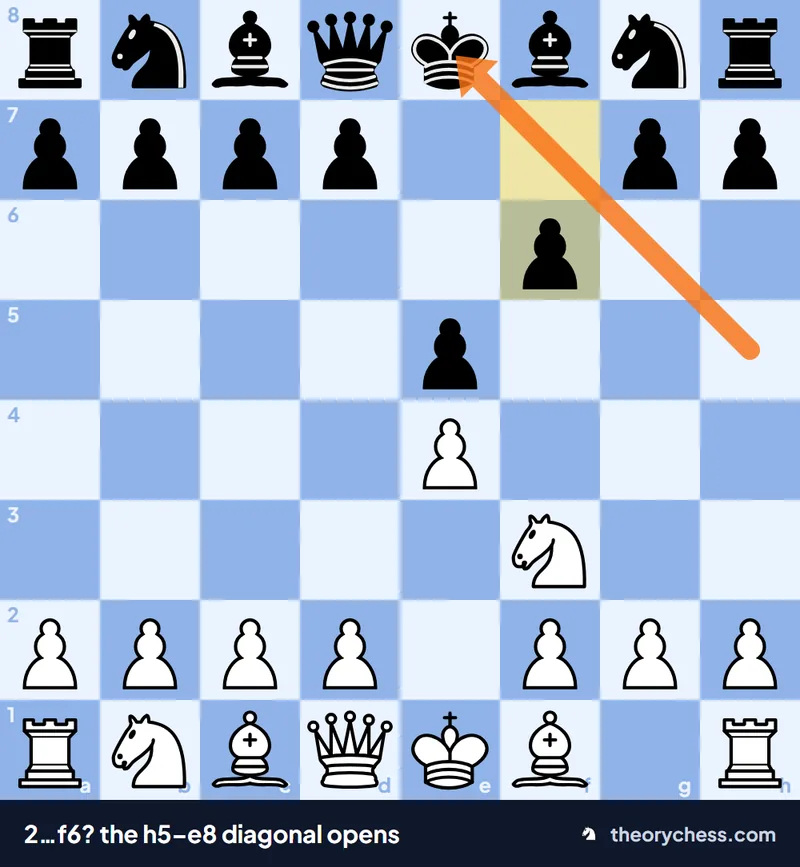
2…f6?: e5 is defended, but the h5–e8 diagonal opens.
The trap move by move
3.Nxe5!: a knight for a defended pawn
White doesn’t wait: 3.Nxe5!. The knight takes a defended pawn and seems to hang. In fact Stockfish picks this as the best move in the position. Even after Black’s best defence, White stays about two pawns up.
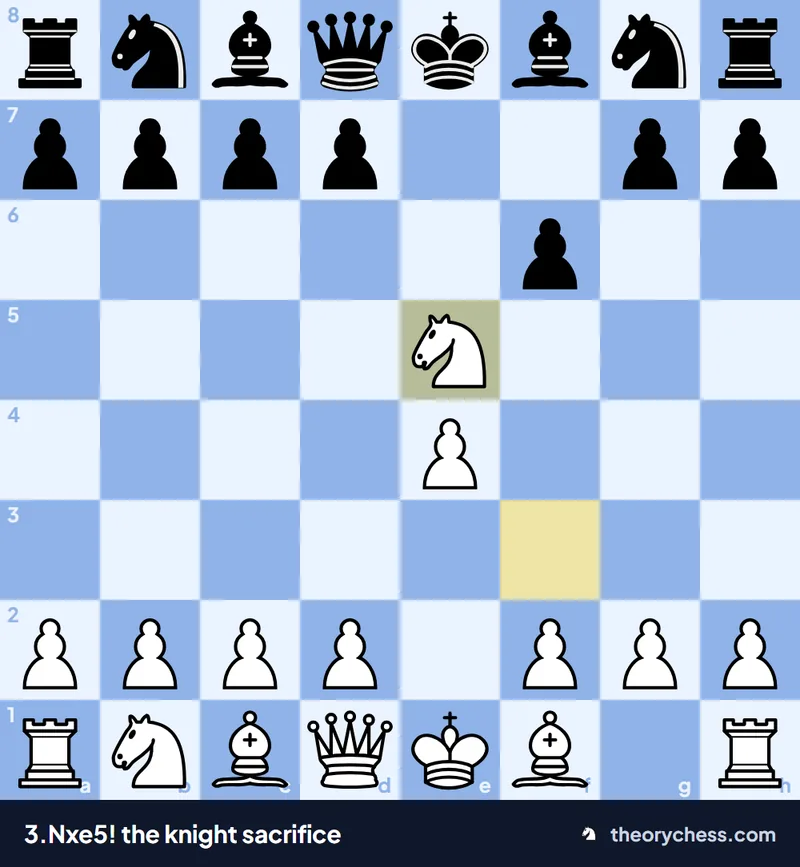
3.Nxe5!: the knight looks free, but taking it is a serious mistake.
3…fxe5??: taking the knight
The natural reaction is to take: 3…fxe5??. Black seems to be a knight up. But once the f-pawn has gone to e5, nothing stands between the king on e8 and the h5-square.
4.Qh5+: two bad choices
4.Qh5+ gives check. Black has two replies, and both lose heavily:
- 4…g6 5.Qxe5+: from e5 the queen checks the king on e8 and attacks the rook on h8 at the same time. After 5…Qe7 6.Qxh8 White wins the rook, and Stockfish has White about four pawns up.
- 4…Ke7 5.Qxe5+ Kf7 6.Bc4+: the king is chased around the middle of the board. The engine shows no forced mate, but the attack is very dangerous and the engine rates White about four and a half pawns better.
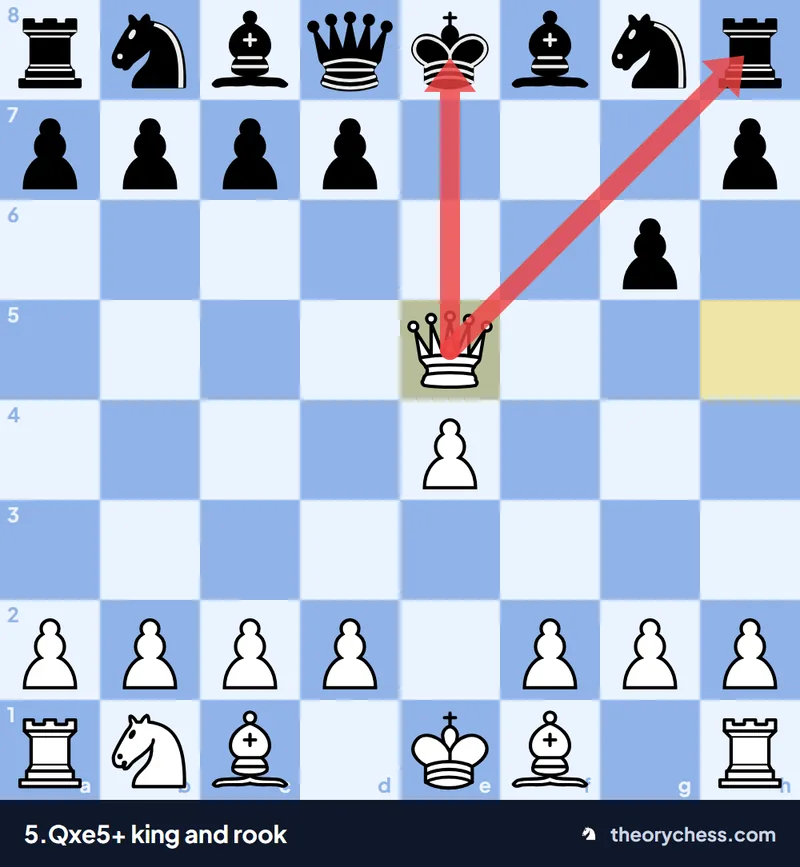
5.Qxe5+: the queen forks the king and the rook.
The main line: 1.e4 e5 2.Nf3 f6 3.Nxe5 fxe5 4.Qh5+ g6 5.Qxe5+ Qe7 6.Qxh8.
Why does the trap work?
- 2…f6 opens the h5–e8 diagonal, so the king has no cover against a queen check.
- 3…fxe5 moves the f-pawn even further away and leaves the diagonal completely empty.
- 4…g6 blocks the check, but with the g-pawn gone the rook on h8 is undefended.
- None of Black’s pieces are developed, so nothing can come to the king’s aid.
What should Black play?
After 3.Nxe5 the best move is 3…Qe7!. The queen attacks the knight on e5 and also looks down the e-file at the pawn on e4. White retreats with 4.Nf3. Over the next few moves Black can win the pawn back with …d5 and …Qxe4+, but the queen has come out early and the pieces are behind in development. Stockfish still has White about two pawns better.
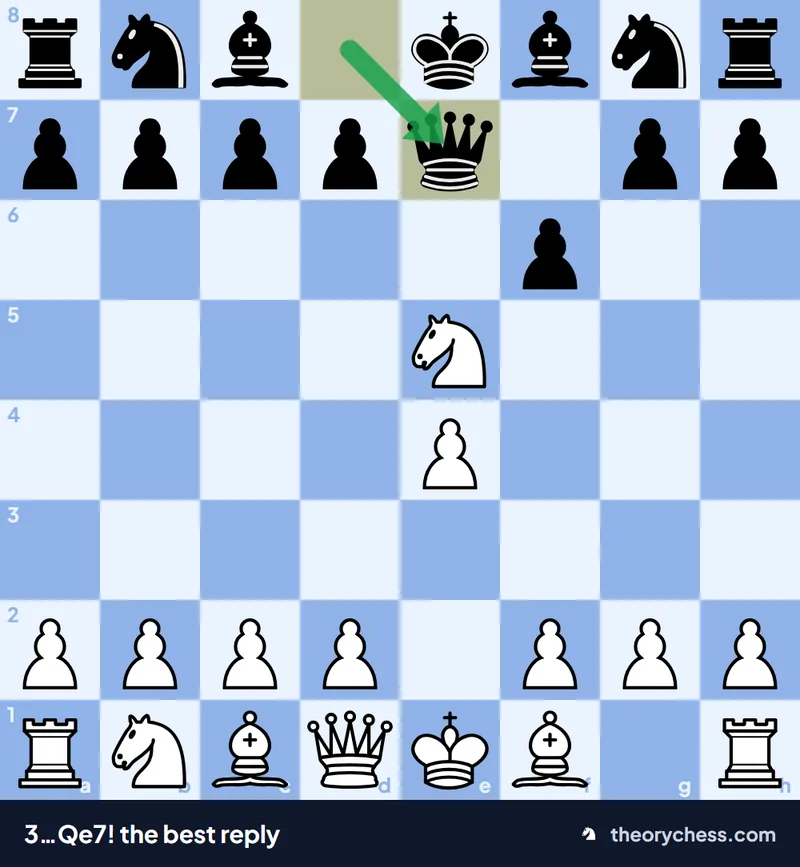
3…Qe7!: the queen hits the knight and limits the damage.
The real cure comes a move earlier: answer 2.Nf3 with 2…Nc6 or 2…d6 instead of 2…f6. Both defend e5 without opening a road to the king.
Key moments at a glance
| Move | What happens | Lesson |
|---|---|---|
| 2…f6? | e5 is defended, the h5–e8 diagonal opens. | The f-pawn is part of the king’s shield. |
| 3.Nxe5! | The knight takes a defended pawn. | Check whether the defender can really recapture. |
| 3…fxe5?? | The diagonal is wide open. | A free piece is often not free. |
| 4.Qh5+ g6 5.Qxe5+ | King and rook are forked. | Forks with check are the strongest forks. |
| 3…Qe7! | The queen hits the knight and limits the damage. | In a bad position, find the cheapest way out. |
What this trap teaches
The shortest way to defend a pawn isn’t always the best one. In the opening, the f-pawn is one of the most important shields in front of the king, and the h5–e8 diagonal is exactly what it covers. Before you move it, ask which diagonal you are opening.
The second lesson is about what “defended” really means. The f6-pawn can recapture on e5, but the moment it does, the king is exposed. You only find out whether a defender is doing its job by calculating what happens when it actually takes. A similar idea appears in Légal’s mate, where a piece that looks free opens the squares around the king.
For White there is a useful note too: 3.Nxe5 isn’t a cheap trick that backfires if Black finds the right reply. It is the best move, and even against 3…Qe7 White keeps a clear advantage. The best traps work like that: if your opponent doesn’t fall for it, you still have a good position.
Frequently asked questions
Does the Damiano Defense lose?
Not by force, but after 3.Nxe5 Black is about two pawns worse even with the best defence. That is a very high price to pay on move two.
Can I take the knight after 3.Nxe5?
If you do, 4.Qh5+ follows and you lose either the rook on h8 or your king’s safety. The right reply is 3…Qe7.
Why is it called the Damiano Defense?
It is named after Pedro Damiano, a 16th-century Portuguese author. He actually considered 2…f6 a bad move, so the name is a little ironic.
What should Black play against 2.Nf3?
The most common reply is 2…Nc6, and 2…d6 also defends e5 without weakening the king.
Practise it on TheoryChess
The Damiano isn’t a separate opening in our catalogue, but the way to avoid it is simply to play 1.e4 e5 properly. On TheoryChess you can play these positions in the Italian Game trainer against Stockfish, then test yourself with the Italian Game quiz. For the bigger picture, read our practical guide to the Italian Game, and for more classic mistakes see opening traps every club player should know. Every opening is waiting in the opening catalogue.
Keep reading
· 6 min read
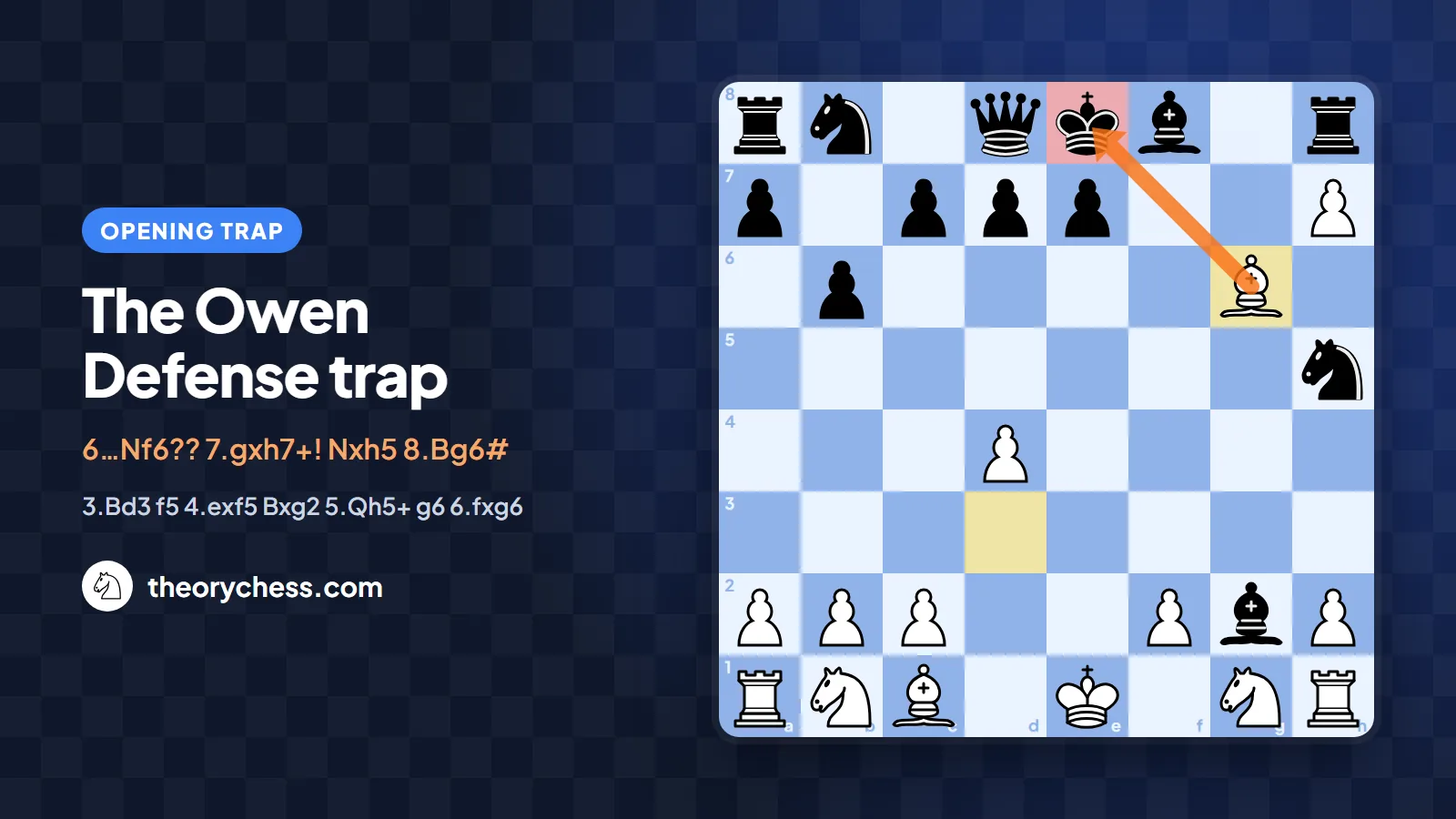
The Owen Defense trap: checkmate in eight after 3…f5?In the Owen Defense, 3…f5? opens the h5-e8 diagonal. After 4.exf5! Bxg2? 5.Qh5+ g6 6.fxg6 Nf6?? 7.gxh7+! Nxh5 8.Bg6# the game is over on move eight. The trap, why it works and the right reply, 3…e6.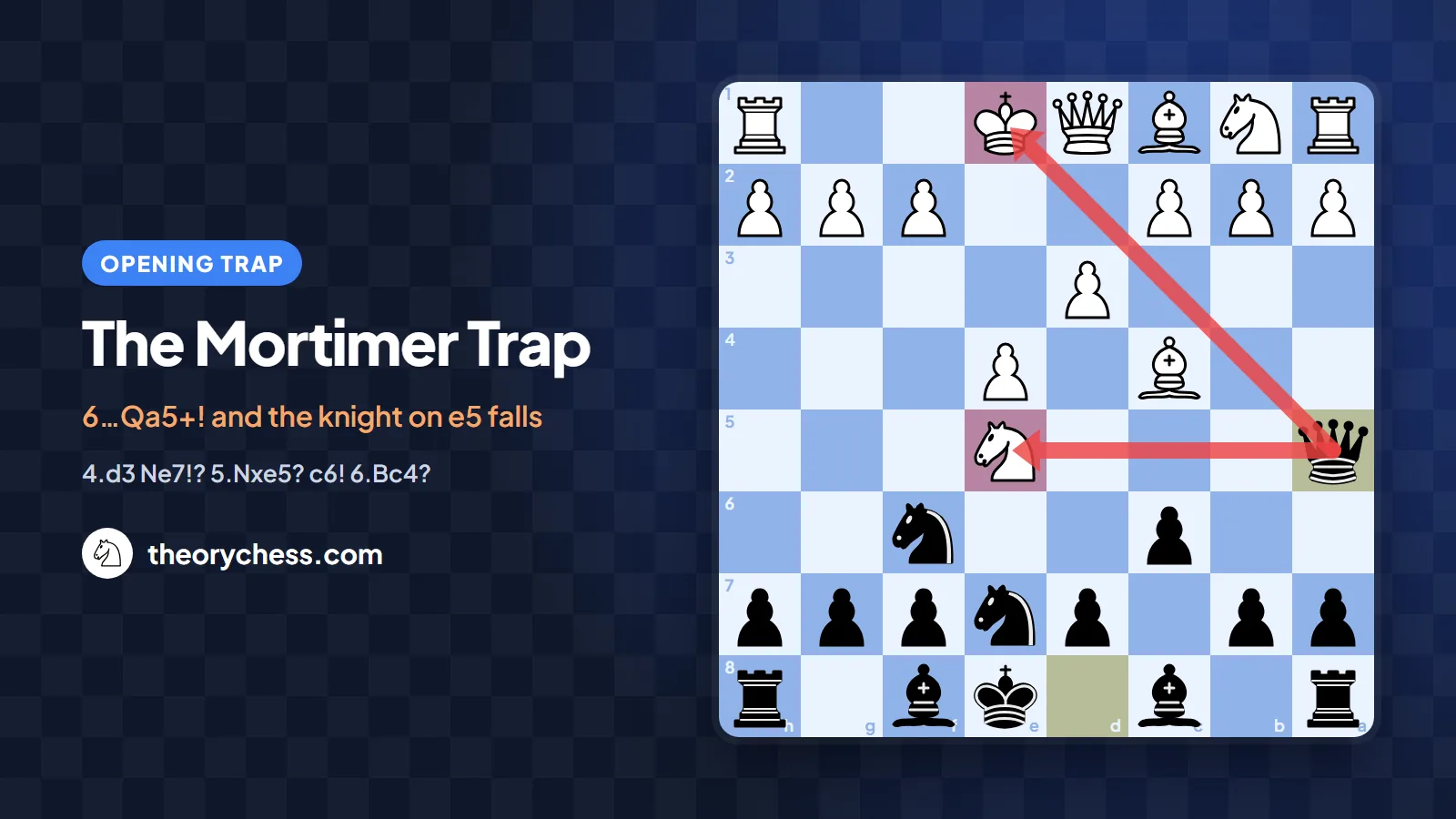
· 6 min read
The Mortimer Trap: how 6…Qa5+ wins a knight in the Ruy LopezIn the Berlin with 4.d3, 4…Ne7!? leaves the e5-pawn unguarded. After 5.Nxe5? c6! 6.Bc4? Qa5+! the queen hits the king and the knight on e5 at once. The trap move by move and the right plan, 5.Nc3.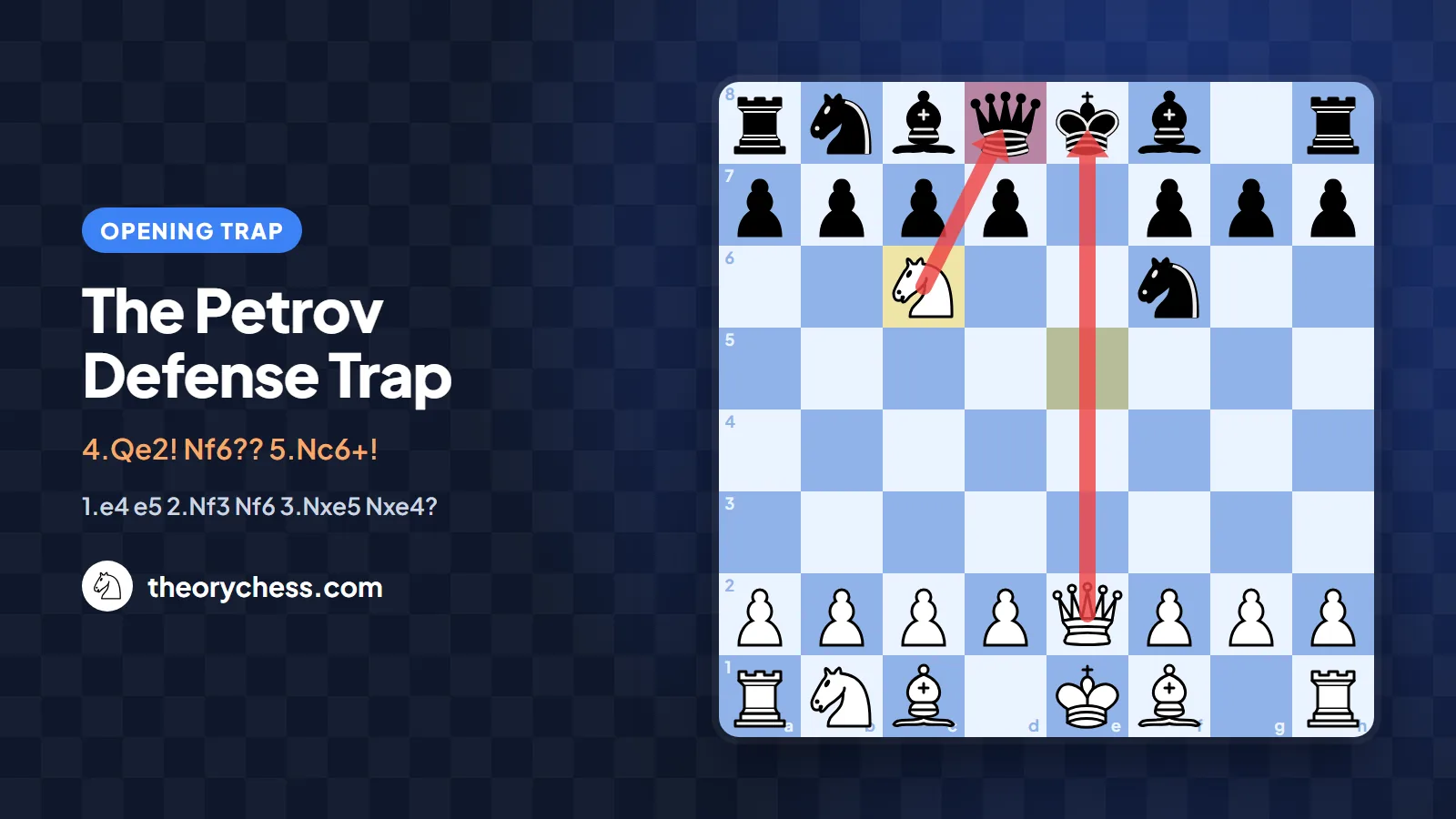
· 5 min read
The Petrov Defense trap: why copying your opponent loses the queenIn the Petrov Defense, copying with 3…Nxe4? after 3.Nxe5 lets White play 4.Qe2!, and 4…Nf6?? loses the queen to 5.Nc6+! The trap move by move and the right replies, 3…d6! and 4…Qe7!